Legal profession will thrive or self-destruct depending on how we maintain our integrity: CJI
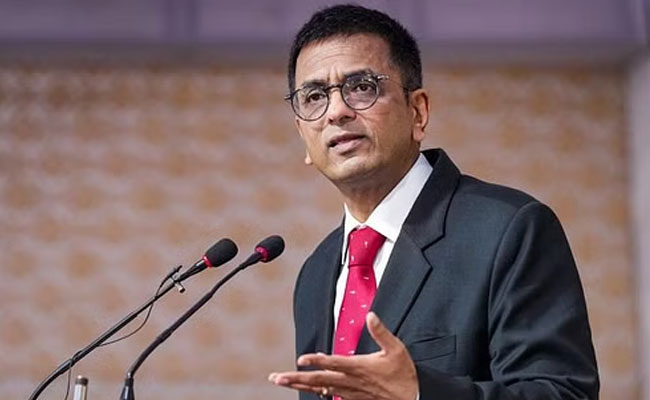
Chhatrapati Sambhajinagar (PTI): Our profession will continue to thrive or it will self-destruct based on whether we do or do not maintain our integrity, Chief Justice of India Dhananjay Chandrachud said here on Sunday.
Integrity is the core of the legal profession, the CJI asserted.
Integrity is not eroded by one thunderstorm, it gets eroded by small, little concessions and compromises made by lawyers and judges, the CJI said while speaking at the an event on the theme 'Enhancing collaboration between Advocates & Judges: Towards strengthening legal system'.
"Our profession will continue to thrive or it will self-destruct based on whether we do or do not maintain our integrity. Integrity is eroded not by one thunderstorm, it erodes by small little concessions and compromises which are made by lawyers and judges," he said.
"We all sleep with our conscience. You can fool the whole world but can't fool your conscience. It keeps on asking questions every night. Integrity is the core of the legal profession. With integrity we will either continue to survive or we will self-destruct," the CJI added.
Lawyers get respect when they respect judges and judges get respect when they respect lawyers, and the mutual respect takes place when there is realisation that both are part of the same wheel of justice, he said.
Talking about women in the judiciary, he said gender is not a woman's issue alone and it was equally a man's issue.
"I believe one significant challenge before the Indian legal profession is to create an equal opportunity profession. Because the composition of the legal profession today will define it 30 or 40 years down the line," CJI Chandrachud said.
"When I am asked why we don't have enough women judges, I tell them don't look at the collegiums today because it has to select among the talent available at the bar. You have to look at the status of our society 30-20 years ago. The judges who are entering higher judiciary today are members of the bar from 20-25 years ago," he said.
As key stakeholders in the legal profession it is for the judges and lawyers to ensure women are given an appropriate voice in the legal system, he added.
He asked lawyers to adopt technology and keep pace with time to manage the expectations of people.
"Eliminating the barriers to access to justice is another significant challenge. At the judicial level we are trying to manage the expectations of Indian people by developing, adopting various technology related initiatives such as virtual courts and e-filing. The lawyers must adopt technology. Today we cannot say I come from the rural part. We have to keep pace with time," he said.
Talking about the initiatives of the Supreme Court, the CJI cited ESCR, a free service that provides access to all judgments of the apex court.
"Thirty-six thousand judgments (are available) free of charge. We are now about to launch digital SCR. We have launched a mission of translating all the judgments of the Supreme Court in all the Indian languages, including Marathi. The purpose is to ensure young lawyers, law students are not denied access to law because they don't understand English," the CJI said.
Asserting that the best minds were now coming into the legal profession, he said senior lawyers should spend a few hours a week teaching courses at law universities, while retired judges should play an active role in imparting their knowledge and experience to law students.
It is our responsibility that young lawyers have knowledge about substantive law and procedure to enter judicial service, the CJI asserted.
"I think seniors have to start paying junior lawyers much better. All of us seniors have a perception that young juniors who come to us come to learn. But there is so much they can teach you which you don't know about," he added.
The CJI's lecture, at Mahatma Gandhi Mission University here, was organized by Aurangabad Bench of the Bombay High Court and Advocate Association of Bombay High Court here.
Justices Abhay Oka, Deepankar Datta, Devendra Kumar Upadhyay, PV Varale, SV Gangapurwala, RV Ghuge, Advocate General Virendra Saraf, President of Advocate Association NC Jadhav and Secretary RK Ingole were present at the event.
Let the Truth be known. If you read VB and like VB, please be a VB Supporter and Help us deliver the Truth to one and all.
AIITA welcomes Karnataka’s ban on obscene songs in school events

Bhatkal: The Karnataka unit of the All India Ideal Teachers Association (AIITA) has welcomed the Karnataka government’s decision to strictly ban school children from dancing to obscene songs during educational and cultural programmes in government, aided, and private schools across the state.
AIITA Karnataka State President M. R. Manvi congratulated the government for taking what he termed an important step to preserve the sanctity of education.
“Such decisions to safeguard the dignity of school children and uphold the values of education are the need of the hour. This rule should not be limited to government schools alone but must be strictly implemented in all private educational institutions as well,” he said.
He further urged the government to address other concerns within school programmes.
“The government should not only prohibit obscene dances in the name of school anniversaries, but also ensure that plays and dialogues that incite religious hatred are avoided. Schools should be centres of harmony, not platforms for spreading hatred,” he added.
According to a recent circular issued by the Department of School Education and Literacy, obscene dances are adversely affecting the mental health and moral values of students.
In this regard, schools have been advised to use songs that promote nationalism, positive thinking, the greatness of Kannada culture, and value-based traditions instead of inappropriate content during programmes.
The circular also emphasises that students should be dressed in decent attire.
AIITA also backed the department’s warning that disciplinary action would be taken against head teachers if such guidelines are violated. The association has further demanded that district Deputy Directors of Public Instruction strictly monitor the implementation of these rules.