Less than 10 percent Indian arbitrators on international panels are women: CJI
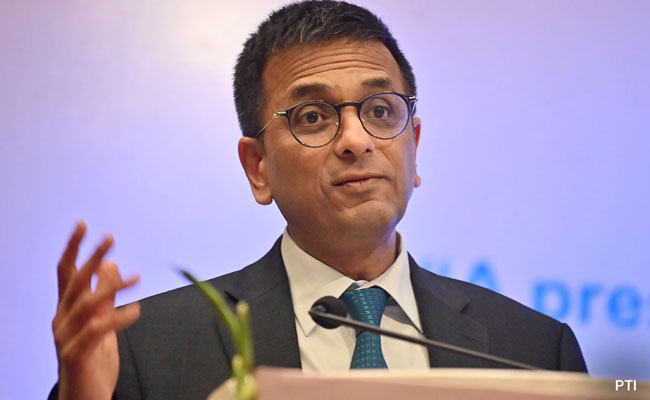
New Delhi (PTI): Chief Justice of India (CJI) D Y Chandrachud has lamented that less than 10 per cent of all Indian arbitrators on various international panels are women, terming the situation as a "diversity paradox".
The CJI was speaking at the inaugural session of the United Nations Commission on International Trade Law (UNCITRAL) South Asia Conference, 2023 on Thursday.
Justice Chandrachud hailed the fact that now various international arbitral institutions have "curated regionally diverse panels of arbitrators".
"However, the gendered compositions of these panels are hard to miss. We face what is called a diversity paradox i.e. a mismatch between our stated objectives and actual appointments. Less than 10 per cent of all Indian arbitrators on various international institutional panels are women," he said.
He referred to a report on Gender Diversity and said it identified unconscious bias' was contributing to this gender mismatch.
"It suggests using gender-neutral pronouns in our legislation and rules. It is heartening to see that some arbitration rules have taken the cue in employing gender-neutral pronouns in their texts. However, the overwhelming majority of empanelled arbitrators are men. Women, as persons of all genders, also belong in all institutions of dispute resolution," he said.
The CJI said countries must learn from others and the successes and difficulties that they faced with its people, businesses, and legal systems..
"This is all the more possible in this conference because South Asian countries have much and more in common the many similarities in our cultural and social set up undoubtedly seep into our business practices and legal systems. Our economies are also inter-connected, especially in the digital age...." he said.
Our legal frameworks must evolve in tandem with the expansion of the digital economy, he said and referred to the MoU signed between India and Singapore last week on advancing cooperation in judicial education and research.
"Sunshine, as they say, is the best disinfectant. Fortunately, UNCITRAL assisted countries in the simplification and uniformisation of their laws and rules, which in turn has made the justice delivery system more accessible," he said.
Legislative efforts in India in ensuring clarity, as well as judicial thrust on party autonomy significantly reduced the sense of unease amongst contracting parties, he said, highlighting the importance of alternative dispute redressal (ADR) mechanism.
"With its eye on best practices, India has steadily charted a course where arbitrations are the preferred mode of dispute resolution," he said, adding, "Indian courts have encouraged the use of ADR mechanisms over the years. In enforcing arbitration agreements, they have remained watchful of attempts to undercut party autonomy by artfully drafted contracts."
Besides the CJI, Attorney General for India R Venkataramani and senior advocate Fali Nariman attended the function.
Let the Truth be known. If you read VB and like VB, please be a VB Supporter and Help us deliver the Truth to one and all.
AIITA welcomes Karnataka’s ban on obscene songs in school events
Bhatkal: The Karnataka unit of the All India Ideal Teachers Association (AIITA) has welcomed the Karnataka government’s decision to strictly ban school children from dancing to obscene songs during educational and cultural programmes in government, aided, and private schools across the state.
AIITA Karnataka State President M. R. Manvi congratulated the government for taking what he termed an important step to preserve the sanctity of education.
“Such decisions to safeguard the dignity of school children and uphold the values of education are the need of the hour. This rule should not be limited to government schools alone but must be strictly implemented in all private educational institutions as well,” he said.
He further urged the government to address other concerns within school programmes.
“The government should not only prohibit obscene dances in the name of school anniversaries, but also ensure that plays and dialogues that incite religious hatred are avoided. Schools should be centres of harmony, not platforms for spreading hatred,” he added.
According to a recent circular issued by the Department of School Education and Literacy, obscene dances are adversely affecting the mental health and moral values of students.
In this regard, schools have been advised to use songs that promote nationalism, positive thinking, the greatness of Kannada culture, and value-based traditions instead of inappropriate content during programmes.
The circular also emphasises that students should be dressed in decent attire.
AIITA also backed the department’s warning that disciplinary action would be taken against head teachers if such guidelines are violated. The association has further demanded that district Deputy Directors of Public Instruction strictly monitor the implementation of these rules.