Less than 50 weapons fired by IAF forced Pakistan to call for ending conflict: Air Marshal Tiwari
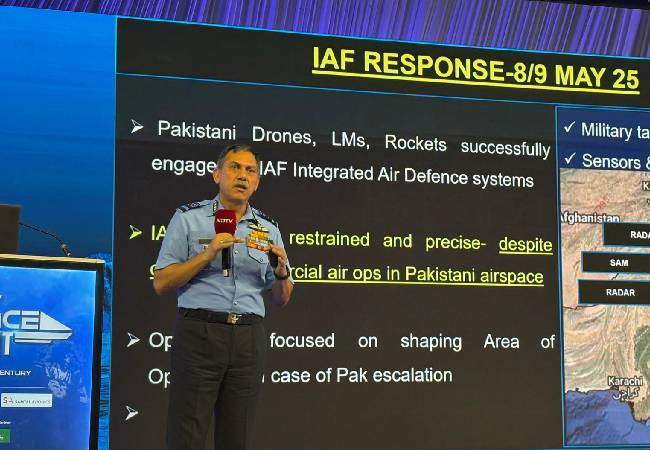
New Delhi (PTI): Less than 50 weapons fired by the Indian Air Force at carefully chosen Pakistani military targets forced Islamabad by mid-day of May 10 to request the end of military hostilities, Vice Chief of the Air Staff Air Marshal Narmdeshwar Tiwari said on Saturday.
Air Marshal Tiwari, recounting the mission, said the IAF was able to achieve "complete domination" over the Pakistan military with the strikes that were carried out following Pakistan's attack on the intervening night of May 9 and 10.
"I must tell you that it was a key takeaway for us that in less than 50 weapons, we were able to achieve complete domination. It has not happened before," Tiwari said at the NDTV Defence Summit.
The senior IAF officer, who played a key role in Operation Sindoor, said some of the Pakistan targets that were "taken out" in the course of the mission were not hit even during the 1971 war.
"We made every weapon count and that is a tacit acknowledgement of the capability of our planners and people who executed the missions," he said.
India launched Operation Sindoor on May 7, targeting terrorist infrastructure in territories controlled by Pakistan in response to the Pahalgam terror attack.
The strikes triggered four days of intense clashes that ended with an understanding on stopping the military actions on May 10.
The Vice Chief of Air Staff also elaborated on the sequence of events relating to Operation Sindoor and showed certain graphic details of India's response to the April 22 Pahalgam terror attack.
Air Marshal Tiwari said India was not willing to escalate the situation following its strikes on Pakistani terror infrastructure on the early morning of May 7.
"We expected a response and still kept it calibrated, and we engaged only military targets. But when the main attack came on the night of May 9-10, that was the time we decided that we needed to go and send the right message. We hit them pan-front," he said.
"There were targets which were taken out, which were not even taken out during the 1971 war. That is the kind of extent and damage to capability that we had caused to them," he said, adding that the IAF restricted its strikes to only military targets.
The senior IAF officer said the idea behind the strikes was to take out Pakistan's capability and send out the "right message".
He acknowledged that the use of such long-range vectors to hit enemy targets involves risks but the IAF executed the mission with perfection.
"The precision targeting from this range is very very essential as it is very risky because the longer the vector, you feel that there are more chances of collateral (damage)."
"But to the credit of our planners and credit of people who executed the missions, we were able to take out each target precisely. We were able to ensure there was no collateral damage. This is not an easy game," he said.
"You may have a long-range vector, but the work that goes behind making that vector or that weapon hit a target accurately is actually an effort of the whole team, not only the pilots who fired them. There are a lot of people on the ground who make that happen," he said.
After the strikes at the terror infrastructure, India informed Pakistan that it does not want to escalate the situation and the strikes were aimed at terrorist bases.
But as Pakistan launched a military retaliation, India responded to it very strongly.
Let the Truth be known. If you read VB and like VB, please be a VB Supporter and Help us deliver the Truth to one and all.
BJP will form govt in Bengal with thumping majority: Nabin
Mirzapur (UP) (PTI): BJP president Nitin Nabin on Wednesday voiced confidence that his party will form the government in West Bengal with a "thumping majority".
Polling is underway for 142 constituencies in the second and final phase of the West Bengal assembly elections, covering key districts, including Kolkata, Howrah and North and South 24 Parganas.
The high-stakes contest is being seen as decisive for the ruling TMC's bid for a fourth consecutive term and the BJP's push to form its first government in the state. The first phase held on April 23 recorded a high voter turnout of over 93 per cent, reflecting intense electoral engagement.
Speaking to reporters in Mirzapur, Nabin said, "The BJP will form the government in Bengal. We are winning the elections with a massive majority."
Earlier in the day, the BJP chief visited the Vindhyavasini temple and offered prayers. The rituals were conducted by his priest Acharya Agastya Kumar Dwivedi.
On his first visit to the district after assuming office, Nabin was welcomed by party workers at several places. At the temple, he was received by city MLA Ratnakar Mishra and District Magistrate Pawan Kumar Gangwar, who felicitated him with a traditional 'angvastram'.
After offering prayers for about 10 minutes amid Vedic chants, Nabin held a meeting at a hotel with local MLAs, including Mishra, Majhwan MLA Suchismita Maurya and Madihan MLA Ramashankar Patel.
Patel said Nabin emphasised strengthening the organisation and asked public representatives to focus on serving people in their respective constituencies.
Several party leaders, including district president Lal Bahadur Saroj, district vice-president Gaurav Umar, municipal chairperson Shyam Sundar Kesari, women workers and senior officials, were present on the occasion.
Elaborate security arrangements were put in place by the district administration for the visit, with multiple officers of circle officer rank deployed, officials said.