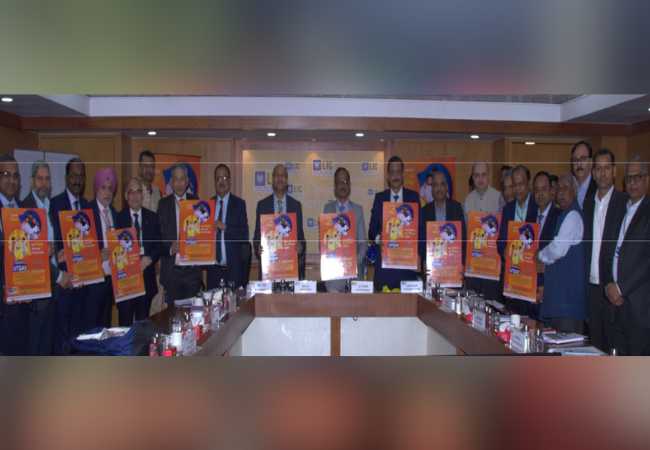
Mumbai: LIC of India has launched the new Jeevan Utsav Single Premium plan offering lifelong income and risk cover. The new plan was launched by the CEO & MD of LIC of India, R. Doraiswamy, on Tuesday, January 6.

LIC’s Jeevan Utsav Single Premium is a Non-Participating, Non-Linked, Individual Savings Whole Life Insurance plan, designed as a single premium product with the accrual of Guaranteed Additions during a specified Guaranteed Addition period.

The plan carries the Unique Identification Number (UIN) 512N392V01 and aims to provide policyholders with assured lifelong financial security.

The plan is available for individuals aged from 30 days to 65 years. The minimum Basic Sum Assured is ₹5 lakh, while there is no upper limit, subject to underwriting decisions as per LIC’s Board Approved Underwriting Policy. Under the plan, Guaranteed Additions accrue at the rate of ₹40 per thousand of the Basic Sum Assured at the end of each policy year during the Guaranteed Addition period.

For survival benefits, policyholders can choose between two options.

Under Option I – Regular Income Benefit, the policyholder receives 10% of the Basic Sum Assured as income at the end of each policy year, commencing after a deferment period ranging from 7 to 17 years, as chosen at inception.

Under Option II – Flexi Income Benefit, the same 10% income can be deferred and accumulated for withdrawal at a later stage, subject to policy conditions. LIC will pay interest at 5.5% per annum, compounded yearly, on such deferred Flexi Income amounts.

In the event of death after the commencement of risk, the policy provides a Death Benefit equal to the Sum Assured on Death along with accrued Guaranteed Additions, provided the policy is in force. The Sum Assured on Death is defined as the higher of the Basic Sum Assured or 1.25 times the Tabular Single Premium.

On survival till maturity, the Maturity Benefit payable will be the Sum Assured on Maturity along with accrued Guaranteed Additions. The Sum Assured on Maturity is also defined as the higher of the Basic Sum Assured or 1.25 times the Tabular Single Premium.

The plan offers additional liquidity through loan facilities and includes attractive High Sum Assured Rebates. Policyholders may also opt for two additional riders by paying an an extra premium, subject to eligibility conditions:  LIC’s Accidental Death and Disability Benefit Rider and LIC’s New Term Assurance Rider.

LIC has advised customers to refer to the Product Prospectus and Sales Brochure for detailed terms and conditions or visit the official website.

The Jeevan Utsav Single Premium plan can be purchased offline through licensed agents, corporate agents, brokers and Insurance Marketing Firms, as well as online directly through LIC’s website.

LIC’s Jeevan Utsav Single Premium plan will be available for purchase from January 12, 2026.

Let the Truth be known. If you read VB and like VB, please be a VB Supporter and Help us deliver the Truth to one and all.


New Delhi (PTI): The Supreme Court on Friday said it would not go into the allegations of harassment of women dog feeders and caregivers by purported anti-feeder vigilantes since it was a law-and-order issue and the aggrieved persons could lodge FIRs about it.

Hearing arguments in the stray dogs case, the apex court also refused to go into the claims about certain derogatory remarks being made about women in the issue.

A three-judge special bench comprising Justices Vikram Nath, Sandeep Mehta and N V Anjaria observed that some of the arguments made before it were "far from reality" and there were a number of videos of stray dogs attacking children and the elderly.

The top court was hearing arguments on pleas, including the ones filed by dog lovers, seeking modification of its earlier orders and those for stringent compliance with the directives.

Senior advocate Mahalakshmi Pavani highlighted the plight of women dog feeders and caregivers and said anti-feeder vigilantes have assumed the role of enforcing the apex court's order passed earlier in the matter. "Under the garb of this, they are harassing women, they are molesting women, and they are beating women," she said.

Justice Nath observed, "Lodge an FIR against them. Who stops you?"

The bench said that if anyone was harassing or molesting women, it was a crime, and the aggrieved person could set the criminal law in motion by lodging an FIR.

When Pavani referred to an incident where a dog feeder was attacked in her house, the bench said, "All this is a criminal offence. You lodge an FIR against that".

"We can't take up these individual cases where something is going wrong somewhere. This court is not going to monitor that. That is a law-and-order problem," Justice Nath observed.

Pavani said that in Haryana, certain societies hired bouncers to remove dog feeders, and a woman was slapped in Ghaziabad, but no FIR was lodged.

"We are not going to accept this. If a criminal offence is committed, an FIR will be registered. There are procedures available to you, remedies available, and how to get it registered," the bench said.

The senior advocate flagged the issue of unregulated breeding and exotic imports.

"Again, this has nothing to do with the stray dogs issue. There are remedies in the Act and the rules. Don't make this a platform for other objects. You address us on the issues which we are dealing with in this matter," the bench said.

It said the import of the top court's order was very clear, and it was restricted to stray dogs only. "Tomorrow, you will say why Cheetahs have been imported to Kuno (national park). Why not take care of the local breeds? This is too much. Sorry," Justice Mehta said.

When Pavani argued that derogatory remarks were being made regarding women in the matter, the bench said, "How is that relevant in this context?"

"Even though we are being criticised in very derogatory language, we don't react," Justice Nath said, adding that one can take action on this issue.

"We have not given any kind of licence to people to talk like this. If they are talking like this, you take action against them," the bench said.

The bench also heard submissions of other lawyers, including senior advocates Abhishek Singhvi and Shadan Farasat, in the matter.

When one of the lawyers referred to a dog at the All India Institute of Medical Sciences (AIIMS), the bench asked whether it was taken even to the operation theatre.

"Any dog on the street is bound to have ticks. And a dog with ticks in a hospital, do you understand what disastrous consequences would befall?" the bench posed. "Don't try to glorify that there was a dog at AIIMS".

Singhvi said this was now not entirely a matter about dogs or humans, and it was about certain constitutional principles.

At the fag end of the hearing, a lawyer said he has put up videos if the court would like to see them. "There are 'n' number of videos on YouTube of dogs attacking children, dogs attacking old people," the bench observed.

The hearing in the matter remained inconclusive and would continue on January 13.

While hearing arguments on Thursday, the bench said it had not directed the removal of every dog from the streets, and the directive was to treat stray canines according to the Animal Birth Control (ABC) Rules.

It had earlier flagged the non-compliances of rules and directions by civic bodies and said people were dying not only due to dog bites alone in the country but also because of accidents caused by stray animals on roads.

Taking note of the "alarming rise" in dog bite incidents within institutional areas such as educational institutions, hospitals and railway stations, the apex court on November 7 directed relocation of stray canines forthwith to designated shelters after due sterilisation and vaccination.

It also said stray dogs picked up shall not be released back in the place they were picked up. It directed the authorities to ensure the removal of all cattle and other stray animals from the state highways, national highways and expressways.

The top court is hearing a suo motu case, initiated on July 28 last year, over a media report on stray dog bites leading to rabies, particularly among children, in the national capital.