Live-streaming to include hearings on socially important issues: SC
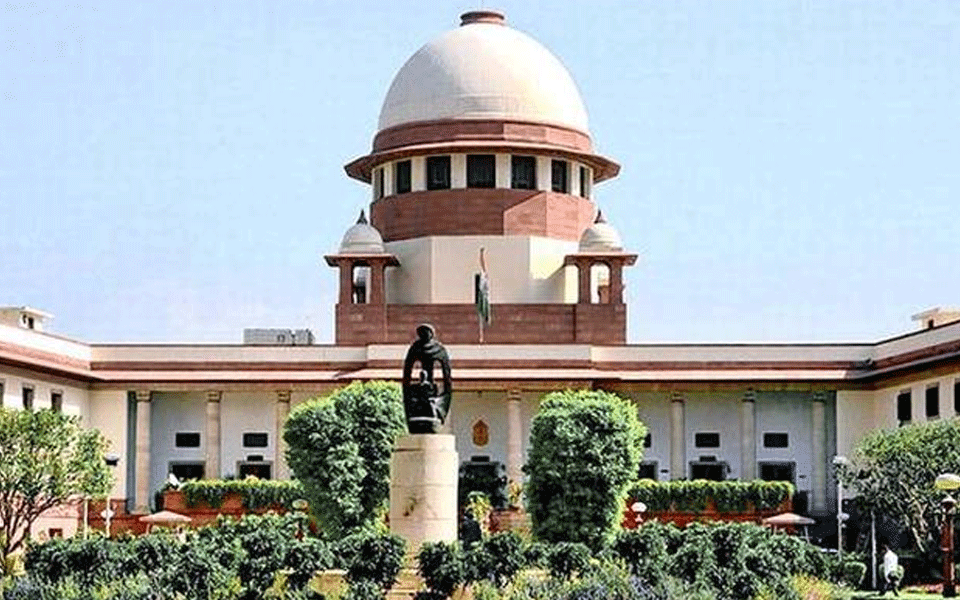
New Delhi, Aug 3 : The Supreme Court on Friday said that the proposed live- streaming of its proceedings will include, besides important matters before constitution bench, socially important issues requiring interpretation of legal provisions.
A bench of Chief Justice Dipak Misra, Justice A.M. Khanwilkar and Justice D.Y. Chandrachud directed Attorney General K.K. Venugopal to prepare holistic guidelines on the issue while considering the ones suggested by the petitioner and the intervenors.
The court did not elaborate when the Attorney General wanted to know what it meant by socially important issues.
The AG reiterated that the live-streaming, to begin with, should start with Court Number 1 presided over by the Chief Justice of India.
Justice Chandrachud said that the guidelines suggested by Venugopal provide for recording of proceedings, after one of the lawyers sought it.
As another lawyer drew the court's attention to its direction for the installation of CCTVs and audio recording of proceedings in two trial courts each in all states and Union Territories, Chief Justice Misra said that the "trial court proceedings are different and the Supreme Court proceedings are entirely different."
The court directed for next hearing in the matter on August 17.
The top court had, on February 9, sought Venugopal's assistance while dealing with three petitions, including those filed by senior counsel Indira Jaising and lawyer Mathews J. Nedumpara.
Jaising had pleaded for live-streaming and videotaping of court proceedings in cases of national importance having a bearing on a large section of people.
Jaising had based her PIL on the right to receive information under Article 19(1)(a) of the Constitution and the principle of open courts and access to justice as protected under Article 21.
Pointing to the principle of law that justice should not only be done but also seen to be done, Jaising had contended that the best possible way to achieve this was to live-stream the proceedings in important cases so that arguments of all counsel and interaction between Judges and lawyers during hearings was "recorded accurately and without distortions".
Meanwhile, when a law intern urged the court for permission to watch court proceedings on Mondays and Fridays, known as miscellaneous matter days in court parlance, the Chief Justice pointed to space constraint and said the court was seized of the matter and will do something.
Let the Truth be known. If you read VB and like VB, please be a VB Supporter and Help us deliver the Truth to one and all.
Ruckus outside counting centre in Mamata's constituency, TMC claims entry of car with BJP flag
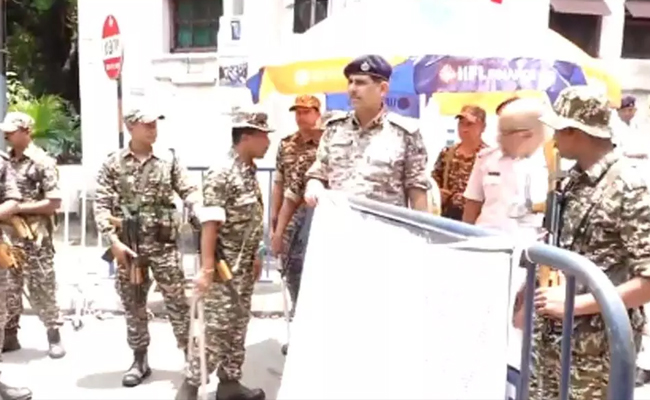
Kolkata (PTI): The counting centre at West Bengal Chief Minister Mamata Banerjee's Bhabanipur assembly constituency witnessed a ruckus a day ahead of the counting of votes, with TMC workers alleging two cars bearing the BJP's flag were allowed entry to the compound where EVMs are kept.
The incident comes close on the heels of a four-hour-long sit-in by Banerjee in front of the same counting centre at the Sakhawat Memorial Girls School on Thursday night, alleging unauthorised entry of persons into the strongroom.
With the polling now over, the wrangling for power in West Bengal has turned into a battle of nerves between the incumbent TMC and the BJP. Workers and leaders of both parties have been keeping a steely gaze on the security of strongrooms across the state where the electoral fate of the candidates is sealed.
Despite expressing her confidence in a "landslide victory", Banerjee has repeatedly aired her apprehensions of "counting malpractice and EVM tampering ahead of the day of results".
On Sunday morning, TMC workers camping 100 metres from the counting centre alleged that two cars with BJP flags entered the premises and went near the strongroom.
"The CAPF personnel at the spot are not allowing any vehicle or person to enter the premises of the counting centre without valid identity proof. Then how come this car, which we have not seen in the past few days, was allowed entry? Once we protested, the central forces asked us to move 100 metres away," a TMC activist said.
The TMC claimed that while the police personnel posted there promised the vehicle would be removed from the spot, it remained there for some time.
A senior Election Commission official said the car was passing by the Harish Mukherjee Road, and after checking by security forces and police, it was allowed to leave as nothing objectionable was found in it.
On Thursday night, two counting centres, including one at Sakhawat Memorial Girls School in the city, witnessed high drama after TMC leaders alleged a lack of transparency and possible malpractice at the strongrooms housing sealed EVMs of the assembly polls, which concluded on April 29.
TMC leaders and candidates, Sashi Panja and Kunal Ghosh, held a sit-in outside the Khudiram Anushilan Kendra counting centre on Thursday evening, alleging unauthorised activities inside the strongroom amid the absence of TMC agents
In Howrah, TMC protested renovation work by the public works department at a place adjacent to the strongroom, and the EC stopped the work temporarily.
On Saturday, the ruling party filed a complaint with the poll panel, alleging unauthorised sorting of postal ballot covers at the EVM strongroom in Khudiram Anushilan Kendra.
Similar scenes were witnessed on Saturday outside the strongrooms at Asansol College in Paschim Bardhaman and the Barasat Government College in North 24 Parganas districts, where TMC workers held protests, alleging that CCTV cameras were switched off for several minutes.
The EC turned down all allegations, saying the surveillance cameras were working in an uninterrupted manner.
BJP spokesperson Sajal Ghosh told reporters that the people of Bengal were finding it "hilarious" that the TMC, "which used to win elections through unfair means and strongarm tactics" were now coming up with all sorts of "frivolous charges".
"Are they scared of losing?" he posed.