Lok Sabha proceedings disrupted as DMK members protest over Pradhan's remarks
_vb_26.jpeg)
New Delhi (PTI): Lok Sabha proceedings were on Monday adjourned for about 30 minutes after DMK members staged protests over Union Education Minister Dharmendra Pradhan's remarks that the Tamil Nadu government was "dishonest" on the issue of implementing the PM Schools for Rising India (PM SHRI) scheme.
Replying to a question on the PM SHRI scheme, Pradhan said the DMK-led Tamil Nadu government has changed its stand on implementing the centrally-sponsored scheme which envisaged strengthening the schools managed by central, state or local bodies.
The state concerned has to sign an MoU with the central government that it would implement the National Education Policy (NEP) 2020 and in return the central government provides the fund.
"The Tamil Nadu government had initially agreed to sign the MoU. But now they have changed the stand. Many non-BJP-ruled states, including Karnataka and Himachal Pradesh, have signed the agreement," he said.
Pradhan said: "They are dishonest and they are ruining the future of the students of Tamil Nadu. They are doing politics".
The minister said at one point of time, the government of Tamil Nadu had agreed to PM SHRI scheme and several (DMK) MPs, who came to see him, conveyed this to him.
"But when they went back, they made a U-Turn. They are doing mischief with the life of the students. They are misleading the people and doing injustice to students of Tamil Nadu. They are undemocratic, uncivilised," he alleged.
Pradhan said Tamil Nadu Chief Minister M K Stalin had also agreed initially "but suddenly some super CM appeared and they took a U-Turn. They just want to do politics".
"Today is March 10. We have still 20 days left in the month of March," he said, indicating the time left for the Tamil Nadu government to sign the MoU on PM SHRI.
Taking strong exception to the minister's remarks, the DMK members registered strong protests by raising slogans against the central government.
Speaker Om Birla asked the agitating members to return to their seats and allow the House to function normally.
Birla said he has given the opposition members opportunity to pose questions and subsequently the minister has replied. "But now you are doing this (protests). This is not good. You are setting wrong precedence. Don't violate the Parliamentary procedures," he said.
However, the DMK members ignored his pleas and continued their protests.
After sometime, Birla adjourned the House till 12 noon.
Last month, Stalin had said he was firm on his stance of not implementing the NEP in Tamil Nadu even if the Centre offered to provide Rs 10,000 crore to the state.
The chief minister said the opposition to the NEP is not merely over the "imposition of Hindi" but there are several other factors that would have serious consequences on the future of students and the social justice system.
The total cost of the PM SHRI scheme will be Rs 27,360 crore spread over a period of five years which includes central share of Rs 18,128 crore.
A total of 12,079 schools have been selected from 32 states and UTs of which 1329 schools are primary, 3,340 schools are elementary, 2,921 schools are secondary and 4,489 schools are senior secondary.
Let the Truth be known. If you read VB and like VB, please be a VB Supporter and Help us deliver the Truth to one and all.
Sujit Nair raises concerns over speculation of DMK-AIADMK understanding to block TVK
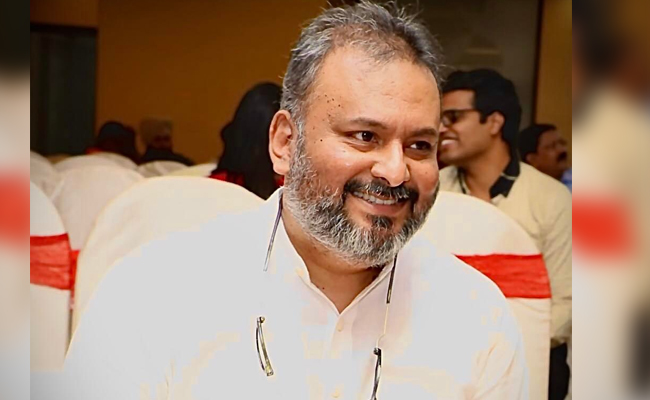
Chennai: Journalist and political commentator Sujit Nair has expressed concern over speculation that the Dravida Munnetra Kazhagam and the All India Anna Dravida Munnetra Kazhagam could explore a post-poll understanding to prevent Vijay-led Tamilaga Vettri Kazhagam from forming the government in Tamil Nadu.
In a social media post, Sujit Nair said the election verdict in Tamil Nadu reflected a clear public demand for political change and argued that the mandate should be respected irrespective of political preferences.
Referring to reports and political discussions surrounding a possible understanding between the DMK and AIADMK, he said he hoped such developments remained only speculative conversations and did not turn into reality.
Nair stated that if such an alliance were to take shape, it would raise serious questions about ideological politics in the country. He said TVK had emerged through a democratic electoral process and that the legitimacy to govern in a parliamentary democracy comes from the people’s verdict.
According to him, attempts to prevent an electoral winner from forming the government through unexpected political arrangements may be constitutionally valid, but many people could view them as politically opportunistic.
He further said that such a move could particularly affect the political image of the DMK, which has historically projected itself around ideology, social justice and opposition politics. Nair said that in ideological terms, the DMK appeared closer to TVK than to the AIADMK, and joining hands with its long-time political rival only to remain in power could weaken its broader political narrative.
He added that the same questions would apply to the AIADMK as well, as the party had spent decades positioning itself against the DMK and such an arrangement could create discomfort among its cadre and supporters.
Drawing a comparison with Maharashtra politics in 2019, Nair said he had expressed similar views when the Shiv Sena formed an alliance with the Indian National Congress and the Nationalist Congress Party after the Assembly elections.
He said post-poll alliances between long-standing political rivals often create a public perception that ideology and electoral mandates become secondary when political power equations come into play.
Nair also said such developments increase public cynicism towards politics and reinforce the belief among voters that ideology is often sidelined after elections.
He maintained that the Tamil Nadu verdict was emphatic and said respecting both the spirit and substance of the mandate was important for the credibility of democratic politics.