'Love jihad', 'cow terror' will not work in UP polls; farmers' issues supreme: RLD chief
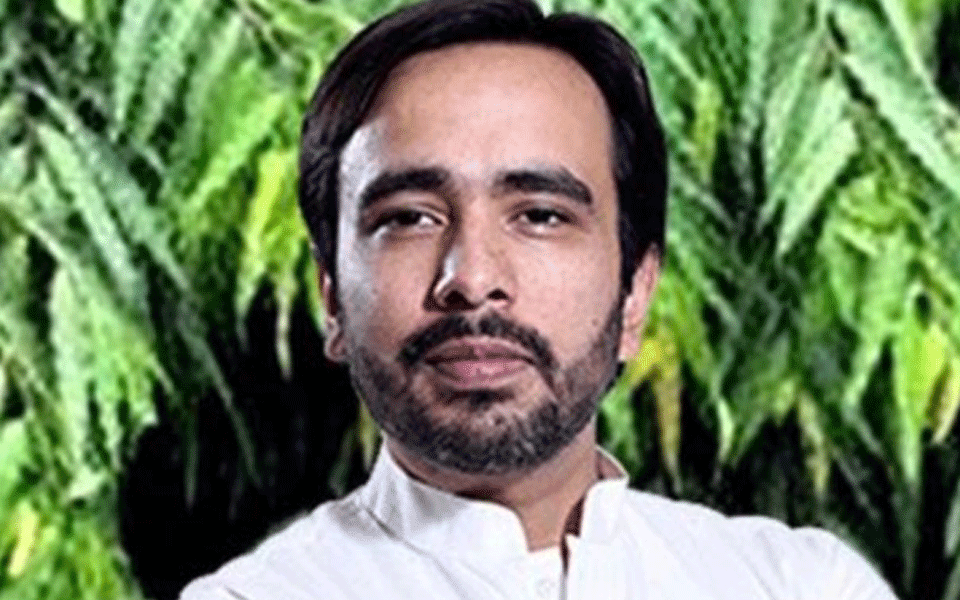
New Delhi: Asserting that the BJP's alleged "apathy" towards protesting farmers will hurt it in the Uttar Pradesh Assembly polls, RLD chief Jayant Chaudhary on Sunday said artificial issues such as "love jihad" and "cow terror" will not work as issues of development will win in the elections.
As the focus shifts from the West Bengal polls earlier this year to the high-stakes election battle in Uttar Pradesh in 2022, newly-appointed Rashtriya Lok Dal chief Chaudhary asserted that his party will not allow a communally polarised campaign to ruin the Hindi heartland state in the run up to the assembly polls.
In an interview with PTI, Chaudhary, who took over as RLD chief after his father Chaudhary Ajit Singh's demise last month, said his party and the Samajwadi Party have a good rapport and a strong working relationship.
He said details need to be worked out for a formal alliance for the polls.
Asked if a 'Mahagathbandhan' or a grand alliance is needed in UP to take on the BJP and whether the BSP and the Congress would be part of such an alliance, Chaudhary said, for him, issues come first and an understanding of those needs to be built between all alliance partners.
"Who can be accommodated depends on who is honestly open to working together on the common framework," the 42-year-old leader said.
On whether the Congress would play a significant role in the assembly polls despite its poor showing in the panchayat elections, Chaudhary said he would not like to comment on the Congress' plans and chances.
Asked about the speculation over UP Chief Minister Yogi Adityanath's political future as CM and reports about Cabinet reshuffle in the state, Chaudhary said the BJP is just trying to divert attention and create an illusion of dialogue to manage the disgruntled elements in the party.
"Social engineering doesn't come about by tinkering with one or two leaders at the top. The fact is that BJP's Uttar Pradesh government has been caught in a caste-based matrix and has not delivered jobs, economic growth, and efficient governance to people," he alleged.
The state government's Covid response has been atrocious and no one can forget the scenes of dead bodies in the Ganga, he added.
"Now, after four-and-a-half years to create rumours of change in leadership is a poor attempt to shift focus from failures," Chaudhary said.
Talking about the farm laws protests and whether they would be a key issue in the polls, he said farmers will and should be the biggest poll issue in our country, and asserted that as a class they have been denied their rights for far too long.
"The Centre's new laws are prescribing a takeover of the entire market and value chain by the private sector and the withdrawal of the government from procurement and subsequent monopolisation will hurt producer and consumer interests," the RLD chief said.
The "apathy and insensitive" attitude towards the protesting farmers will continue to haunt and hurt the BJP in polls, he claimed.
Chaudhary has participated in a number of 'kisaan panchayats' in western Uttar Pradesh, where his party has had a significant presence over the years, and campaigned aggressively against the Centre's farm laws.
Farmers from various parts of the country are protesting at Delhi's borders against the three farm laws brought by the Centre last year, alleging that the legislations will hamper farming.
Asked about the electoral chances of the Opposition against the BJP in UP, Chaudhary said "when the nation is grieving and hurting, the Hindi heartland also will respond appropriately".
"Love jihad, cow terror, Kairana exodus and other useless artificial issues will be rejected; healthcare, education and balanced development will win (in the polls)," he asserted.
The Opposition in UP has been alleging that cow vigilante violence is on the rise in the state, a charge denied by the BJP.
The 'Kairana exodus' was a reference to a BJP MP's claim in 2016 that close to 350 Hindus had left Kairana over alleged threats and extortion by criminal elements belonging to a particular community.
Asked how he plans to turnaround the fortunes of the party which drew a blank in the last assembly polls, Jayant Chaudhary said, "I am humbled by the opportunity and the faith reposed in me by the Party at this critical juncture."
"Chaudhary Saheb's untimely passing has been a jolt for all of us. Just as any family copes with stress responds by coming together, the office bearers and workers of Rashtriya Lok Dal will need to work cohesively and look to the future," Chaudhary said.
For reviving the party, Chaudhary said, as a first step he wants to engage with people who have worked at the grassroots and have political experience.
He said the party is also in conversation with a lot of leaders from other parties who want to join the RLD and work with us, Chaudhary said.
Asked if a fragmented opposition will be able to pose a challenge to the BJP in UP, the RLD chief said poll arithmetic has its own rhythms and rules and it's not as easy to combine different parties and fight elections and assume a "2+2=4 result".
"It is not as if the multiplicity of players is helping the incumbent. Some of the parties could also be taking away votes which might otherwise shift to the BJP," he argued.
Asserting that it is most important to pick the right issues, Chaudhary said social developmental deficits need to be addressed aggressively if we want the state to progress.
Let the Truth be known. If you read VB and like VB, please be a VB Supporter and Help us deliver the Truth to one and all.
Sujit Nair raises concerns over speculation of DMK-AIADMK understanding to block TVK
Chennai: Journalist and political commentator Sujit Nair has expressed concern over speculation that the Dravida Munnetra Kazhagam and the All India Anna Dravida Munnetra Kazhagam could explore a post-poll understanding to prevent Vijay-led Tamilaga Vettri Kazhagam from forming the government in Tamil Nadu.
In a social media post, Sujit Nair said the election verdict in Tamil Nadu reflected a clear public demand for political change and argued that the mandate should be respected irrespective of political preferences.
Referring to reports and political discussions surrounding a possible understanding between the DMK and AIADMK, he said he hoped such developments remained only speculative conversations and did not turn into reality.
Nair stated that if such an alliance were to take shape, it would raise serious questions about ideological politics in the country. He said TVK had emerged through a democratic electoral process and that the legitimacy to govern in a parliamentary democracy comes from the people’s verdict.
According to him, attempts to prevent an electoral winner from forming the government through unexpected political arrangements may be constitutionally valid, but many people could view them as politically opportunistic.
He further said that such a move could particularly affect the political image of the DMK, which has historically projected itself around ideology, social justice and opposition politics. Nair said that in ideological terms, the DMK appeared closer to TVK than to the AIADMK, and joining hands with its long-time political rival only to remain in power could weaken its broader political narrative.
He added that the same questions would apply to the AIADMK as well, as the party had spent decades positioning itself against the DMK and such an arrangement could create discomfort among its cadre and supporters.
Drawing a comparison with Maharashtra politics in 2019, Nair said he had expressed similar views when the Shiv Sena formed an alliance with the Indian National Congress and the Nationalist Congress Party after the Assembly elections.
He said post-poll alliances between long-standing political rivals often create a public perception that ideology and electoral mandates become secondary when political power equations come into play.
Nair also said such developments increase public cynicism towards politics and reinforce the belief among voters that ideology is often sidelined after elections.
He maintained that the Tamil Nadu verdict was emphatic and said respecting both the spirit and substance of the mandate was important for the credibility of democratic politics.