Low inflation,falling growth leave more room for rate cut: RBI Governor Shaktikanta Das
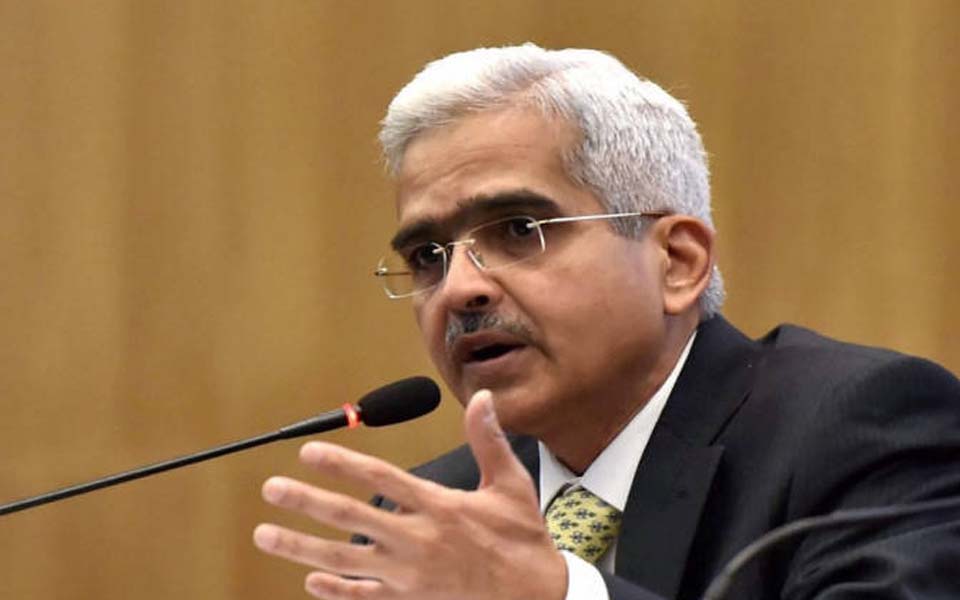
Mumbai, Sep 19: The government has limited fiscal space to support growth, but low inflation can help the monetary authority ease policy rates further and help boost the economy that has badly lost its momentum, governor Shaktikanta Das said Thursday.
Government measures to boost growth are more on the administrative side and it has been fiscally prudent in its moves, Das said, adding there can be more such off-balance- sheet measures from New Delhi in the offing.
It can be noted that GDP slipped to a six-year low of 5 percent in the June quarter, which led the government to announce some booster doses in three installments so far.
Courtesy the space created by low-inflation, the RBI has already cut rates four times to the tune of 110 bps this year to push growth.
"Today, when we see that the price stability is maintained and inflation is much below 4 percent and is expected to be so in the next 12 months horizon, there's room for (more) rate cuts, especially when growth has slowed down," Das said, speaking at an event organised by Bloomberg News here this evening.
However, the governor was quick to add that "within this policy framework, the MPC will consider these aspects as well as several other factors and the final decision will be taken in the ensuing MPC meetings in October."
Das also refused to share the RBI's revised growth projection, stating that it will go public with the revised numbers at the next monetary policy announcement on October 4.
Das reiterated there are many areas of opportunity amid the "challenging" environment and called for focusing on the same without getting mired in negative sentiments.
He also said the recent issues on the oil front, especially after the drone attacks on the largest Saudi Arabian facility and resultant drop in capacity by a tenth, will not have a negative effect either on the domestic situation, including the fiscal balances or inflation as well.
It is possible to contain the impact on the fiscal math as most fuel prices are now linked to market prices, thus capping the fiscal burden to the minimum, he said.
Das said there is a need for a "nuanced understanding" on the fiscal measures, stating that sometimes better spending of the expenditure can deliver the desired benefits without really entailing additional expenditure burden.
As government goes through a raft of growth enhancing measures, Das advocated front-loading of its capex plans in the budget to help the economy.
Commenting on the fiscal balances, he said the space enjoyed by the government to boost growth is "limited".
"Fiscal deficit is at 3.3. There are lots of discussions about the borrowings by PSUs. Both put together there is already very little fiscal space for fiscal expansion," the governor said.
The measures announced through the three announcements are "non-fiscal" and administrative in nature, where the government is streamlining certain things to help boost the growth numbers, Das said.
Apart from this, the government also needs to assess its internal position which is visible through inputs like tax collections and expenditure management, he said.
It can be noted that there is a huge pressure on the revenue side, with the numbers indicating advance tax collections have grown by less than 5 percent in the first half of the year against a full year target of 17.5 percent, a senior tax official told PTI.
Reiterating the need to have structural reforms in sectors like land records, labour and agriculture, Das said there is an immediate need to either repeal or substantially amend the APMC Acts in several states.
Das underlined that the government has initiated many structural reforms to address the issues.
He also said the RBI's interventions on the rupee are to contain the volatilities and have been on either sides in the last few months, which have helped the country being taken off the US list of currency manipulators.
Let the Truth be known. If you read VB and like VB, please be a VB Supporter and Help us deliver the Truth to one and all.
TraceX Guard Strengthens National Safety Against Mobile Cyber Threats

India is witnessing a sharp rise in trojanised Android APK scams, as cybercriminals increasingly exploit fake government, banking, LPG, challan, and welfare scheme apps to seize full remote control of victims’ smartphones.
Cybersecurity investigators warn that attackers are now widely deploying Remote Access Trojan (RAT) malware, often powered by leaked builder kits such as CraxsRAT and heavily modified custom payload frameworks. Once installed, these malicious APKs can convert an ordinary Android phone into a fully controlled fraud device, enabling silent surveillance, banking theft, and mass scam propagation.
These malware campaigns are primarily being distributed through WhatsApp, Telegram, SMS phishing links, and fake APK download websites, where users are tricked into installing apps disguised as:
- e-Challan apps
- SBI KYC verification tools
- PM Yojana portals
- mParivahan clones
- LPG booking apps
- fake adult video call apps
As the scale of the threat intensifies, cybersecurity startup TraceX Labs has introduced TraceX Guard, positioning it as a frontline mobile defence platform against APK fraud, RAT infections, QR scams, and malicious permission abuse.
Fear-Based Social Engineering Behind the Surge
According to investigators, these frauds typically begin with panic-driven social engineering messages sent over WhatsApp or Telegram.
Common bait messages include:
- Your traffic challan has been issued
- Your SBI KYC is pending
- PM Yojana verification required
- Your LPG cylinder booking failed
- Your bank account will be blocked
These alerts often include fake challan numbers, vehicle details, Aadhaar-linked references, or forged bank notices, creating a sense of urgency that pushes victims to install the malicious APK without verification.
One of the most dangerous variants currently in circulation is a fake mParivahan-style application, which closely mimics India’s legitimate transport services interface while secretly embedding a hidden RAT payload.
How the Malware Takes Over Smartphones
Once installed, the malicious APK immediately requests dangerous permissions, including:
- Accessibility access
- SMS permissions
- Call logs
- Notifications
- File storage
- Battery optimization exemptions
Security researchers say Accessibility Service abuse remains the most critical attack vector, allowing the malware to silently:
- read screen contents
- detect banking and UPI apps
- auto-click Allow / Confirm / Pay buttons
- capture OTPs
- launch hidden overlays
- navigate banking sessions
- trigger silent fund transfers
Because these actions occur directly on the victim’s trusted device, attackers are often able to bypass traditional fraud detection systems.
Within minutes, victims may lose control over:
- bank balances
- UPI wallets
- Aadhaar and PAN scans
- contact lists
- personal photos and media
- incoming calls
- SMS OTPs
In many cases, the malware also self-propagates by forwarding malicious APK links through the victim’s own WhatsApp groups and Telegram chats, triggering a chain infection effect across trusted social circles.Fake RTO Challan APKs Become the Most Dangerous Variant
Among the most active campaigns, fake RTO challan APK scams have emerged as one of the most financially destructive.
Victims are first lured into paying a ₹1 “verification fee”, after which the malicious app requests highly sensitive information such as:
- card number
- expiry date
- CVV
- UPI PIN
- net banking credentials
- even ATM PINs
Cybersecurity experts stress that no legitimate government payment system ever asks for an ATM PIN inside an app, making this an immediate red flag.
Once payment details are entered, the embedded RAT intercepts OTPs and silently completes unauthorized transactions.
India’s Mobile Fraud Crisis Reaches Critical Levels
Investigators estimate that more than 70% of reported cyber fraud cases in India now originate from mobile devices, with millions of complaints linked to:
- malicious APKs
- phishing URLs
- QR scams
- RAT droppers
- banking session hijacks
- WhatsApp fraud chains
The impact is particularly severe across Tier-2 and Tier-3 regions, where smartphone adoption has expanded faster than awareness around:
- APK sideloading risks
- dangerous permissions
- fake banking overlays
- accessibility abuse
- WhatsApp APK scams
This has effectively turned Android smartphones into the primary battlefield of India’s financial cybercrime ecosystem.
TraceX Guard Introduced as a Real-Time Defence Layer
In response to this rapidly evolving threat landscape, TraceX Labs has launched TraceX Guard, an AI-powered multilingual Android security suite built specifically for India’s APK fraud ecosystem.
The platform offers:
- real-time APK scanning
- malicious permission detection
- hidden app discovery
- RAT behaviour monitoring
- QR & phishing URL safety grading
- OTP and SIM fraud alerts
- Wi-Fi hotspot verification
- ransomware defence
- India-specific scam intelligence feeds
- support for 10+ regional languages
Its offline-first AI architecture allows users to scan threats without uploading personal data, making it especially useful for privacy-conscious users and low-connectivity regions.
TraceX Labs says the system is specifically trained to detect patterns used in:
- fake challan scams
- counterfeit SBI APKs
- PM Yojana malware
- wedding invitation APK attacks
- honey-trap adult apps
- Telegram-based RAT droppers
From Phishing to Malware-Driven Financial Warfare
Cybersecurity analysts say this marks a major shift in India’s digital threat landscape.
What once began as simple phishing links has now evolved into malware-driven financial warfare at scale, where a single infected smartphone can silently compromise:
- families
- WhatsApp groups
- banking accounts
- local communities
- social trust networks
With losses from mobile-first fraud already running into tens of thousands of crores, experts believe the future of cyber defence will increasingly depend on preventive mobile security tools capable of stopping unsafe APKs before installation.
In that battle, TraceX Guard is emerging as one of the most important first lines of defence for India’s digital users.
Download Now : https://play.google.com/store/apps/details?id=com.tracexlabs.guard