LPG price hiked by over Rs 2 after rise in dealers' commission
New Delhi, Nov 9: Domestic cooking gas LPG prices have been hiked by over Rs 2 per cylinder after the government increased the commission paid to LPG dealers.
A 14.2-kg subsidised LPG cylinder in Delhi will now cost Rs 507.42 as against Rs 505.34 previously, according to a price notification of state-owned fuel retailers.
This followed an order of the Oil Ministry that raised the dealer's commission. In that order, the ministry said the domestic LPG distributors' commission for 14.2-kg cylinder and 5-kg cylinder was last fixed at Rs 48.89 and Rs 24.20 respectively in September 2017.
"Pending finalisation of De-Novo Study for revision of LPG distributors' commission and taking into consideration the increase in transportation costs, wages etc, it has been decided to revise the distributors' commission to Rs 50.58 per 14.2 kg cylinder and Rs 25.29 per 5 kg cylinder as an interim measure," the order said.
This is the second increase in rates this month, the earlier one being on November 1, when prices went up by Rs 2.94 per cylinder because of tax component on base price.
Since June rates have gone up every month because of the GST paid on higher base price and cumulatively prices have risen by Rs 16.21.
In Mumbai, a 14.2-kg LPG cylinder now costs Rs 505.05 while in Kolkata it is priced at Rs 510.70. Chennai has a price of Rs 495.39.
Rates differ from state to state depending on local taxes and transportation cost.
The new dealer's commission will be made up of Rs 30.08 establishment charges and Rs 20.50 delivery charges for a 14.2-kg cylinder. For 5 kg cylinder, the establishment charges have been fixed at Rs 15.04 and the rest Rs 10.25 are delivery charges, the ministry order said.
Customers who collect their refills directly from distributor's premises will continue not to be charged for delivery, it said.
Before the hike, the dealer's commission was made up of Rs 29.39 establishment charges and Rs 19.50 delivery charges for a 14.2-kg cylinder. For 5 kg bottle, the establishment charges were Rs 14.70 and delivery charges Rs 9.50.
All LPG consumers have to buy the fuel at market price. The government, however, subsidises 12 cylinders of 14.2-kg each per households in a year by providing the subsidy amount directly in bank accounts of users.
This subsidy amount varies from month to month depending on the changes in the average international benchmark LPG rate and foreign exchange rate.
When international rates move up, the government provides a higher subsidy. But as per tax rules, GST on LPG has to be calculated at the market rate of the fuel. The government may choose to subsidise a part of the price but tax will have to be paid at market rates.
This has led to an increase in price.
On November 1, the non-subsidised or market price LPG rates went up by Rs 60 per cylinder to Rs 939. Because of the rise in dealer's commission, the price is now Rs 942.50 per 14.2-kg cylinder.
Let the Truth be known. If you read VB and like VB, please be a VB Supporter and Help us deliver the Truth to one and all.
Power bank catches fire inside stationary IndiGo plane at Chandigarh airport; all evacuated
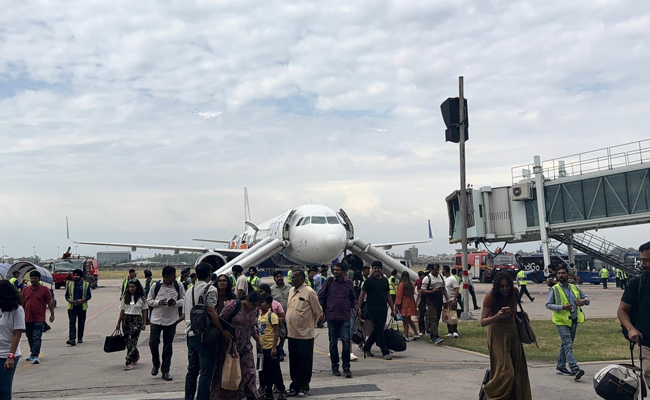
New Delhi (PTI): The power bank of a passenger onboard a stationary IndiGo aircraft caught fire at the Chandigarh airport on Tuesday, and all passengers and the crew were evacuated, according to a source.
In a statement, the airline said that when IndiGo flight 6E 108 from Hyderabad to Chandigarh was stationary after landing, an incident involving a customer's personal electronic equipment catching fire was reported.
"In the interest of safety, an immediate evacuation was carried out, and all the relevant authorities were immediately informed. All customers have been safely moved to the terminal and are being attended to by the team to ensure their well-being," the statement said.
The source said that soon after the aircraft landed, there was smoke coming from one of the overhead bins and all onboard were evacuated.
The smoke was due to the power bank catching fire, the source said, adding that no one sustained major injuries.
Details about the number of passengers could not be ascertained.