LS approves telecom Bill 2023; provides for govt control on communication network in emergency
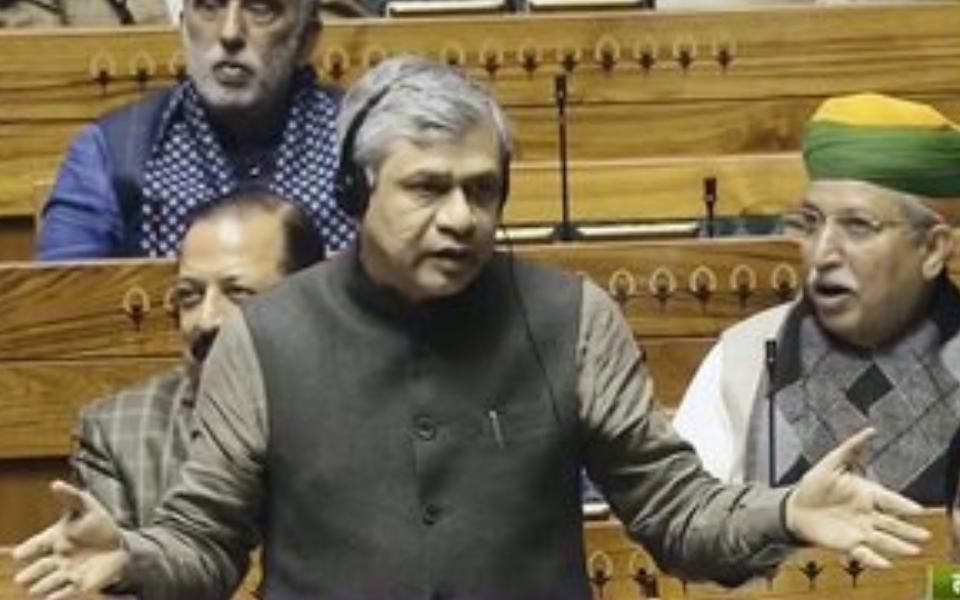
New Delhi, Dec 20: A bill allowing the government to temporarily take control of telecom services in the interest of national security, and providing a non-auction route for the allocation of satellite spectrum was approved by the Lok Sabha on Wednesday.
The Telecommunications Bill, 2023, which was passed by a voice vote after a short debate, also allows the Centre to take possession of a telecom network in case of any public emergency or in the interest of public safety.
Most of the opposition members did not attend the House following their suspension.
The bill, piloted by Communications Minister Ashwini Vaishnaw, provides for stopping transmission and intercepting messages in case of public emergency, in the interest of the public, to prevent incitement for committing offence.
"The bill will promote structural reforms in the telecom sector," Vaishnaw said.
"On the occurrence of any public emergency, including disaster management, or in the interest of public safety, the central government or a state government or any officer specially authorised in this behalf by the central government or a state government, if satisfied that it is necessary or expedient so to do, by notification take temporary possession of any telecommunication service or telecommunication network from an authorised entity," the bill said.
According to the bill, the press messages of correspondents accredited to the Centre or state governments shall not be intercepted or detained unless their transmission has been prohibited under rules applicable for public emergency, public order etc.
The bill provides for the allocation of spectrum to satellite communications companies through the administrative method, Vaishnaw said.
The provisions of the bill, it may be mentioned, are in line with the demand of global satellite services companies and reject the argument made by domestic telecom players Jio and Vodafone Idea for allocation of spectrum for commercial use through the auction route.
As per the bill, "the central government shall assign spectrum for telecommunication through auction except for entries listed in the First Schedule for which assignment shall be done by administrative process."
The first schedule has 19 cases for which spectrum will be assigned through the administrative process including global mobile personal communication by satellites, national long-distance and international long-distance services, mobile satellite services, VSAT, In-Flight and maritime connectivity, BSNL and MTNL.
Once the bill is approved by Parliament, the companies will require authorisation to start providing telecom services instead of licences that are issued at present.
The government has proposed a cap of Rs 5 crore on penalties imposed on telecom operators which was Rs 50 crore earlier per circle implying a maximum penalty of around Rs 1,100 crore on a telecom company.
The bill also provides protective measures for telecom infrastructure and reinforces provision for smooth roll-out of networks especially optical fibre cables.
The Centre has also proposed the exemption of telecom networks installed on any property from any claims, encumbrances, liquidation or the like, relating to such property.
The bill provides for the termination of spectrum assignment if the government determines that the assigned spectrum has remained unutilised without any sufficient reasons.
The bill makes it mandatory for companies to issue SIMs after capturing verifiable biometric data of the applicant to prevent misuse of telecom resources.
The bill has a provision for a jail term of up to three years or a fine of up to Rs 50 lakh for a person obtaining SIM or other telecom resource through fraud, cheating, personation, the minister said.
The government has proposed to mandate sector regulator Telecom Regulatory Authority of India to share its reply on clarification sought from it within 30 days.
Vaishnaw said that the bill would repeal two laws, including 138-year-old Indian Telegraph Act, 1885.
He regretted that the opposition did not participate in the debate and "they ran away".
"The bill will usher in the biggest reforms in the sector Now there will be one simple authorisation instead of 100 licences," he said, adding there is a provision for four-tier dispute resolution which will help in reducing litigation in the sector.
"It will also strengthen the legal system for dealing with cyber-security issues...There will also be provision for regulatory sandbox which will encourage innovation," he added.
Talking about the spectrum, the minister stressed that it is "a natural resource which has to be used judiciously."
The members who participated in the discussion included Bhartruhari Mahtab (BJD), Jayant Sinha (BJP) and Shrirang Appa Barne (Shiv Sena).
Let the Truth be known. If you read VB and like VB, please be a VB Supporter and Help us deliver the Truth to one and all.
Putin meets Iran's FM Araghchi, says Russia ready to do its best to help bring peace to West Asia
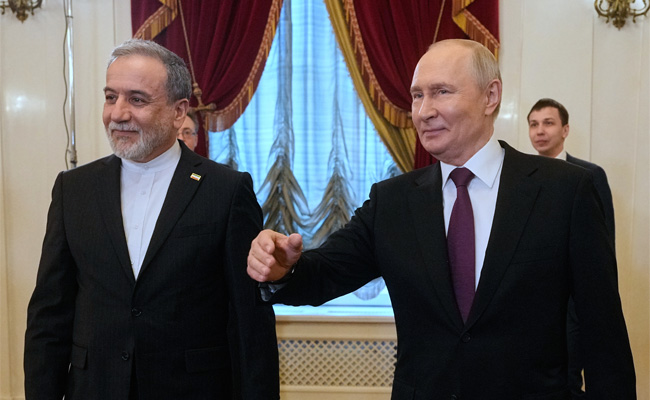
Moscow (PTI): Iran's Foreign Minister Abbas Araghchi on Monday met Russian President Vladimir Putin, who hailed the Iranian people for fighting bravely and heroically for their sovereignty and said Moscow is ready to do its best to help bring peace to West Asia as soon as possible.
Araghchi, who held talks with Omani and Pakistani leadership before arriving in Russia, met Putin in St. Petersburg and thanked him for supporting Iran, state-owned TASS news agency reported.
"Russia is ready to do everything in its power to ensure that peace in the Middle East is achieved as soon as possible," Putin said during his meeting with Araghchi, which was also attended by Russian Foreign Minister Sergey Lavrov.
Revealing that he received a message from Iranian Supreme Leader Mojtaba Khamenei last week, Putin asked Araghchi to convey his "gratitude for this message and best wishes for his health and well-being."
He praised the Iranian people for fighting "bravely and heroically" for their sovereignty, Iran's state-run PRESS TV reported.
"We really hope that, based on the courage and desire for independence, the Iranian people, under the guidance of the new leader, will weather this difficult period of trials and peace will come,” Putin said.
He also stressed that Russia “intends to maintain” its strategic relations with Iran.
Araghchi said that the world witnessed Iran’s strength in countering the US during the recent war, and that the Islamic Republic is a "stable and powerful establishment."
"With their courage, the Iranian people succeeded in resisting the US aggression and will be able to endure it,” he said.
He said that it became clear that Iran has “great friends and allies” like Russia, and conveyed “warmest greetings” from Supreme Leader Mojtaba Khamenei and President Masoud Pezeshkian to the Russian leader.
Araghchi said relations between Moscow and Tehran represent a “strategic partnership at the highest level” and will continue to develop "regardless of circumstances."
"We are grateful to you for the solid and strong positions in support of the Islamic Republic of Iran," he said.
Foreign Minister Lavrov said that the talks between President Putin and the Iranian Foreign Minister were "useful and constructive."
Kremlin Spokesman Dmitry Peskov later said that Russia is "ready to provide any good offices, any mediation services that are acceptable to the parties."
"We will be ready to do everything so that ultimately peace ensues, guaranteed peace, and that there is no return to hostilities," Peskov was quoted as saying by TASS.
He was asked how Moscow can assist in future negotiations on the Iranian settlement.
Araghchi arrived in Russia after his whirlwind trip to Islamabad, which, according to him, was “very productive” and involved “good consultations" with Pakistan's Army Chief Field Marshal Asim Munir, amid uncertainty over the second round of peace talks to resolve the war in West Asia.
"We held good consultations with our friends in Pakistan. The trip was successful. We assessed the outcome of our recent (meetings) and discussed in what direction and under what conditions talks can move on,” Araghchi said in a video posted on his Telegram channel upon his arrival in St Petersburg.
Referring to the second round of talks between the US and Iran to resolve the conflict in West Asia, Araghchi said: "Developments have taken place in the negotiations."
"Despite some progress in earlier rounds, the talks failed to reach their objectives due to the Americans' approach, the excessive demands they made, and the wrong approaches they adopted. Therefore, it was necessary to consult with our friends in Pakistan to review the latest situation,” Iran's official news agency IRNA quoted him as saying.
He said that the trip to Pakistan was a good opportunity to review developments related to the US-Israeli war against Iran, expressing confidence that “these consultations and coordination between the two countries will be highly significant.”
Araghchi arrived at St. Petersburg's Pulkovo Airport early Monday, where he was welcomed by Russian officials and Iran’s ambassador to Russia, Kazem Jalali, the report said.
The first round of peace talks between Iran and the US, held on April 11 and 12, failed to bring the desired result for the parties to the conflict.
The Iranian minister arrived in Islamabad for the second time on Sunday after a short visit to Oman, where he held talks with Sultan Haitham bin Tariq al-Said on security in the Strait of Hormuz and diplomatic efforts to end the Iran-US conflict.
After Araghchi left Pakistan for Oman on Saturday, President Donald Trump announced that US negotiators Steve Witkoff and Jared Kushner would no longer be going to Islamabad for talks with Iran, contending that Washington held all the cards on the matter.
Trump on Sunday reiterated that the US and Iranian officials can talk by phone for a peace solution to the conflict.
On Tuesday, Trump extended the two-week ceasefire with Iran indefinitely to give Tehran more time to prepare a unified proposal to end the war, just hours before the truce was set to expire.
The war began when the US and Israel jointly attacked Iran on February 28, killing Iranian Supreme Leader Ayatollah Ali Khamenei and several top commanders. The retaliation by the Islamic Republic extended the war to the entire Gulf region.