Maha court grants Rahul Gandhi permanent exemption from appearance in defamation case
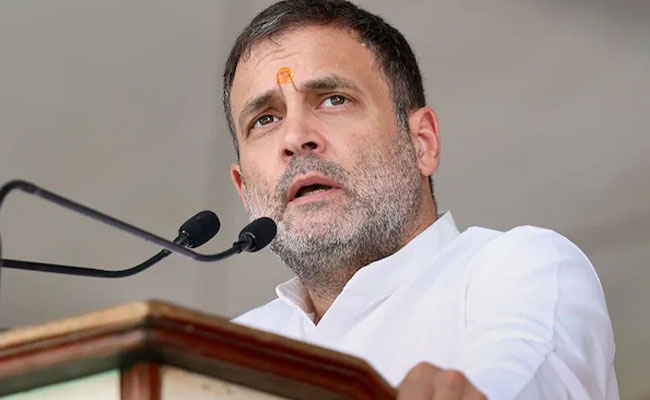
Thane (PTI): A court in Maharashtra's Thane district on Saturday granted a permanent exemption to Congress leader Rahul Gandhi from appearing before it in a defamation case filed against him by a Rashtriya Sawyamsevak Sangh (RSS) functionary.
Bhiwandi First Class Judicial Magistrate Laxmikant C Wadikar who heard Gandhi's application filed through his counsel Narayan Iyer observed that the Congress leader deserves a permanent exemption.
The magistrate also set June 3 for recording evidence in the defamation suit filed by local RSS worker Rajesh Kunte.
Kunte had in 2014 filed a private complaint before the Bhiwandi magistrate's court after watching Gandhi's speech where he allegedly accused the RSS of Mahatma Gandhi's assassination. Kunte claimed this statement slandered the reputation of the RSS.
Gandhi had appeared before the court in June 2018 and pleaded not guilty.
"Accused Rahul Rajiv Gandhi is hereby exempted from appearance in the court till the further order passed by the court subject to following conditions," reads the order, a copy of which was accessed by PTI.
"Accused to undertake that his duly designated advocate punctually and regularly appears before court on each and every scheduled date and conduct the trial in absence of accused," says one of the conditions. "Accused to remain present in court as and when directed," reads another.
Rahul Gandhi, who was recently disqualified as an MP after his conviction by a Surat court in a defamation case, had last year sought exemption from appearance in the Bhiwandi court on the grounds that he was a Delhi resident and a Lok Sabha member who had to visit his constituency (Wayanad), attend party work and travel a lot. Gandhi had requested that whenever required, he be allowed to be represented by his lawyer in the hearing.
Kunte recently argued that since Gandhi is no longer a parliamentarian, he should not be given an exemption in the matter.
The Surat court had on March 23 sentenced Gandhi to two years in jail in a 2019 criminal defamation case filed against him over his "why all thieves have Modi surname" remarks. The court also granted him bail and suspended the sentence for 30 days to allow him to appeal in a higher court. The next day, he was disqualified as a member of the Lok Sabha.
Let the Truth be known. If you read VB and like VB, please be a VB Supporter and Help us deliver the Truth to one and all.
UP man gets life term for electrocuting mentally challenged wife to death in Bareilly

Bareilly (UP) (PTI): A local court here has sentenced a man to life imprisonment for murdering his mentally challenged wife by repeatedly electrocuting her while she was tied to a cot, lawyers said on Thursday.
Additional district government counsel Harendra Singh Rathore said Additional Sessions Judge Avinash Kumar Singh on Wednesday convicted Vinod Kumar (45) for killing his wife, Satyavati, in Chaina village of Bareilly district and imposed a fine of Rs 15,000 on him.
According to the prosecution, he was allegedly frustrated with his wife Satyavati's mental illness and often assaulted her.
Rathore said the prosecution examined nine witnesses to establish the charges against him.
As per court records, on the night of May 1-2, 2022, when Satyavati was asleep, Vinod tied her hands and legs to a cot using ropes and then connected an aluminium cable to an electric board to repeatedly administer electric shocks to her.
"She writhed in pain, but the accused continued to electrocute her until she died," the prosecution said.
The court observed that the murder was carried out in an inhuman manner.
After committing the crime, the accused threw the rope and cable on the roof and left for work at a brick kiln around 2 am to create a false alibi.
He later tried to mislead the police and the victim's family by claiming that Satyavati, whose mental condition was unstable, had accidentally died by suicide after grabbing a live electric wire.
However, the victim's brother, Sanjeev, a resident of Shahjahanpur district, suspected foul play and lodged an FIR under sections 498A (husband subjecting wife to cruelty) and 302 (murder) of the Indian Penal Code at Nawabganj police station.
During the trial, the prosecution relied on the post-mortem report prepared by Dr Faraz Anwar, who stated that multiple electrocution marks found on different parts of the victim's body could not have been self-inflicted.
The police also recovered the rope and electric wire used in the crime on the accused's identification, officials said.