Maha Kumbh begins in Prayagraj, nearly 60 lakh devotees take holy dip
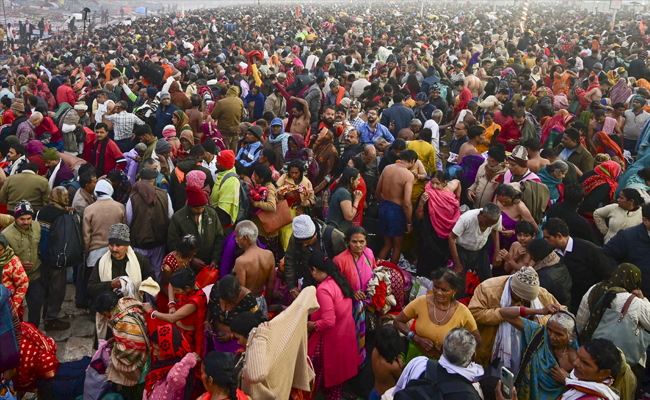
Mahakumbh (UP) (PTI): The fog was thick, the cold intense and the waters freezing as the Maha Kumbh, the world’s largest gathering, began on Monday with tens of lakhs of people taking a dip in the Sangam in their quest for ‘moksha’ and the belief it will cleanse their sins.
Spirituality and faith, culture and religion, tradition and modern-day technology… it all fused into one in the confluence of the Ganga, Yamuna and the mystical Saraswati in Prayagraj. More than 40 crore people are expected over 45 days in the mela, being held after 12 years. Besides, seers claim the celestial permutations and combinations for the event are taking place after 144 years, making the occasion even more auspicious for the faithful.
And as the famed mela formally began on the occasion of ‘Paush Purnima’ to the sound of conch shells and bhajans, the excitement was palpable in the sprawling Sangam area as devotees -- mostly in groups -- walked towards the waters chanting 'Jai Ganga Maiyya'.
"Till 9.30 am, around 60 lakh pilgrims had taken a dip," the Uttar Pradesh government said in a statement.
"A very special day for crores of people who cherish Bharatiya values and culture! Maha Kumbh 2025 commences in Prayagraj, bringing together countless people in a sacred confluence of faith, devotion and culture. The Maha Kumbh embodies India’s timeless spiritual heritage and celebrates faith and harmony," Prime Minister Narendra Modi said on X.
Ash smeared sadhus from their abode in the Himalayas, the religious from across the country and abroad and those just curious to take in the sights and sounds of the biggest religious spectacle of all… the 45-day Maha Kumbh beckoned them all.
Thirteen Akharas of seers from different sects are participating in the Maha Kumbh.
"I practise yoga in Brazil, I have come here for 'moksha'. This one is very special, once in 144 years. I am very lucky to be here. India is like spiritual heights of the world. I have four days to get 'moksha' (laughs). Sanatan Dharma is my mission of life and it changed my life, it changed the way I see the world, my family… Jai Shri Ram,” a devotee from Brazil said.
"It is very special for me to be with you all Indians here. I am feeling grateful for this opportunity to dive into the sacred river here at the sacred point. I am fulfilled with bliss at this moment, " added Julie from Spain.
Chants of 'Jai Shri Ram', 'Har Har Mahadev' and 'Jai Ganga Maiyya' chants could be heard as the pilgrims moved towards the bathing area in groups.
A group of women from Uttar Pradesh's Siddharth Nagar was busy singing folk songs. And there was a team of YouTubers from South Korea capturing various shots of the Maha Kumbh as was a team from Japan.
Contingents from states across India were seen too at various ghats of Prayagraj.
Appreciating the arrangements made for the devotees, Kailash Narayan Shukla from Hamirpur in Himachal said, “Good arrangements were made for the pilgrims and we had no problems in taking the holy dip".
"Where there is a confluence of cultures, there is also a confluence of faith and harmony. Maha Kumbh-2025 is giving the message of 'unity in diversity', Prayagraj is providing an encounter with Sanatan along with the welfare of humanity," Uttar Pradesh Chief Minister Yogi Adityanath said on X.
It is a massive logistical exercise for the government.
"Spanning 10,000 acres, the event will set an exemplary standard for cleanliness, security, and modernity. To enhance the convenience of devotees, a digital tourist map will facilitate monitoring the cleanliness of toilets, while an AI-powered security system integrated with smartphones will ensure safety," the chief minister said earlier.
Mahakumbh Nagar is the world’s world's largest temporary city, accommodating 50 lakh to 1 crore devotees at any given time, Adityanath said.
According to Uttar Pradesh Chief Secretary Manoj Kumar Singh, more than 55 police stations have been set up along with 45,000 police personnel being deployed for the fair. Projects have also been sanctioned to monitor social media continuously to guard against any mischief, he said.
As many as 30 pontoon bridges, both in the Sangam area and Phaphamau, have also been readied to facilitate the movement of people from one end of the confluence to the other.
Huge gates have also been installed at some of the entry points to welcome the devotees into the holy city.
In the digital era, Maha Kumbh is also trending on social media, with devotees sharing their experiences by posting videos and pictures, with many offering their families virtual ‘darshan’ of Ganga via video call.
Let the Truth be known. If you read VB and like VB, please be a VB Supporter and Help us deliver the Truth to one and all.
Rajnath to top commanders: Outmaneuver adversaries with strategic surprise
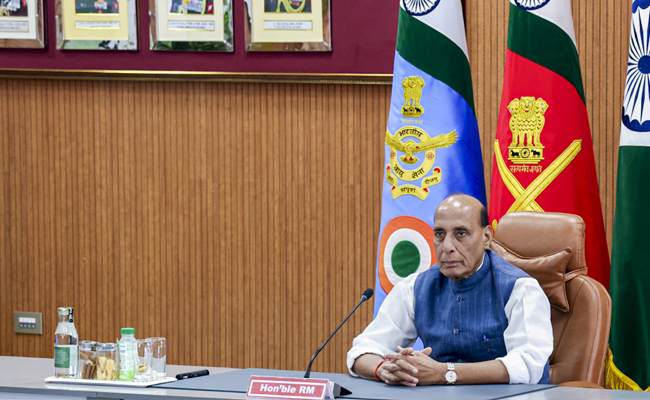
Jaipur/New Delhi (PTI): Defence Minister Rajnath Singh on Friday directed the top military commanders of the three services to integrate an "element of surprise" into modern warfare to outmaneuver India's adversaries and bolster strategic posture.
In his address at the joint commanders conference in Jaipur, Singh also described the Operation Sindoor as a testament to the "swift, precise, and joint response" of the Indian armed forces to safeguard national interests and called upon the military to remain ready to deal with any security challenges.
In their two-day deliberations, the commanders carried out a comprehensive review of the combat preparedness of the military in the wake of the evolving regional security situation.
Operation Sindoor was a demonstration of India's growing capabilities and a symbol of the nation's collective resolve and new military ethos, Singh said, a day after the first anniversary of Operation Sindoor.
He also unveiled a 'Joint Doctrine for Integrated Communication Architecture' that is aimed at strengthening doctrinal clarity, interoperability and integrated communications across the armed forces in future multidomain operations.
The joint commanders' conference, themed 'Military Capability in New Domains', brought together the top leadership of the defence ministry and the three services to deliberate on emerging security challenges and future readiness.
Comprehensive deliberations were held on future warfare, multidomain operations, technological transformation and joint capability development.
The conference witnessed extensive discussions on cognitive warfare, cyber resilience against evolving quantum and AI-enabled threats, military capability development in emerging domains, indigenous innovation and AI-enabled warfighting concepts.
It was attended by Chief of Defence Staff Gen Anil Chauhan, Chief of the Naval Staff Admiral Dinesh Kumar Tripathi, Chief of the Army Staff Gen Upendra Dwivedi, Chief of the Air Staff Air Chief Marshal AP Singh and Defence Secretary Rajesh Kumar Singh among others.
In his remarks, Singh asked the commanders to remain "future-ready" by learning from the operation as well as the current global security landscape.
He underscored the need to strengthen capabilities in artificial intelligence, autonomous systems, data analytics and secure communication networks to stay prepared in the rapidly evolving geopolitical security scenario. He emphasised that future conflicts will increasingly be shaped by hybrid threats, information dominance and operations conducted simultaneously across cyber, space, electromagnetic and cognitive domains, according to an official readout.
Highlighting the transformative impact of emerging technologies, Singh stressed on the importance of ensuring integrated national preparedness across all spectrums of conflict, it said.
Singh's remarks at the conference came a day after the first anniversary of Operation Sindoor.
The defence minister appreciated the progress achieved in enhancing jointness, integration and technological adoption across the three services, the readout noted.
Singh said that jointness constitutes a pivotal dimension within the transformative changes sweeping across the global defence sector.
"Future wars will not be won solely through weaponry, but through innovative thinking and enhanced synergy," he said.
The defence minister exhorted the commanders to cultivate the "element of surprise" to remain unpredictable to the nation's adversaries and secure a strategic edge in any given situation.
He, however, urged them to remain vigilant of the element of surprise of the enemy and always stay two steps ahead.
Singh also reiterated the Narendra Modi government's commitment to enhancing the capabilities of the defence forces through state-of-the-art weapons and platforms. He added that special focus is being laid on research in niche domains.
During the conference, he released a documentary film on Operation Sindoor.
The film reaffirms the nation's and defence forces' commitment to operational preparedness and decisive national response capabilities.
Demonstrations of advanced systems and platforms developed for intelligence fusion, operational planning and information management were also showcased during the conference reflecting growing integration of cutting-edge technologies into joint operational structures, according to the defence ministry.
The discussions will contribute significantly towards shaping India's future military transformation and integrated operational preparedness, it said.