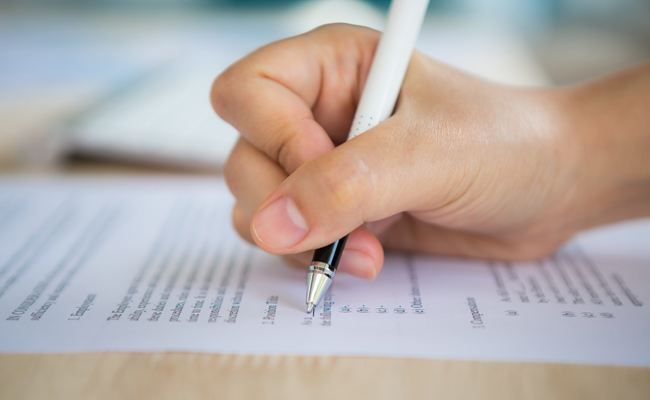
Nagpur (PTI): Police are investigating a suspected leak after the class 12 Chemistry question paper was allegedly circulated on social media in Nagpur ahead of the exam being conducted by the Maharashtra board, officials said on Saturday.

The exam malpractice came to light on Wednesday at a high school examination centre after a female student’s frequent visits to the washroom raised suspicion.

Invigilators seized the student's smartphone. Its analysis showed that the question paper had been shared on a WhatsApp group before the exam began, officials said, adding that possible answers were also exchanged in the same group.

Based on the student's statement, another pupil is being questioned.

The preliminary investigation suggests a person linked to a private coaching shared the question paper for money, officials said.

A case was registered at Sadar police station, and an investigation was launched.

Let the Truth be known. If you read VB and like VB, please be a VB Supporter and Help us deliver the Truth to one and all.


Imagine you are the most powerful person in the world. You can sanction countries, move armies, and shake stock markets with a single tweet. Now imagine nine judges — sitting quietly in black robes — telling you: "Sorry, you cannot do that." That is exactly what happened to Donald Trump on February 20, 2026. The United States Supreme Court, in a historic 6–3 ruling, told the most powerful president on earth that his tariffs were illegal. And the world, including India, is still calculating what this really means.

So what exactly happened? Let us understand it simply.

Trump had been using a 1977 law called the International Emergency Economic Powers Act — IEEPA for short — to impose huge import taxes, called tariffs, on goods coming into America from almost every country. He called trade deficits and the fentanyl drug crisis "national emergencies" and used that excuse to slap heavy taxes — some as high as 25 to 50 percent — on foreign products. He said it would protect American jobs and bring in billions of dollars. And it did bring in over $175 billion. But the question was — did he have the legal right to do it?

The Supreme Court said no. Chief Justice John Roberts, writing for the majority, gave a very simple and powerful reasoning: if Congress — the law-making body of America — truly wanted to give the President the power to impose tariffs, it would have clearly written so in the law. The 1977 IEEPA law talks about controlling trade during emergencies, but it does not specifically mention the word "tariff" even once. So the President cannot assume powers that the law never gave him. This is what lawyers call the "major questions doctrine" — in big matters that affect the entire country's economy, the law must be clear. Silence is not permission.

What made this ruling even more dramatic was that six out of nine judges agreed — three conservatives and three liberals, crossing political lines. Even two judges appointed by Trump himself — Neil Gorsuch and Amy Coney Barrett — voted against him. Only three judges — Thomas, Alito, and Kavanaugh — disagreed. Kavanaugh, in fact, warned that returning the $175 billion already collected from companies could be a financial "mess" for the government. Hundreds of companies have already filed cases asking for refunds. That legal battle is just beginning.

Now, what will Trump do next? He is not the type to sit quietly. Almost immediately after the ruling, he announced he would sign a new executive order using a different law — Section 122 of the Trade Act of 1974 — to impose a 10% global tariff. But there is a catch: Section 122 tariffs can last only 150 days and cannot exceed 15%. That is a much smaller weapon than what IEEPA allowed him. He is also continuing with Section 232 tariffs — justified on national security grounds — on steel, aluminium, cars, and even robotics. And he has started new Section 301 investigations to punish countries for "unfair trade." So the tariff wall is not completely gone. It has just become shorter and narrower.

Now here comes the part that concerns us directly — India.

India had been negotiating a temporary trade deal with the United States for months. Trump had placed a 25% tariff on Indian goods and added another 25% penalty because India was buying oil from Russia. That was a 50% tax on our exports. After months of talks — which officially began after PM Modi's Washington visit in February 2025 — both countries agreed on a framework. The tariff on Indian goods would come down from 50% to 18%. In return, India would lower import taxes on American industrial and farm products.

The deal was expected to be signed in March and come into effect from April 2026. When asked if the Supreme Court ruling changes anything, Trump said firmly — "Nothing changes." He even praised PM Modi as a "great gentleman" while insisting that the new arrangement is fair: "They pay tariffs to us. We do not pay tariffs to them."

For India, this is a moment of cautious optimism. The 18% tariff, as Commerce Minister Piyush Goyal pointed out, is one of the lowest rates compared to countries like Bangladesh, Vietnam, Thailand, and China, which compete directly with India in exports. Our exports to the US from April to January this year have grown by 5.8%, reaching $72 billion. The trade surplus — meaning India is selling more to America than it is buying — stands at $28.53 billion. These are solid numbers.

But let us be honest. The situation is still uncertain. Trump may find new legal routes to impose tariffs. Section 301 investigations could target India specifically. The 150-day limit on Section 122 tariffs means another round of drama is possible by mid-2026.

What the Supreme Court has done is historic. It reminded the world — and America itself — that no one, not even the president, is above the law. For India, it is a moment to stay alert, stay at the table, and keep negotiating smartly.

Because in global trade, just like in cricket, the match is never truly over until the last ball is bowled.

(Girish Linganna is an award-winning science communicator and a Defence, Aerospace & Geopolitical Analyst. He is the Manag ing Director of ADD Engineering Components India Pvt. Ltd., a subsidiary of ADD Engineering GmbH, Germany)

Disclaimer: The views and opinions expressed in this article are solely those of the author. They do not necessarily reflect the views, policies, or position of the publication, its editors, or its management. The publication is not responsible for the accuracy of any information, statements, or opinions presented in this piece.