Mallikarjun Kharge accuses BJP of misleading house on Vande Mataram, defending Nehru
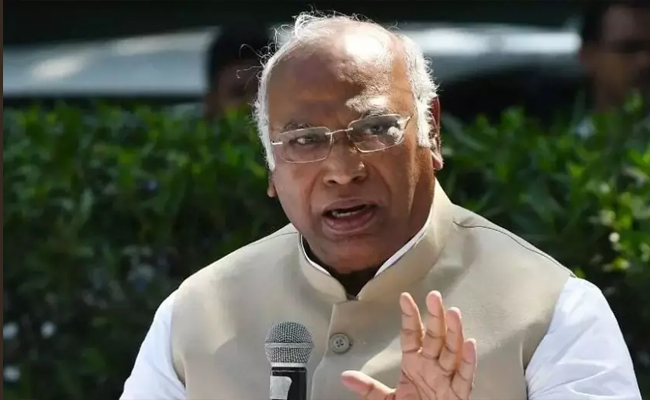
New Delhi: Congress President Mallikarjun Kharge on Tuesday accused BJP leaders of misleading the Rajya Sabha over facts related to Vande Mataram. He asserted that the Congress requires no lessons from the ruling party on nationalism, patriotism, or the national song.
Kharge alleged that Prime Minister Narendra Modi and Home Minister Amit Shah have repeatedly disrespected former Congress leaders, including India’s first Prime Minister, Jawaharlal Nehru.
Participating in a Rajya Sabha discussion on Vande Mataram, Kharge said the Prime Minister had “misled the House” regarding past correspondence between Nehru and Subhas Chandra Bose. He added that leaders who did not sing Vande Mataram during the freedom struggle are “now singing the national song”.
Kharge said BJP’s allegations against Congress leaders are “far from the truth” and demanded an apology. He argued that the country is facing serious issues, declining rupee value, unemployment and economic stress, which should be prioritised instead of unnecessary controversies.
He criticised attempts to “divert attention” by targeting Nehru, stating that such attacks disrespect not only Nehru but also national icons such as Rabindranath Tagore and Bose, as well as freedom fighters who sacrificed their lives.
Kharge claimed he has been singing Vande Mataram for 60 years and highlighted that the Congress has a long tradition of singing the national song at party conventions, making it an anthem of the freedom struggle. He noted that the Congress Working Committee, including Mahatma Gandhi, Subhas Chandra Bose and Madan Mohan Malviya, had decided to recite only the first two verses.
The Congress chief also accused non-Congress parties of failing to participate in the freedom struggle and said some had even “disrespected the Constitution” by burning copies alongside effigies of Mahatma Gandhi and Dr. B.R. Ambedkar.
He reiterated that Congress has always respected Vande Mataram, recalling that a special postage stamp was released during Indira Gandhi’s tenure to mark the song’s 100th anniversary.
Let the Truth be known. If you read VB and like VB, please be a VB Supporter and Help us deliver the Truth to one and all.
TVK falls short within touching distance; what next to ensure majority
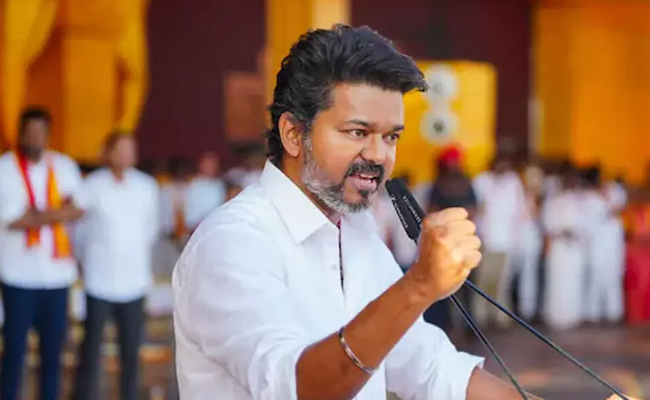
Chennai (PIT): With TVK falling 10 short of a majority, its leader Vijay has the option of forming a minority government in Tamil Nadu without any outside support, analysts said on Tuesday.
Senior political analyst Sumanth Raman told PTI that the TVK is likely to opt to be a minority government with outside support.
"Since it is the single largest party, TVK has the option to go for that. I don't think he (Vijay) will opt for official support from other political party's MLAs", he said.
"If he opts for minority government, the only thing is that, Vijay will have to prove the support once again after six months".
Raman also pointed out that in 2006 when DMK won only 92 seats, the then party president, the late M Karunanidhi formed a minority government with outside support.
In a completely unexpected turn of events in the Tamil Nadu Assembly elections, the TVK has emerged victorious, putting an end to the almost six decade-long dominance of the two major Dravidian parties--DMK and AIADMK.
By clinching victory in its debut electoral contest, the party has elevated its status to that of a recognised political entity. However, the Vijay-led TVK did not secure a mandate large enough to form a government with an absolute majority on its own, requiring another 10 to cross the finish line. Experts have varied opinions.
Specifically, to attain a simple majority, a political party must win at least 118 out of the total 234 constituencies. The TVK, however, secured victory in 108 constituencies. Given that the TVK fell short of the majority mark, what might unfold next?
TVK leader Vijay has won in both constituencies he contested--Perambur in Chennai and Tiruchirappalli East. As per the election commission rule, he will have to resign from one of these seats. TVK sources said that the leader is likely to surrender the Tiruchirappalli assembly seat.
If Vijay does so, the party's total tally of seats will decrease by one. Then it will be 107. Adding to the number games, TVK appointed Speaker of the Assembly will be ineligible to cast a vote during a confidence motion and the party's effective voting strength will be reduced by yet another seat, which comes to 106.
Accordingly, the TVK requires the support of an additional 12 members to demonstrate its majority. As of now, within the DMK alliance, the Congress party has secured five seats, the two Communist parties have won two seats each (totaling four), while the DMDK has secured one seat, the Indian Union Muslim League (IUML) has won two seats and the VCK has secured two seats.
Within the AIADMK alliance, the PMK has grabbed four seats, the BJP has won one seat, and the AMMK has secured one seat. Going by the calculations, if TVK gets the support of other parties within both alliances, it would gain an additional 21 seats.
TVK could potentially secure a total of 129 seats (108 + 21). However, the TVK does not require the support of all those parties, and the backing of just 12 members would suffice.
As Vijay is expected to visit Lok Bhavan on Wednesday (May 6) to meet the governor Rajendra Vishwanath Arlekar to stake claim to form government, the governor is expected to offer the TVK two options.
First, he may summon the TVK chief and instruct him to demonstrate his majority on the floor of the legislative assembly. Alternatively, he might ask Vijay to gather letters of support from "allied" parties and submit them to him.
If the TVK secures support exceeding 118 seats, the governor would invite the party form the government. If TVK fails to garner support from other political parties, it will be denied the opportunity to form the government.
In such a scenario, the governor has the option to invite the DMK, the party holding the second-highest number of seats to form the government.
If DMK too is unable to form a government, the state of Tamil Nadu will come under governor's rule for the subsequent six months. Following this period, fresh legislative Assembly elections will be once again held across all 234 constituencies.
Another political analyst Durai Karuna ruled out that TVK will go for a minority government.
"If he (Vijay) gives an appeal, many political parties including Congress, VCK and left parties will join TVK", he claimed. "In addition, the AIADMK, which has decided to organise MLAs meeting on Wednesday, might also announce that it would support TVK unconditionally".
He said a clear picture on Vijay's decision will emerge in a couple of days.
Tharasu Shyam, political critic, claimed that Congress was "holding talks with Vijay."
"From now on, the DMK must change its approach and this applies equally to the AIADMK," he said in an apparent reference to some reported difference of opinion between allies DMK and Congress over seat-sharing and power-sharing ahead of the April 23 polls.
Incidentally, AICC in-charge for Tamil Nadu, Girish Chodankar, on Tuesday admitted that the Congress party leadership's decision to stick with the DMK alliance went against strong grassroots sentiment favouring the TVK.
"The local leaders, the grassroots level leaders, were suggesting if Rahul Gandhi, who has a large acceptance in Tamil Nadu, joins the campaign with Vijay, it will create a big impact and we can sweep the Tamil Nadu polls, and get somewhere around 180-190 seats," Chodankar told PTI Videos.