Mamata accuses BSF of allowing infiltration to destabilize Bengal; border guards reject claims
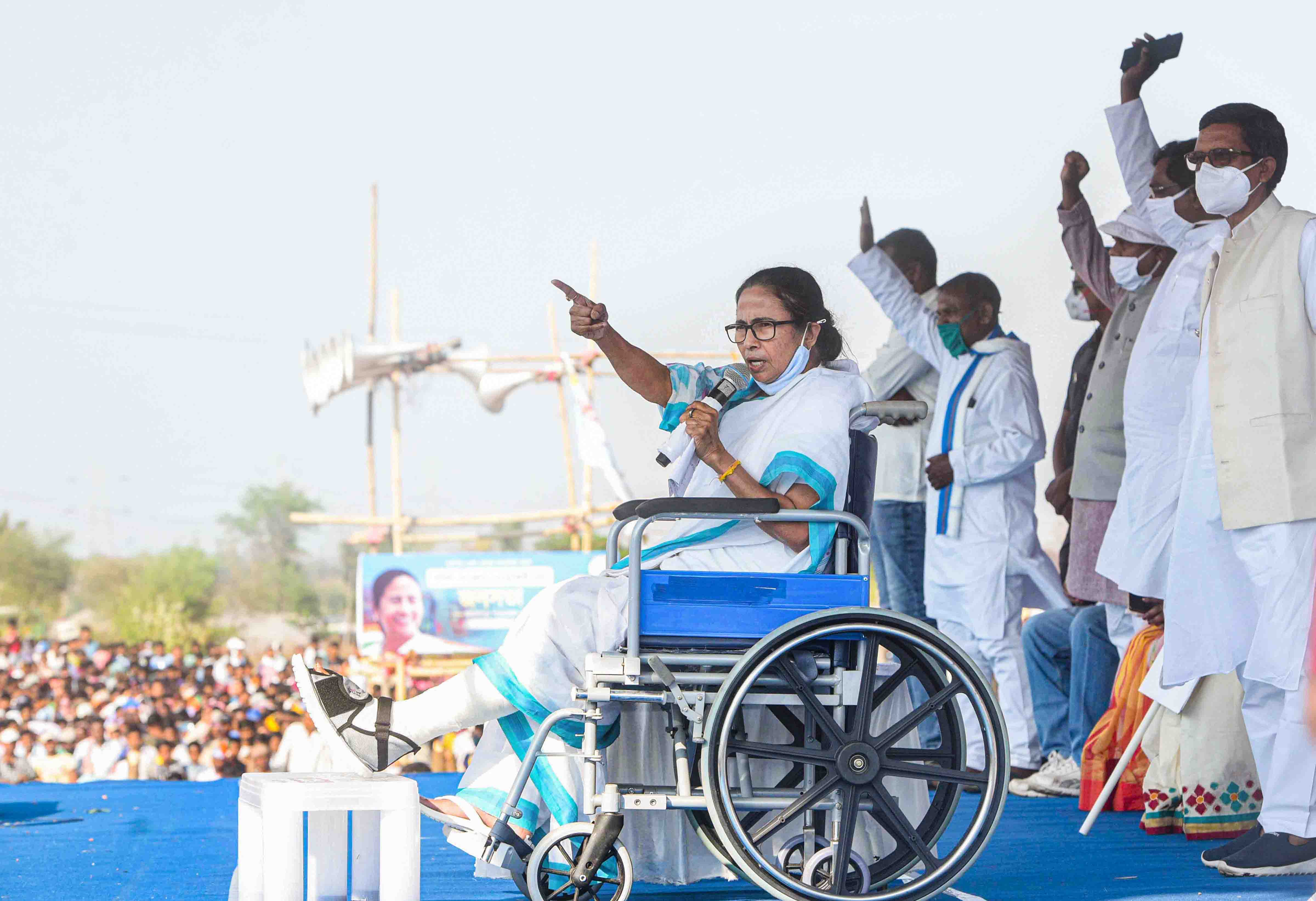
Kolkata, Jan 2: West Bengal Chief Minister Mamata Banerjee on Thursday accused the Border Security Force of facilitating infiltration from Bangladesh as part of a central government "blueprint" to destabilize the state, a charge the BSF denied, asserting it diligently guards the country's boundary.
Speaking at an administrative review meeting at the state secretariat, Banerjee alleged that the BSF was allowing infiltrators to enter through areas like Islampur, Sitai, and Chopra.
"We have information that the BSF is letting infiltrators enter India through various border areas. This is a deliberate attempt to destabilize the state. There is a deep-rooted conspiracy involving the central government," she said.
Banerjee said she could sense a "blueprint of the Centre" behind this attitude of the BSF.
"Goons are entering India. I want peace on both sides of the border. We have a good relationship with neighbouring Bangladesh," she said.
The Trinamool Congress (TMC) supremo further alleged that women were being tortured by the BSF.
"They (BSF) torture women, but why haven't you protested?" she asked officials present at the meeting.
Banerjee emphasized that border security was not the responsibility of the state.
"The guarding of borders is not in our hands. It's the BSF's duty. The Trinamool Congress doesn't guard the border. When people enter, where are they going? The DMs have information on where they are going," she said.
A senior BSF official in the eastern region dismissed the allegations, emphasizing that the border guarding force was performing its duties with utmost sincerity.
"The BSF has maintained a 24/7 vigil along the border. We are diligently performing our responsibilities to ensure the safety and security of the borders," the official told PTI on condition of anonymity.
Accusing the Centre of blaming the TMC unfairly for the infiltration issue, Banerjee said, "If someone thinks to destabilize the state and blame it on the Trinamool Congress, I will say it is not the TMC's fault, as border areas are controlled by the BSF. Some media channels are spreading this misinformation for TRPs."
The CM also raised concerns about the cessation of information sharing related to international arrivals.
"Granting visas is not in the state's jurisdiction; it is handled by the central government. We used to get the list of people taking flights to come here, but now that has been stopped. So, we don't know who is entering Bengal through international arrivals," she stated.
BJP state president Sukanta Majumdar called Banerjee’s claims baseless and accused her of attempting to shield her party's shortcomings.
"The chief minister has reached the height of delusion. Despite not providing land for border outposts, she blames the BSF and even her own administration's officials for infiltration. Her accusations are aimed at deflecting from her party's failures," Majumdar said in a post on X.
Banerjee directed Director General of Police (DGP) Rajeev Kumar to investigate where infiltrators were staying after entering the state.
"I have told the Centre several times that we will follow their decisions. But if I see that someone is helping terrorism to disturb my state, then we will protest. That's why I will send a strong protest letter to the Centre," she added.
Referring to a recent bust of a fake passport racket by West Bengal Police, Banerjee said the arrests highlighted how the porous borders were being exploited.
"The passports were issued to people who illegally entered India from Bangladesh. This is another indication of the need for better coordination," she said.
Highlighting the cultural and linguistic ties with Bangladesh, Banerjee stressed her desire for peace.
"We have a good relationship with Bangladesh. People can come here for treatment, but we must be informed. I want peace on both sides of the border," she said.
India and Bangladesh share a 4,096-km border of which 2,217 KM is with West Bengal, much of which is porous. The issue has gained prominence amid heightened tension following the ouster of Sheikh Hasina from power in Dhaka and an influx of refugees into India.
Banerjee concluded by reiterating her commitment to opposing any attempt to destabilize the state.
"If anyone supports terror to disturb my state, we will protest strongly," she said.
The failed Chief Minister of the state, @MamataOfficial, has reached the ultimate level of delusion!
— Dr. Sukanta Majumdar (@DrSukantaBJP) January 2, 2025
Despite not providing land to set up outposts for border surveillance, she used to blame the Border Security Force (@BSF_India ) for illegal infiltration. But now, crossing all… pic.twitter.com/Jwzk0oAzwF
Let the Truth be known. If you read VB and like VB, please be a VB Supporter and Help us deliver the Truth to one and all.
KMES Institutions shine in SSLC result, continue four-decade legacy of education in rural Karkala
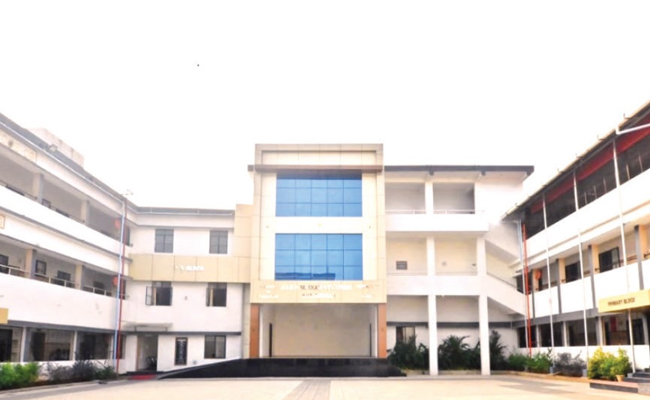
Karkala: KMES Institutions of Education at Kukkundooru in Karkala taluk has recorded outstanding results in the 2025-26 SSLC and PUC examinations, continuing a four-decade educational journey that began with just 22 kindergarten students and no building of its own.
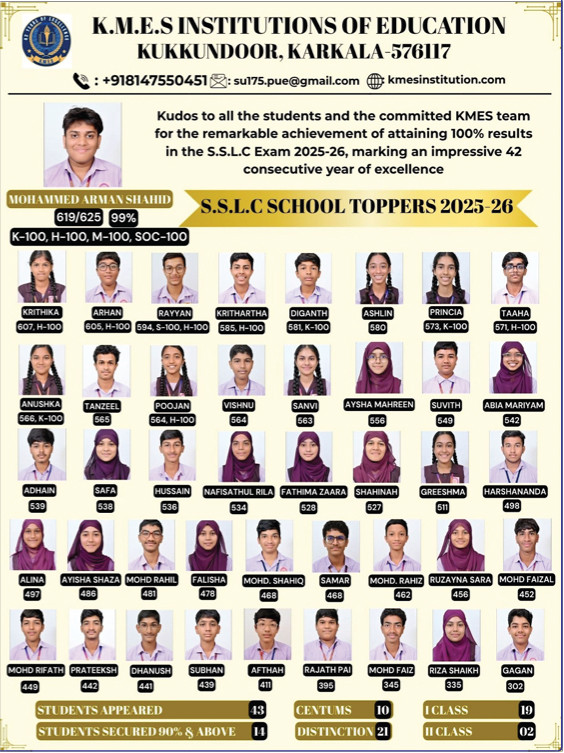
The institution secured a 100 per cent result in the SSLC examinations, with all 43 students passing the examination this year.
Muhammad Arman Shahid emerged as the school topper by scoring 619 marks out of 625, securing 99 per cent and also ranking sixth at the state level. He scored full marks in Kannada, Hindi, Mathematics and Social Science.
Krithika V. Nayak secured the second position in the school with 607 marks and 97.12 per cent, while Arhan stood third with 605 marks and 96.8 per cent.
Out of the 43 students, 21 passed with distinction, 19 secured first class, two students obtained second class and one student passed in third class. Fourteen students scored above 90 per cent.
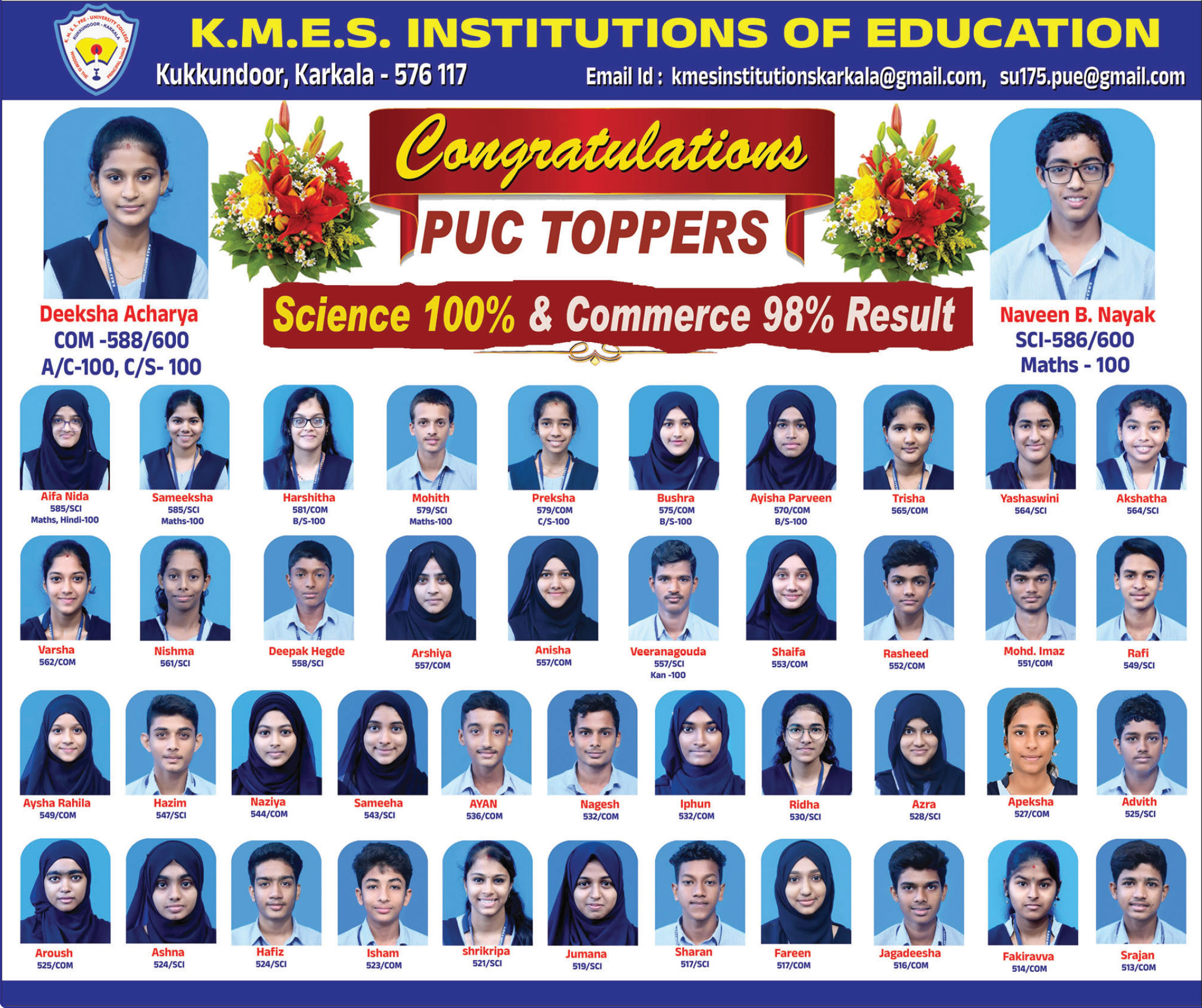
The institution also performed strongly in the PUC examinations. The Science stream recorded a 100 per cent result, with all 44 students passing, while Commerce secured a 98 per cent pass percentage.
Twelve students scored full marks in different subjects, including Mathematics.
In Commerce, Deeksha Acharya topped the college with 588 marks, while Harshitha H. Kini secured the second position with 581 marks.
In Science, Naveen B. Nayak emerged as topper with 586 marks, followed closely by Sameeksha Moily and Aifa Nidha, who both secured 585 marks.
Speaking about the achievement, High School head teacher Shrimati Patkar said the institution has always focused on supporting academically weak students through affordable education and free special classes.
“Our ambition is to provide quality education even to students who struggle in studies. The fees are very low, and free coaching classes are conducted. I have worked here for 28 years and have always found the atmosphere supportive of education,” she said.
Primary School head teacher Lolita Zeena D’Silva appreciated the dedication of the teaching staff and said the school encourages students not only to achieve high marks but also to become role models.
PU College Principal Balakrishna Rao said the institution focuses on value-based education and overall personality development.
“The aim is to help students succeed not only academically but also in cultural activities, sports and leadership. We encourage qualities such as patience, tolerance and discipline,” he said.
Rao also credited the institution’s growth to the support of founders K.S. Mohammed Masood and K.S. Nissar Ahmed, along with President K.S. Imtiaz Ahmed.
Speaking on the occasion, Imtiaz Ahmed said the institution was built on the dream of making quality education accessible to financially backward families in rural areas.
He said the guidance and encouragement of his elder brothers, Mohammed Masood and Nissar Ahmed, along with the contribution of teachers, students and parents, helped transform the institution into a model educational centre.
The KMES Institutions trace their roots back to 1984, when they were founded by senior social activists Haji P.M. Khan, K.S. Nazeer Ahmed and Haji A.S. Rashid Haider.
The institution initially functioned from the Government Urdu School premises as it did not have a building of its own. Classes began with only 22 students in lower kindergarten and two teachers.
Later, under the leadership of K.S. Mohammed Masood and with continuous financial and moral support from non-resident businessman K.S. Nissar Ahmed, the institution gradually expanded.
In 1993, the school shifted to its own building and began conducting classes from LKG to Class 5.
As student admissions increased, Nissar Ahmed personally funded the construction of three additional classrooms to address infrastructure shortages.
The institution’s new school building was completed in 1997, while the PU College building was constructed in 2001.
From humble beginnings in a borrowed building to producing state-level rank holders and consistent academic results, the KMES Institutions have grown into one of the prominent educational centres in the Karkala region.