Mamata continues sit-in for second successive day over Bengal voter roll deletions
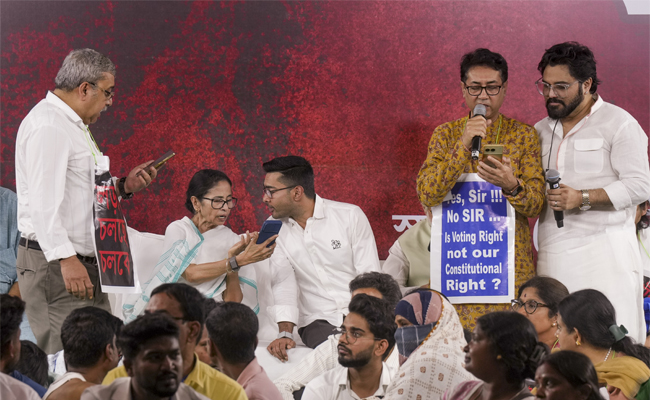
Kolkata (PTI): West Bengal Chief Minister Mamata Banerjee continued her protest against alleged arbitrary deletions in the post-SIR electoral rolls for the second consecutive day on Saturday, after she spent the night at the sit-in site here.
Banerjee had begun the demonstration at Metro Channel in central Kolkata on Friday, accusing the Election Commission of conspiring with the BJP to “disenfranchise Bengal voters” ahead of the upcoming assembly elections.
The chief minister stayed overnight at the protest site, surrounded by senior Trinamool Congress leaders, legislators and party workers, turning the busy Esplanade stretch into a makeshift political camp.
ALSO READ: Headmaster in J'khand's Garhwa suspended for dancing with students on 'vulgar' song
Addressing supporters on Friday afternoon, Banerjee alleged that large numbers of genuine voters were being removed from the electoral rolls under the Special Intensive Revision (SIR) exercise.
The CM also reiterated her claim that several voters had been "wrongly marked as dead” and said she would present such individuals before the media and the Election Commission to expose what she described as an "attempt to manipulate the voter list to help the BJP in the upcoming assembly polls".
Senior TMC leaders and state ministers remained present at the venue, while party supporters gathered at the protest site in the morning.
The protest comes just days before the full bench of the Election Commission is scheduled to visit West Bengal, amid rising political tensions over the voter list revision ahead of the assembly polls.
According to official data released on February 28, as many as 63.66 lakh names — around 8.3 per cent of the electorate — have been deleted since the SIR process began in November last year, reducing the voter base from about 7.66 crore to just over 7.04 crore.
In addition, over 60.06 lakh electors have been placed under the “under adjudication” category, meaning their eligibility will be determined through legal scrutiny in the coming weeks, a process that could further reshape constituency-level electoral equations.
নাগরিকদের ভোটাধিকার,
— Mamata Banerjee (@MamataOfficial) March 6, 2026
এই আমাদের অঙ্গীকার!
BJP has made it their life's mission to dismantle Babasaheb Ambedkar's Constitution brick by brick, tearing apart India's democratic fabric. Obsessed with their fascist fever dream of "One Nation, One Man, One Party," these… pic.twitter.com/vWeA5dVpVH
Let the Truth be known. If you read VB and like VB, please be a VB Supporter and Help us deliver the Truth to one and all.
ED raids in case against former Punjab Police DIG Bhullar, linked entities
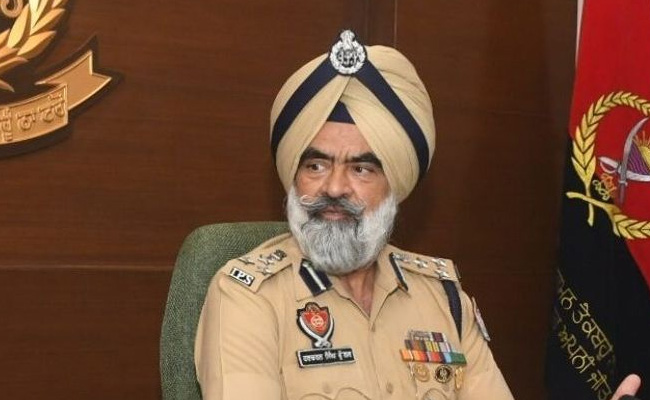
Chandigarh (PTI): The Enforcement Directorate on Monday conducted searches at multiple locations in Punjab as part of a money laundering probe against former state police DIG Harcharan Singh Bhullar and entities linked to him, officials said.
They said about 11 premises in Chandigarh, Ludhiana, Patiala, Nabha and Jalandhar linked to the accused, his associates and suspected benamidars (the owner in whose name a benami property is held) are being covered under the Prevention of Money Laundering Act (PMLA).
The Enforcement Directorate (ED) probe stems from a Central Bureau of Investigation (CBI) case registered against Bhullar on allegations that he sought illegal gratification through a middleman for settlement of a criminal case, along with detection of assets disproportionate to known sources of income.
The searches aim to trace further proceeds of the alleged crime, identify benami assets and gather evidence related to money laundering, ED officials said.
Bhullar, who was serving as the deputy inspector general (DIG) of police (Ropar Range), was arrested by the CBI in October 2025 after a scrap dealer alleged that bribe was demanded from him through an intermediary to settle a case.