Mamata visits injured BJP MP Khagen Murmu at Siliguri hospital, assures him of all help
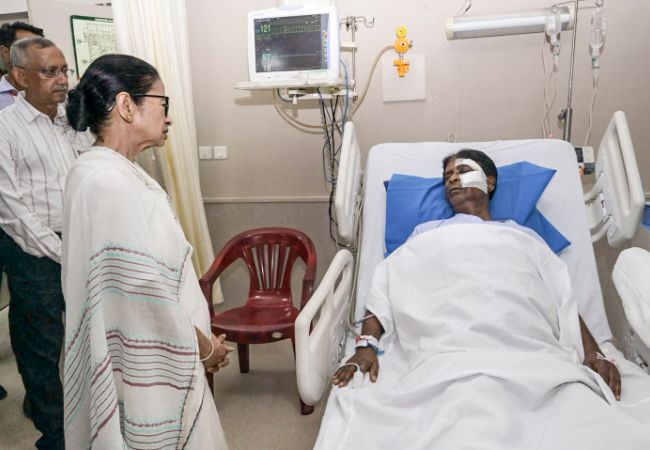
Siliguri (PTI): West Bengal Chief Minister Mamata Banerjee on Tuesday visited BJP MP Khagen Murmu at a private hospital in Siliguri, where he was undergoing treatment after being assaulted during a visit to flood and landslide-affected areas in the northern part of the state a day ago.
The CM's visit comes a day after a political storm erupted over the assault of two BJP leaders – Maldaha Uttar MP Khagen Murmu and Siliguri MLA Sankar Ghosh – at Nagrakarta in Jalpaiguri district in flood-ravaged north Bengal.
Banerjee spent a few minutes speaking to the injured MP, his wife, and son, before consulting the team of doctors attending to him.
According to sources, Banerjee enquired in details about the MP's condition, including his injuries and medications.
"Do you have diabetes? Are you taking insulin and medicines regularly?" she was heard asking Murmu.
Before leaving, the chief minister requested him to follow medical advice carefully and told his family that the government would extend all necessary help.
"If you need any assistance or further treatment elsewhere, please let me know," Banerjee reportedly said.
However, it was still not clear whether Banerjee met BJP MLA Sankar Ghosh, who is also admitted at the hospital.
Ghosh and Banerjee share an acrimonious relationship following several occasions of verbal duels on various issues on the floor of the assembly.
The West Bengal BJP welcomed the CM's gesture but wondered why not a single arrest has been made, even after 24 hours have passed since the incident.
"This was a courtesy visit. But it is really appalling that even after 24 hours have passed, the police have not made any arrest and the culprits, who assaulted Murmu and Ghosh, are roaming free," state BJP president Samik Bhattacharya said.
Leader of Opposition in the state assembly, Suvendu Adhikari, claimed that Murmu suffered facial injuries.
Speaking to reporters at the hospital, the BJP MLA said, "She visited one of the two injured but did not enquire how it happened. She is trying to shield her party workers who were involved in the attack."
"As Murmu has been advised not to speak due to serious facial injury, he could not pose relevant questions to her about the involvement of TMC workers and why no arrests have been made so far," he added.
Adhikari also dismissed the CM's claim that the BJP leaders had visited the spot in a convoy of 20 cars which infuriated locals.
He said the BJP leaders' convoy comprised not more than four-five cars and included central security forces, while both police and local panchayat officials had prior information about their visit and the number of vehicles.
The BJP leader said that as advised by members of the medical board of the hospital, Murmu will undergo treatment in the same private medical facility for another three weeks, while Ghosh will be discharged in one-two days.
A full-blown confrontation broke out on Monday between the Centre and the West Bengal government over the attack on Murmu and Ghosh by a mob.
Prime Minister Narendra Modi had on Monday night condemned the attack, terming it "outright appalling" and "reflective of the absolutely pathetic law and order situation" in the state.
Banerjee hit back, accusing the PM of "politicising a natural disaster", instead of standing by the people during their time of distress.
Torrential rain triggered flash floods and landslides in north Bengal, leaving 32 people dead and several missing.
Let the Truth be known. If you read VB and like VB, please be a VB Supporter and Help us deliver the Truth to one and all.
KKR defeat LSG via Super Over
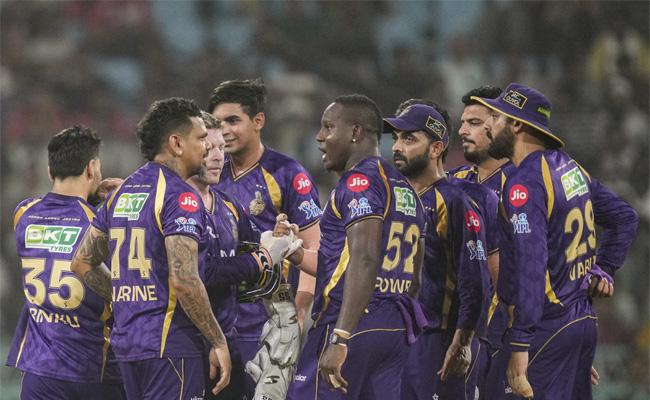
Lucknow (PTI): Kolkata Knight Riders edged Lucknow Super Giants via Super Overs in a battle between two bottom-placed teams in the IPL, here on Sunday.
Chasing a modest 156, LSG suffered a batting collapse and managed to tie the contest and take it to Super Over with No. 9 Mohammed Shami striking a last-ball six against a wayward Kartik Tyagi, who leaked 16 runs in the final over.
But Sunil Narine bowled a stunning Super Over conceding just one run and taking two wickets to give KKR an easy target.
Rinku Singh then finished the chase with a boundary off first ball from Prince Yadav.
Earlier the KKR were in deep trouble with 93/7 in 15 overs but Rinku smashed a sensational 83 not out from 51 balls including four sixes in a row in the final over to lift them to 155/7.
Cameron Green (34) was the only other batter to reach double-digit scores as KKR suffered a familiar batting meltdown with Mohsin taking his maiden fifer.
In reply, LSG continued their dismal show with the bat to succumb to their fifth loss in a row.
Brief Scores:
Kolkata Knight Riders 155/7; 20 overs (Rinku Singh 83 not out, Cameron Green 34; Mohsin Khan 5/23). Lucknow Super Giants 155/8; 20 overs (Rishabh Pant 42). KKR won via Super Over.