Mamata’s allegations on Bengal SIR baseless, exaggerated: BJP's Suvendu
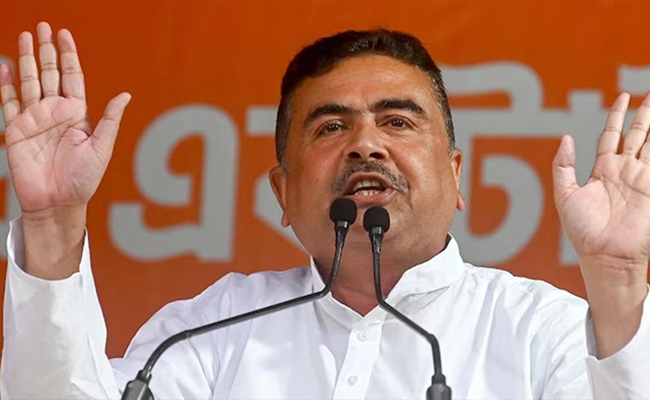
Kolkata (PTI): Leader of the Opposition in the West Bengal Assembly, Suvendu Adhikari, on Sunday termed Chief Minister Mamata Banerjee's allegations over the ongoing SIR in the state as "baseless and exaggerated", and accused her of trying to derail the electoral roll revision exercise for political reasons.
In a post on X, Adhikari also said he has written to Chief Election Commissioner Gyanesh Kumar, and claimed that the Special Intensive Revision (SIR) of the electoral rolls was "exposing the rot in the voter lists - bogus entries, duplicates, and infiltrators that have been nurtured under the TMC's watch for years".
The BJP leader alleged that the SIR exercise was "damaging the TMC's electoral prospects", and that's why the CM was resorting to hysteria".
Banerjee had on Saturday written to the CEC, alleging that the ongoing SIR of electoral rolls has been turned into an exercise to exclude voters rather than correct records.
In her third letter to Kumar since the beginning of SIR, the chief minister accused the Election Commission of "political bias, insensitivity, and high-handedness" during the exercise.
“I would again reiterate that her claims are nothing but a desperate attempt to derail this crucial process, which is exposing the rot in our voter lists - bogus entries, duplicates and infiltrators that have been nurtured under TMC’s watch for years,” Adhikari alleged in the post.
In his letter to the CEC, dated January 10, the leader of the opposition described the chief minister’s objections as a “politically motivated attempt” to obstruct the SIR and termed the ECI’s move as "essential to ensure free, fair and transparent" elections in the state.
"The chief minister’s portrayal of this exercise as ‘unplanned, insensitive and inhuman’ is nothing short of a gross exaggeration, blown out of proportion to create public hysteria and shift focus from her government’s failures," the BJP leader alleged.
He claimed that the SIR exercise had "exposed vulnerabilities in the electoral rolls that threatened the ruling party’s electoral prospects", triggering what he termed “unfounded outbursts” from the state administration.
On December 16, the Election Commission published the draft electoral rolls after the first phase of the SIR, with the electorate dropping from 7.66 crore to 7.08 crore following the deletion of over 58 lakh names.
The second phase, which began on December 27, involves hearings of 1.67 crore electors under scrutiny, including 1.36 crore flagged for logical discrepancies and 31 lakh whose records lack mapping.
The LoP urged the Election Commission to continue the voter list revision exercise with diligence, asserting that the SIR is a routine constitutional process and should not be politicised.
Let the Truth be known. If you read VB and like VB, please be a VB Supporter and Help us deliver the Truth to one and all.
4 workers die after being buried under coal slurry in Jharkhand's Dhanbad

Dhanbad (Jharkhand) (PTI): At least four workers died after being buried under coal slurry in Jharkhand's Dhanbad district on Saturday, a police official said.
The incident took place at Moonidih coal washery in the command area of Bharat Coking Coal Limited (BCCL).
"Bodies of all four workers were dug out of debris during a rescue operation," Putki police station in-charge Waqar Hussain told PTI.
The incident took place when coal slurry was being loaded into trucks by workers, during which a large chunk of slurry fell and trapped several workers underneath, officials said.
The deceased have been identified as Manik Bauri, Dinesh Bauri, Deepak Bauri, and Hemlal Gope.
Meanwhile, the family members of the deceased and local villagers placed the bodies in front of the washery gate and began a protest.
They demanded compensation, jobs for dependents and action against those responsible for the incident.
Police and administration officials are trying to pacify the protesters, an official said.