Man killed, body stored in ice-cream freezer in 'love triangle murder' in Tripura

Agartala (PTI): A 26-year-old man was allegedly murdered and his body stored in an ice-cream freezer in Tripura in a love triangle gone wrong, police said on Wednesday.
The victim was in a relationship with a 20-year-old woman. On the other side, the woman's cousin wanted to be with her, West Tripura's SP Kiran Kumar said.
The couple was not talking to each other after a recent fight, and the cousin got an inkling, he said.
He plotted a well-designed plan to kill the boyfriend, and invited him to the house of a relative in South Indiranagar in West Tripura on June 8, police said.
The cousin, who is an MBBS graduate from Bangladesh, strangulated him to death with the help of three other persons present there, they said.
Then they stuffed the body in a trolley bag. The next day, the cousin called his parents, who live in Gandacherra, to come to Agartala and take the trolley bag with them, police said.
"Accordingly, his parents came to Agartala with a car and took the trolley bag to Gandacherra. They concealed the body in an ice-cream freezer in their shop," the SP said.
The cousin wanted to physically exploit the woman, who recently lost her father. He knew that he couldn't do that till the boyfriend was in the scene, so he conspired to kill him, he said.
The accused was a frequent visitor to the woman's house in Bankumari in the East Agartala police station area, he added.
Police began an investigation after the victim's family lodged a missing person's complaint, and the cousin was the first person to be arrested, the officer said.
"Based on his confession, the body of the victim was retrieved from the freezer on Wednesday. After a post-mortem examination, the body was handed over to the victim's family," he said.
A total of six persons, including the cousin's parents, were arrested, Kumar said.
Let the Truth be known. If you read VB and like VB, please be a VB Supporter and Help us deliver the Truth to one and all.
SC to hear on May 4 PIL seeking stringent guidelines for issuing Aadhaar to adolescents, adults
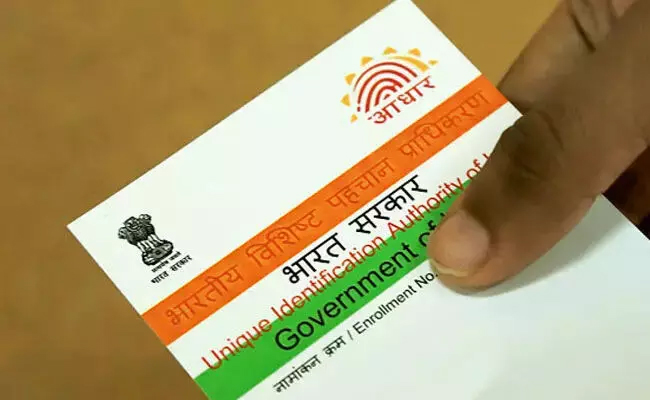
New Delhi (PTI): The Supreme Court is scheduled to hear on Monday a plea seeking a direction to the Unique Identification Authority of India to issue new Aadhaar cards only to citizens up to the age of six years, and frame stringent guidelines for its issuance to adolescents and adults to stop infiltrators from masquerading as Indian citizens.
As per the apex court's causelist of May 4, the plea would come up for hearing before a bench of Chief Justice Surya Kant and Justice Joymalya Bagchi.
The Public Interest Litigation (PIL) filed by lawyer Ashwini Upadhyay has also sought a direction to the authorities to install display boards at common service centres stating that the 12-digit unique identification number is only a "proof of identity" and not a proof of citizenship, address or date of birth.
Besides all the states and Union Territories, the plea has made the UIDAI -- which is the authority that issues Aadhaar -- and the Union ministries of home, law and justice, and electronics and information technology as parties.
The plea, filed through advocate Ashwani Dubey, said Aadhaar, originally intended as a proof of identity, has increasingly become a "foundational document" enabling individuals to obtain other identification documents, such as ration cards, domicile certificates and voter identity cards.
"The UIDAI has issued 144 crore Aadhaar and 99 percent Indians have been enrolled. Therefore, the petitioner is filing this writ petition as a PIL under Article 32, seeking a direction to UIDAI to issue new Aadhaar to children only and frame new stringent guidelines for adolescents and adults, so as to stop infiltrators from getting it and masquerading as Indian citizens," the plea said.
It said the need to file the plea arose when the petitioner came to know the manner in which infiltrators are able to procure Aadhaar through a verification process that is weak and can be easily manipulated.
"Foreigners apply for Aadhaar under the 'foreign' category. But infiltrators apply for Aadhaar under the 'Indian citizen' category and get it easily made. Thereafter, they obtain a ration card, birth and domicile certificate, driving licence, et cetera, essentially becoming indistinguishable from Indian citizens…," it said.
Besides seeking other directions, the plea has raised legal questions, including whether the Aadhaar Act 2016 has become "temporally unreasonable" for failing to keep up with the legislative intent of distinguishing foreigners from Indian citizens.
It said the alleged misuse of Aadhaar undermines targeted welfare delivery and leads to diversion of public resources.