
Man requests for wedding certificate, asks to marry once more

Thiruvananthapuram, July 11: A joke proved costly for four employees at a Kerala marriage registrar office after they refused to hand a man his wedding certificate and instead asked him to marry once more.
State Registration Minister G.Sudhakaran suspended all four government employees from his department for "misbehaviour and dereliction of duty".
In a Facebook post on Thursday, Sudhakaran said when he came to know about this man''s predicament he could not take the "nonsense" and ordered the suspension.
Madhusoodhan had walked into the Sub-Registrar's office at Mukkam in Kozhikode seeking an attested marriage certificate 16 years after he got married. He was first made fun of and then made to wait for several days. The document was supposed to be made available on the same day as the request.
"Madhusoodhan had married under the provisions of the Special Marriage Act on February 27, 2003. He needed his certificate on June 19 and had requested for an attested copy of his marriage certificate.
"Instead of doing that, the officials there made fun of him," the Minister said in his social media post.
They asked him to marry once again, so they could quickly issue a marriage certificate, as they did not want to look up the old records, said Sudhakaran.
The minister further noted that when this certificate could have been given then and there, he was asked to wait for three days and also had to suffer the humiliation.
"When this person expressed his displeasure on social media, it came to my notice, I asked a top official in the Registration Department to probe the issue and submit a report.
Following which, "I decided to suspend four employees in the Mukkom office Devi Prasad, Sivaraman Nair, T.K.Mohandas and P.B.Rejish and have also ordered for further probe to find out if these people are fit to be in government service," noted Sudhakaran.
Let the Truth be known. If you read VB and like VB, please be a VB Supporter and Help us deliver the Truth to one and all.
Mission operations key to space success: ISRO chief Narayanan
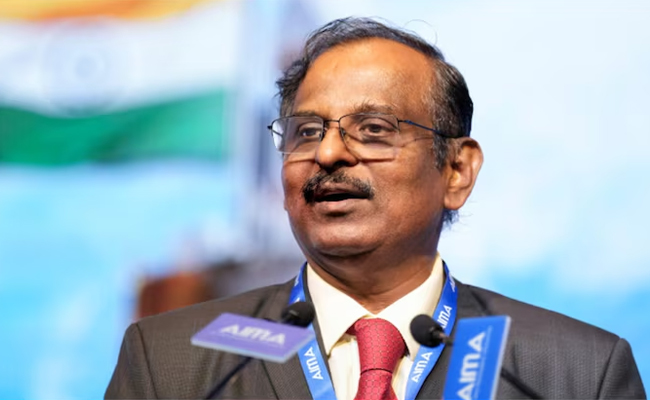
Bengaluru, Apr 8 (PTI): ISRO Chairman V Narayanan on Wednesday highlighted the importance of mission operations in ensuring success, calling it key to India’s expanding space programme.
He was addressing a gathering of scientists, industry experts, and students at the three-day international conference on Spacecraft Mission Operations (SMOPS-2026), themed 'Innovative Operations for Smart and Sustainable Space Mission Management–Next Generation'.
"Mission operations are crucial, especially for long-duration ones. This is an important domain," Narayanan said.
Welcoming delegates from leading global space agencies, including Roscosmos, the Japan Aerospace Exploration Agency (JAXA), the European Space Agency (ESA), and the French space agency, Centre National d'Études Spatiales (CNES), the ISRO chief said the conference marked a significant milestone, as it brought together international expertise, startups, and the broader space ecosystem on a common platform.
"This is not just another conference—it is quite a major global gathering with participation from many countries, experts, startups, and ecosystem partners," he said.
Narayanan pointed to the successful Chandrayaan-3 mission, noting that the "historic landing" near the Moon’s south pole was the outcome of sustained teamwork and operational precision.
He credited the leadership and continuous involvement of senior scientists in mission control, saying their contribution remained indispensable during key phases.
The ISRO chief also recalled the challenges faced after the Chandrayaan-2 mission and said the subsequent success demonstrated India’s technological resilience.
"After the partial setback of Chandrayaan-2, Chandrayaan-3 had to be perfect," he said, adding that the achievement had earned global recognition.
Tracing the evolution of India’s space programme since its inception in 1962, Narayanan said the country has accomplished a wide spectrum of missions spanning launch vehicles, scientific exploration, and satellite operations.
He added that while rockets operate for a brief duration, spacecraft require continuous monitoring and control over several years.
"While a rocket functions only for about 15 to 25 minutes, it must generate tremendous energy to place the spacecraft into orbit. However, the spacecraft itself must operate for years—sometimes from two to 15 years," he said.
The ISRO chairman said even minor errors in command execution could jeopardise an entire mission, and commended engineers, software teams, and planners for their role in sustaining mission health.
Narayanan stressed the importance of emerging technologies such as artificial intelligence and cloud-based systems in transforming mission operations.
He also cited key milestones achieved since the previous conference, including space docking experiments, the Chandrayaan-3 mission, and the Aditya-L1 solar mission, noting that each required advanced operational strategies.
On human spaceflight, he described the Gaganyaan programme as a "defining step" for India’s ambitions.
He added that preparations were progressing towards the first uncrewed mission.
Speaking to reporters later, Narayanan reiterated the long-term nature of mission operations and its significance across mission lifecycles.
"A launch vehicle works only for about 20 to 25 minutes, but mission operations must continue for a long time," he added.
Narayanan explained that communication satellites require continuous monitoring for up to 15 years, while interplanetary missions demand sustained operational control over several months.
He said the SMOPS-2026 conference would focus extensively on advancements in this domain.
"Around 400-plus papers will be presented and discussed. This will be useful for the student community, startup companies, and engineers working in this field," the ISRO chief said.
Responding to queries on the Gaganyaan programme timeline, Narayanan said ISRO was proceeding in a phased manner.
"Before proceeding with the crewed mission, three uncrewed missions are planned. At present, we are working on the first uncrewed mission," he said.
Narayanan said further details would be announced at an appropriate time. On the challenges involved, he pointed to the complexities of developing human-rated systems and integrating numerous technologies.
"We have to human-rate the launch vehicle. There are also many new developments involved, such as the crew escape system, environmental control and life-support systems, and the interface between humans, machines, and software," he said.
Narayanan described the programme as a "coordinated national effort" involving multiple laboratories.
When asked about the procurement of critical systems, he said, "The process is underway."

_vb_29.jpeg)
_vb_72.jpeg)