Manipur govt urges Centre to withdraw AFSPA
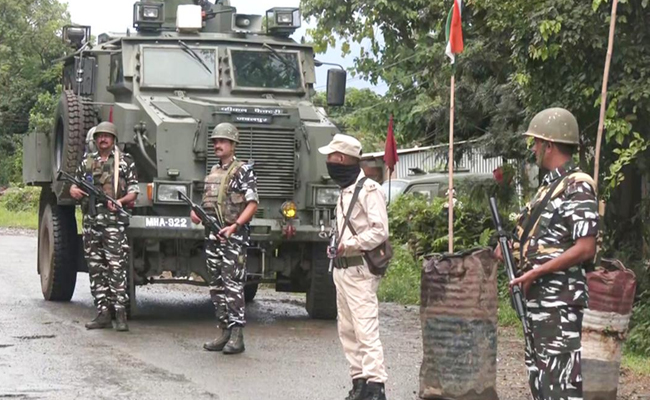
Imphal (PTI): The Manipur government has requested the Centre to review and withdraw AFSPA from areas falling under the jurisdiction of six police stations in the state, an official said.
The Centre has reimposed the Armed Forces (Special Powers) Act, 1958 in Manipur's six police station areas, including violence-hit Jiribam.
A letter from the Joint Secretary (Home) to the Centre on Saturday, mentioned that "the state cabinet has deliberated upon the same (reimposition of AFSPA) in its meeting held on November 15 and has decided to recommend to the central government to review and withdraw the said declaration of areas falling under the jurisdiction of six police stations in the state as disturbed areas under Section 3 of AFSPA 1958."
"It is accordingly requested to kindly review and withdraw the notification dated 14-11-2024 in public interest," it said.
The Ministry of Home Affairs had on November 14 reimposed AFSPA in areas falling under Sekmai PS and Lamsang PS in Imphal West district, Lamlai in Imphal East, Moirang in Bishnupur, Leimakhong in Kangpokpi and Jiribam in Jiribam district.
Let the Truth be known. If you read VB and like VB, please be a VB Supporter and Help us deliver the Truth to one and all.
UP man gets life term for electrocuting mentally challenged wife to death in Bareilly

Bareilly (UP) (PTI): A local court here has sentenced a man to life imprisonment for murdering his mentally challenged wife by repeatedly electrocuting her while she was tied to a cot, lawyers said on Thursday.
Additional district government counsel Harendra Singh Rathore said Additional Sessions Judge Avinash Kumar Singh on Wednesday convicted Vinod Kumar (45) for killing his wife, Satyavati, in Chaina village of Bareilly district and imposed a fine of Rs 15,000 on him.
According to the prosecution, he was allegedly frustrated with his wife Satyavati's mental illness and often assaulted her.
Rathore said the prosecution examined nine witnesses to establish the charges against him.
As per court records, on the night of May 1-2, 2022, when Satyavati was asleep, Vinod tied her hands and legs to a cot using ropes and then connected an aluminium cable to an electric board to repeatedly administer electric shocks to her.
"She writhed in pain, but the accused continued to electrocute her until she died," the prosecution said.
The court observed that the murder was carried out in an inhuman manner.
After committing the crime, the accused threw the rope and cable on the roof and left for work at a brick kiln around 2 am to create a false alibi.
He later tried to mislead the police and the victim's family by claiming that Satyavati, whose mental condition was unstable, had accidentally died by suicide after grabbing a live electric wire.
However, the victim's brother, Sanjeev, a resident of Shahjahanpur district, suspected foul play and lodged an FIR under sections 498A (husband subjecting wife to cruelty) and 302 (murder) of the Indian Penal Code at Nawabganj police station.
During the trial, the prosecution relied on the post-mortem report prepared by Dr Faraz Anwar, who stated that multiple electrocution marks found on different parts of the victim's body could not have been self-inflicted.
The police also recovered the rope and electric wire used in the crime on the accused's identification, officials said.