Manmohan Singh 'tried very hard' to establish 'some kind of peace' with Pakistan: Former deputy NSA
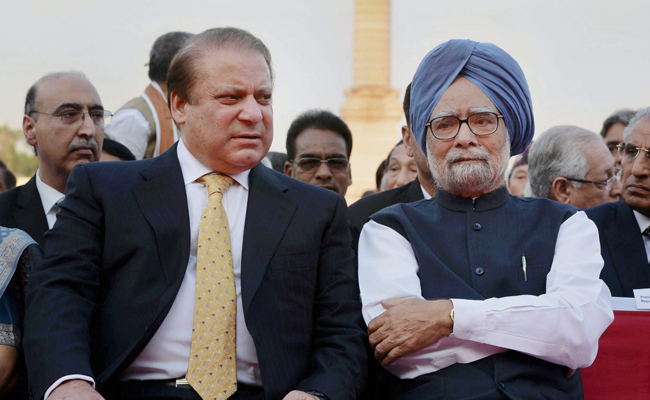
New Delhi (PTI): During his tenure as prime minister, Manmohan Singh "tried very hard" to establish "some kind of peace" with Pakistan but it didn't work, former deputy NSA and his then-close aide Pankaj Saran said.
Singh, the architect of India's economic reforms, died here at the age of 92 late on Thursday.
Saran on Thursday termed Singh's passing as "very unfortunate", and described him as an intellectual, an economist of world standing, but also a "man who symbolised humility".
He was a consensus builder, a very simple man, "never expected to be a prime minister, but he served for 10 years," the former deputy National Security Advisor (NSA) recalled.
Saran, a 1982-batch IFS officer, had served as India's envoy to Russia. He had also held various positions in India and abroad, including the country's high commissioner to Bangladesh.
He was appointed deputy NSA in 2018.
"He (Manmohan Singh) was always a great listener, intellectual, an economist of world standing, widely respected. He was the first (Indian) prime minister at the start of the G20 Summit in 2008, and he developed a very high reputation among the global leaders, whose understanding of economics... All in all, I would say, a very fine person, a great human being, both in his personal life and officially," Saran told PTI Videos.
Singh greatly believed that India's future "lay in good relations with the West", the former diplomat said.
"Among the neighbours, he tried very hard to establish some kind of peace with Pakistan but it didn't work. But he tried and he was very disappointed that his efforts did not succeed. In fact, they were rebuffed with the 26/11 Mumbai attacks in 2008 when he was prime minister, and that really shook him up very badly," he recalled.
Singh also made greater outreach to the Gulf and he visited Saudi Arabia, one of the first prime ministers to do so, Saran added.
The veteran diplomat said he felt that Singh "gave India a very good image overseas of someone who was deeply committed to the country... building the country".
"After all, he was also the shaper of the economic reforms that began in 1991. He was the architect of those reforms, he was deeply committed to the growth of the Indian economy. In the foreign policy field, I think he will go down in history as the leader who changed the paradigm of India-US relations with his success of the nuclear deal with the US," he said.
"So, both on economic policy and foreign policy, he made a mark, as someone who was respected, but as an individual very understated, very simple man, willing to learn, willing to read, willing to understand," Saran said.
"He never tried to assert himself or shut down contrary opinions. I think he was one of the greats of the non-family Congress, and serving as prime minister for 10 years, outside of the family, was a huge achievement," he said.
Let the Truth be known. If you read VB and like VB, please be a VB Supporter and Help us deliver the Truth to one and all.
Air India resorts to cost-cutting ways amid 'tough times'; layoffs not anticipated
New Delhi/Mumbai (PTI): Hit hard by Pakistan airspace closure and Iran war, Air India has resorted to cost-cutting measures, including holding back annual increments for staff and asking them to cut discretionary spending as well as non-critical expenditures, warning of "tough times".
On Friday, Air India Chief Executive Officer & Managing Director (CEO & MD) Campbell Wilson told the staff it is going to be a "very, very difficult year" if things don't improve on the Middle East front.
A day after the loss-making airline's board discussed various cost-saving steps, Wilson, along with Chief Financial Officer (CFO) Sanjay Sharma and Chief Human Resources Officer (CHRO) Ravindra Kumar GP, addressed the employees during a townhall on Friday where the emphasis on the need to keep a close watch on costs.
With higher jet fuel prices due to the West Asia conflict and airspace curbs, the loss-making airline's expenses have spiralled in recent times and against this backdrop, Sharma also told staffers that FY26 has seen a softening in revenue amid heightened external uncertainties.
Calling for a relentless focus on costs in these tough times, Wilson urged employees to suspend discretionary spending, renegotiate rates where feasible, and defer non-critical expenditures.
"There must be a laser-sharp focus on eliminating wastage and leakages," he said.
Stressing the need to tighten the belt for a while, Wilson sounded optimistic that travel demand would rebound and the industry would continue on its upward path.
CHRO Ravindra Kumar told staff that the airline will proceed with variable pay for the last financial year and continue with planned promotions while noting that annual increments will be deferred by at least one quarter.
"We don't anticipate layoffs," he said.
At the airline's board meeting on Thursday, various cost-saving steps, including likely furloughs, were discussed. The Tata Group-owned airline has around 24,000 employees.
Generally, furlough refers to sending staff on unpaid leaves by companies during a tough financial situation.
During the townhall, CFO Sanjay Sharma said while strong revenue growth and fleet expansion drove financial momentum through FY25, FY26 has seen a softening in revenue amid heightened external uncertainties.
Air India has seen around 40 per cent CAGR (Compounded Annual Growth Rate) in revenue between 2022 and 2025, he added.
The airline was acquired by the Tata Group from the government in January 2022.
The Air India CEO mentioned the external challenges being facing the aviation industry as a whole, including the continued closure of Pakistan airspace that is expected to persist for the foreseeable future and geopolitical conflicts leading to disruptions and airspace closures across West Asia.
Wilson, who is set to step down later this year, also flagged a sharp depreciation of the rupee and a 2.5-3 times increase in jet fuel prices, and added that these factors have adversely affected travel sentiment and consumer confidence, as per the sources.
If the Strait of Hormuz opens, oil prices fall and consumer as well as business confidence come back, there is a decent chance of a solid recovery, Wilson said, adding that unless those circumstances happen, it was going to be "a very, very difficult year".
"I feel somewhat responsible that we ended up with probably the biggest surprise of the year in the external environment which was a full-scale war in our neighbouring region in the Gulf. That has had a huge impact on airspace," he said.
For Air India, Wilson said the situation is compounded by the fact that the airline cannot fly over the neighbouring country and has to take a much longer routing for any west-bound destination.
"Every airline is reporting that they are under some sort of financial pressure as a result of higher fuel prices and economic uncertainty. So, it is unfortunately not a great environment to be running an airline," the Air India CEO said.
The Air India Group -- Air India and Air India Express -- is projected to have incurred more than Rs 22,000 crore loss in the financial year ended March 2026.
At the townhall, Wilson also highlighted various initiatives, including completion of the retrofit of its legacy narrow-body aircraft and rapid network optimisation to redeploy capacity more efficiently.