Many firsts at R-Day Parade: Bhairav Battalion, Suryastra, 61 Cavalry in combat gear
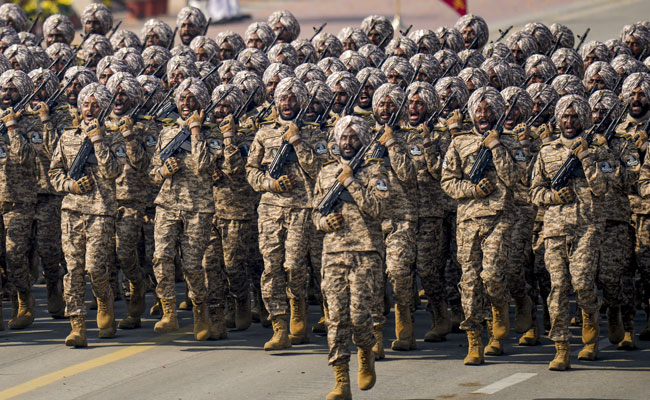
New Delhi (PTI): Newly raised Bhairav light commando battalion and Shaktiban Regiment, rocket launcher system 'Suryastra' with deep-strike capabilities, and key military assets, including indigenous platforms accompanied with personnel, rolling down the Kartavya Path in a "phased battle array formation" -- the 77th Republic Day Parade saw many firsts.
Double-humped Bactrian camels and Zanskar ponies were also part of the ceremonial event for the first time, adding an element of curiosity and excitement among the crowds.
Also, marking a first, the contingent members of the mounted 61 Cavalry were seen in battle gear during the parade.
The 61 Cavalry, known for its imposing presence as its members wear ceremonial uniform and a striking headgear, has traditionally been the leading contingent of the armed forces in the ceremonial parade.
Capt Ahaan Kumar, 26, a third-generation officer, who led the iconic contingent, an honour he had in the 2025 parade as well, returned to Kartvaya Path, along with his charger 'Ranveer', a Hanoverian breed, as the contingent commander thus year as well, albeit in a combat gear.
"For me, leading this historic contingent in a ceremonial uniform gives much greater joy than I had doing it in a combat gear, but yes, it felt very different in this year's parade," he told PTI, after the parade.
The Republic Day Parade also saw many other firsts this time.
A mixed scouts contingent seen in their heavy thermal gear in an operational role, were also part of the parade for the first time, the officials said.
For Lt Amit Choudhary, a second-generation army officer, who led this contingent in the parade, it was both be a personal milestone and a nostalgic nod to his father who was part of the ceremonial parade in 1990.
Dressed up in characteristic multi-layer suits teamed with special boots and polarised sunglasses meant for high terrain and harsh weather, he and his contingent members drew loud cheers from the crowd, as they marched along the Kartavya Path.
The young officer, a resident of Jammu and Kashmir, is currently serving in 2 Arunachal Scouts of the Assam Regiment.
The mixed scouts contingent had members drawn from Ladakh Scouts, Dogra Scouts, Arunachal Scouts, Kumaon Scouts, Garhwal Scouts, and Sikkim Scouts.
The parade also see the debut of the Shaktiban Regiment, which has been set up in the artillery, to boost the Army's firepower capabilities.
The newly raised regiment will be equipped with a drone, counter-drone and loiter munition.
Bhairav light commando battalion had also made its Army Day Parade debut on January 15 in Jaipur. The battalion was raised around October last year.
A Bhairav Battalion of the Sikh Light Infantry regiment took part in the January 26 parade in the national capital.
Bhairav Battalion is a specialised assault infantry unit, bridging the capabilities of conventional infantry and special forces.
"Designed for rapid response and high-intensity operations, it serves as as the first responder on the battlefield," a defence ministry official said.
They embody the ethos of 'Sant Sipahi', fierce in battle yet spiritually composed.
The name 'Bhairav', inspired by the fierce and protective manifestations of Lord Shiva, symbolises "controlled aggression, invincibility and righteous power," the official said.
Other key defence assets showcased during the parade included BrahMos, Akash missile system, Medium Range Surface-to-Air Missile (MRSAM) system, Advanced Towed Artillery Gun System (ATAGS), Dhanush artillery gun, and a static display of some drones.
The Defence Research and Development Organisation (DRDO) showcased its Long Range Anti-Ship Hypersonic Missile (LR-AShM), a hypersonic glide missile capable of engaging static and moving targets, designed to carry various payloads.
Captain Harshita Raghav, who led the Remount Veterinary Corps (RVC) contingent, said the contingent also included raptors (kites) and a few Army dogs.
"These animals are soldiers of the Indian Army only. In fact, they are the silent warriors, making them operationally ready, and understanding the requirements of operations from these animals are two very important aspects. They are true force multipliers of the Indian Army," she told PTI.
Eighteen marching contingents and 13 bands took part in the parade that lasted around 90 minutes.
The dominant theme of this year's parade was 150 years of 'Vande Mataram'.
Let the Truth be known. If you read VB and like VB, please be a VB Supporter and Help us deliver the Truth to one and all.
Bridge portion collapses on Jammu outskirts; 3-4 labourers feared trapped, 1 rescued
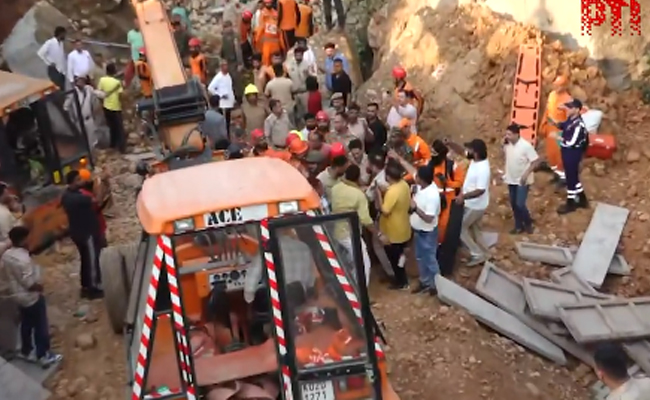
Jammu (PTI): A portion of a small bridge collapsed in the Bantalab area on the outskirts of Jammu city on Friday, trapping at least three to four labourers under the debris, while one injured worker was rescued, official sources said.
Authorities have closed the road link following the collapse of the portion of the bridge.
The incident occurred when labourers were carrying out repair work on a retaining wall near the bridge that was damaged in last year's flash floods, the sources said.
According to the sources, a section of the bridge suddenly gave way, burying workers engaged at the site under the rubble.
Police, Army and State Disaster Response Force (SDRF) teams launched rescue operations to extricate those buried under the debris. They pulled out one injured labourer and shifted him to a hospital, the sources said.
Family members of the labourers present at the site said around six workers engaged at the site at the time of the incident came under the debris when the structure collapsed. The family members said while two of the labourers managed to escape, four got trapped.
The sources said those trapped included the husband of a woman labourer, a mason, an unmarried labourer and a relative of the contractor.
There was no official confirmation on the exact number of persons trapped under the debris till the filing of this report.
The rescue operations are ongoing.