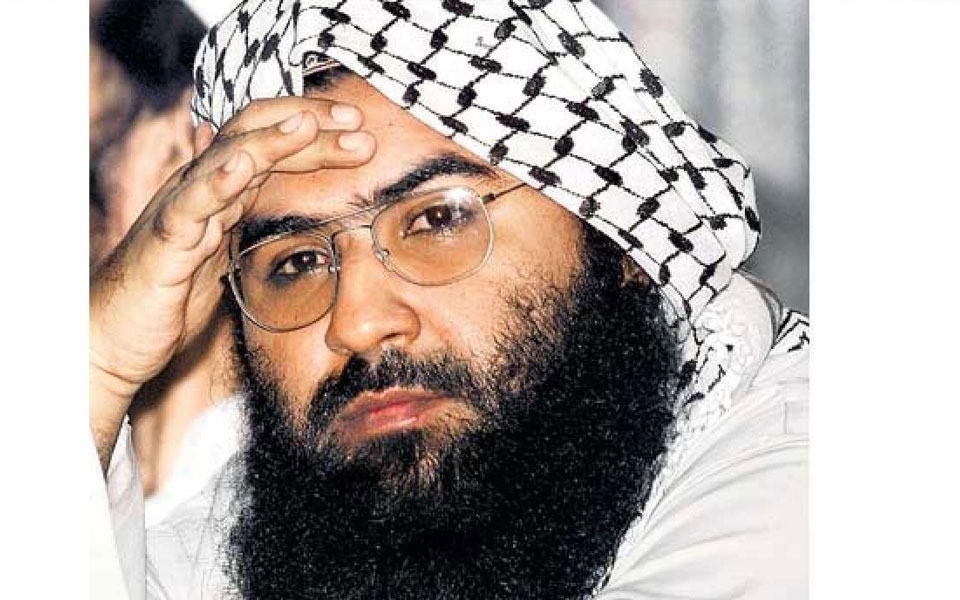
New Delhi : Massod Azhar, the founder of the dreaded terrorist group Jaish-e-Mohammad (JeM), is suspected to be afflicted with renal failure and is under regular dialysis at an army hospital in Rawalpindi in Pakistan, officials said here Saturday.

This suggestion of security officials came after Pakistan Foreign Minister Shah Mahmood Qureshi said the JeM chief is "unwell".

"Recent reports indicate that Masood Azhar is now afflicted with renal failure and is under treatment and regular dialysis at the army hospital in Rawalpindi, the headquarters of the Pakistan Army," a senior security official said.

Qureshi said Thursday: "He is in Pakistan, according to my information. He is unwell to the extent that he can't leave his house, because he's really unwell".

The Jaish-e-Mohammad chief was a close associate of Osama bin Laden, terror motivator in several African countries and also known by many as the Pakistani cleric who brought jihad into the religious discourse at mosques in the UK, the official said.

The influence of the 50-year-old overweight terrorist mastermind was so huge that, when he was released by India in exchange for freeing the hijacked Indian Airlines aircraft IC-814 on December 31, 1999 in Kandahar, Laden hosted a banquet for him the same night.

In the banquet, Laden recalled how he and Azhar had first worked together in 1993, the official said.

Azhar was arrested for preaching jihad in Jammu and Kashmir in 1994. One of his British recruits, Omar Shaikh, as a member of the terrorist group Harkat-ul-Ansar (HuA), kidnapped four western tourists in India in 1994 in order to secure the release of Azhar.

However, security agencies succeeded in releasing the hostages and arresting Shaikh.

Again in 1995, five western tourists were kidnapped by HuA and eventually killed in order to gain the release of Azhar.

Almost immediately after Azhar's release, Jaish-e-Mohammad was formed and it carried out its first suicide attack in Jammu and Kashmir in April 2000 by striking the Badami Bagh cantonment in Srinagar.

The 24-year-old bomber, Asif Sadiq, was one of Azhar's earliest recruits and student from Birmingham. At this time, Azhar also began using several al-Qaeda recruits, another official said.

In 1979-1989, after he suffered injuries in the Soviet Afghan War, he was chosen as the head of Harkat-ul-Ansar's department of motivation.

In the early 1990s, Azhar became the general secretary of Harkat-ul-Ansar and visited international locations to recruit, raise funds and spread the message of pan-Islamism.

Among his destinations were Zambia, Abu Dhabi, Saudi Arabia, Mongolia, the United Kingdom and Albania, the second official said.

He also went to Kenya to meet an al-Qaida affiliate of Somalia in 1993 and in August 1993, Azhar entered the UK for a speaking, fund-raising, and recruitment tour with the message of jihad.

Azhar made contacts in Britain with people who helped to provide training and logistical support for terrorist plots. In January 1993, Azhar visited Bangladesh along with Sajjad Afghani, a terrorist leader to facilitate the intrusion of Afghani to India.

Azhar was part of Harkat-ul-Mujahideen or Harkat-ul-Ansar, when he was arrested in 1994 in India for spreading hate. Azhar formed Jaish-e-Mohammad after his release in 1999 when Indian Airlines flight IC 814 was hijacked and taken to Kandahar.

Since then, the JeM has been involved in terror attacks in the country.

The terror group was responsible for the attack on Indian Parliament on December 13, 2001 in which nine security personnel and officials were killed.

On January 2, 2016, a heavily armed group of JeM attacked the Pathankot airbase in which seven security personnel were killed. The JeM also carried out the attack on Uri brigade headquarters on September 18, 2016, killing 17 soldiers and injuring 30 others.

On February 14 this year, the JeM carried out a suicide attack on a CRPF bus in Pulwama in Jammu and Kashmir killing 40 Jawans.

Let the Truth be known. If you read VB and like VB, please be a VB Supporter and Help us deliver the Truth to one and all.


Dubai, Mar 26 (AP): US President Donald Trump said Wednesday that a deal to end the Iran war is near, after Tehran dismissed his 15-point ceasefire plan and issued its own sweeping demands to stop fighting as it launched more attacks on Israel and Gulf Arab countries.

Two officials from Pakistan described the 15-point US proposal broadly, saying it included sanctions relief, a rollback of Iran's nuclear programme, limits on missiles and reopening the Strait of Hormuz, through which a fifth of the world's oil is normally shipped.

Iran issued its own plan via state TV, which includes a halt to killings of its officials, means to make sure no other war is waged against it, reparations for the war, the end of hostilities, and Iran's sovereignty over the Strait of Hormuz.

“No negotiations have happened with the enemy until now, and we do not plan on any negotiations,” Iran's foreign minister later told state TV.

Trump insisted at a Republican fundraiser Wednesday night that talks were underway with Iran's leaders.

ALSO READ: Iranian military mocks Trump's claim of US-Iran negotiations

“They are negotiating, by the way, and they want to make a deal so badly, but they're afraid to say it because they figure they'll be killed by their own people,” Trump said.

The death toll from the war has risen to more than 1,500 people in Iran, nearly 1,100 people in Lebanon, 20 in Israel and 13 US military members, as well as a number of civilians on land and sea in the Gulf region.

Millions of people in Lebanon and Iran have been displaced.


Here is the latest:

Iran's parliament working on bill to impose fees on ships in Strait of Hormuz

Iran's parliament is working on a bill to formalise the fees it is reportedly charging on some ship transiting through the Strait of Hormuz, local media reported.

ALSO READ: Pakistan ‘relaying messages’ between Iran and US for peace in West Asia: official

The Fars and Tasnim news agencies, both close to Iran's Revolutionary Guard, quoted lawmaker Mohammadreza Rezaei Kouchi as saying that “parliament is pursuing a plan to formally codify Iran's sovereignty, control and oversight over the Strait of Hormuz, while also creating a source of revenue through the collection of fees”.

“This is entirely natural, just as goods pay transit fees when passing through other corridors, the Strait of Hormuz is also a corridor,” he reportedly said.

“We provide its security, and it is natural that ships and oil tankers should pay such fees.”

The Strait of Hormuz, the narrow mouth of the Persian Gulf, is considered an international waterway open to all shipping.

Imposing fees would end that and likely be strongly opposed by the Gulf Arab states, the United States and others.

 ALSO READ: Indian deputy chief of mission meets lawmakers; India-US ties discussed

Emirati oil executive calls Iran's chokehold on the Strait of Hormuz economic terrorism

The comment by Sultan al-Jaber, who leads the massive state-run Abu Dhabi National Oil Co., signalled the hardening rhetoric of the United Arab Emirates as the war nears its one-month mark.

“Weaponising the Strait of Hormuz is not an act of aggression against one nation,” al-Jaber said in a speech for an event hosted by the Middle East Institute in Washington.

“It is economic terrorism against every consumer, every family that depends on affordable energy and food. When Iran holds Hormuz hostage, every nation pays the ransom, at the gas pump, at the grocery store and at the pharmacy. No country can be allowed to destabilise the global economy in this way. Not now. Not ever.”


Sirens sound in central Israel

Sirens sounded about an hour after sunrise across a large swath of central Israel, including areas around Tel Aviv and Jerusalem, and in the occupied West Bank.

ALSO READ: Philippines president declares national energy emergency amid global fuel supply risks

Israel's military said early Thursday morning that Iran had launched missiles toward the country.

The first such alert of the day came after an unusually long lull of more than 14 hours.

Hezbollah rocket fire, however, remained constant overnight in northern Israel, and once reached the Tel Aviv area overnight.


Iran running a toll booth' regime in Strait of Hormuz, experts say

Iran is running a “de facto toll booth' regime” in Strait of Hormuz, controlling which ships come through and getting payment for their safe passage, a leading shipping intelligence firm said Thursday.

Lloyd's List Intelligence published an analysis highlighting Iran's practices through the strait.

It described vessels having to provide manifests, crew details and their destination to Iran's paramilitary Revolutionary Guard.

The information goes to the Guard's “Hormozgan Provincial Command for sanctions screening, cargo alignment checks that currently prioritises oil over all other commodities, and for what is described as geopolitical vetting”, Lloyd's List said.

“While not all ships are paying a direct toll at least two vessels have and the payment is settled in yuan,” Lloyd's List said, referring to China's national currency.

Such payments likely would run afoul of American and European sanctions on the Guard, a key power centre within Iran that controls its ballistic missile arsenal and was key in suppressing nationwide protests in January.

Iran has not directly explained the process for ships to go through the strait, though a Foreign Ministry spokesperson appeared to acknowledge Tehran was receiving payments for some ships in an interview.


Fuel prices surge in Thailand

Fuel prices in Thailand surged Thursday after the government lifted a cap on diesel prices and reduced fuel subsidies.

The majority of fuel types rose by 6 baht (USD 0.18) per litre. Diesel prices jumped by about 18 per cent.

The increase is expected to hit the industrial and transportation sectors particularly hard and has raised concerns about a ripple effect on the cost of goods.

Videos and photos shared on social media showed long lines forming at gas stations after the price hike was announced late Wednesday night.

Thai Prime Minister Anutin Charnvirakul said earlier this week the government would allow fuel prices to adjust in line with global market rates, aiming to manage demand following a surge in panic buying.


Australia restricts some Iranians from travelling to the country

Australia has temporarily restricted some Iranians from travelling to the country for fear that they would be unwilling or unable to return to their homeland because of the war.

The restrictions apply from Thursday for six months to Iranian Visitor (Subclass 600) visa holders.

These visas have been issued to more than 7,000 Iranians who intend to visit Australia for tourism, business or to see family.

“When you get a sudden conflict like has happened with Iran, who have a large number of people who've been issued visas who, if they applied now, would in fact not be eligible,” Immigration Minister Tony Burke told Parliament on Thursday.

Authorities will use the six months to reassess visa applicants. An unknown number will be exempt.


Heavy strikes reported around Isfahan

Activists in Iran reported heavy strikes early Thursday morning around Isfahan, a city some 330 kilometres south of Iran's capital, Tehran.

The pro-reform newspaper Ham Mihan reported online about strikes in the area.

Isfahan is home to a major Iranian air base and other military sites, as well as one of the nuclear sites bombed by the United States during the 12-day war between Israel and Iran in June.

The semiofficial Fars news agency, close to the paramilitary Revolutionary Guard, described the attacks as targeting “two residential areas”, without elaborating.

Earlier, Israel's military said it had completed “a wide-scale wave of strikes” across Iran, including in Isfahan.


Latest reports of live fire

A missile alert sounded on mobile phones in Dubai, United Arab Emirates, on Thursday morning.

Saudi Arabia's Defence Ministry said it intercepted multiple drones over its oil-rich Eastern Province on Thursday morning.

Kuwait reported it was working to intercept incoming Iranian fire early Thursday morning.

Bahrain sounded its missile alert sirens early Thursday morning.

The United Arab Emirates air defences early Thursday also worked to intercept incoming fire.