Mayawati has to deposit money used for erecting her statues, BSP symbol's elephant: SC
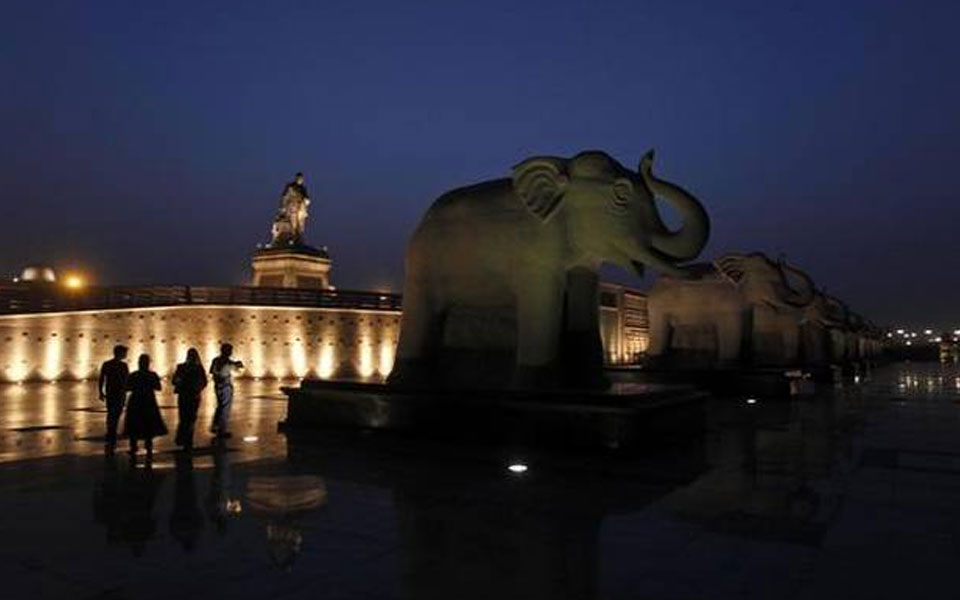
New Delhi, Feb 8: The Supreme Court Friday said it was of the tentative view that BSP chief Mayawati has to deposit public money used for erecting statues of herself and elephants, the party's symbol, at parks in Lucknow and Noida to the state exchequer.
The remarks were made by a bench hearing a petition filed by an advocate who had contended that public money cannot be utilised for creating own statues and for propagating the political party.
"We are of the tentative view that Mayawati has to deposit the public money spent on her statues and party symbol to the state exchequer," a bench headed by Chief Justice Ranjan Gogoi said.
The bench, also comprising justices Deepak Gupta and Sanjeev Khanna, posted the matter for final hearing on April 2.
The bench made it clear the tentative view was expressed by it as the matter would take some time for hearing.
"We will have it for final disposal on April 2," the bench said.
The petition on the issue was filed by advocate Ravi Kant in 2009 and on Friday the matter came after quite a long time.
Earlier, the apex court had passed various interim orders and directions in which the issue of environmental concern was also raised.
Further, there was also a direction to the Election Commission that during the election the elephants built in the park have to be covered.
The petitioner has alleged that crores of rupees was used from the state budget for 2008-09 to glorify Mayawati who was then the chief minister of Uttar Pradesh.
Let the Truth be known. If you read VB and like VB, please be a VB Supporter and Help us deliver the Truth to one and all.
Teen killed after being hit by private bus in Bengaluru
Bengaluru (PTI): A 16-year-old boy was killed after he was allegedly hit and run over by a private bus while crossing a road here on Friday, police said.
The deceased was identified as Varun, they said.
According to police, the accident occurred around 11:30 am on the Hennur–Bagalur main road.
The boy who crossing the road on foot when he was allegedly struck by the bus and came under its rear wheel, leading to his death on the spot.
He was rushed to a nearby hospital, where he was declared brought dead.
Following the incident, family members and locals staged a protest by blocking the Hennur–Bagalur road, resulting in heavy traffic congestion in the area.
The driver of the bus has been detained, and further legal action is being initiated, a senior police officer said, adding that an investigation is underway.