Meghalaya HC bans single-use plastic

Shillong (PTI): The Meghalaya High Court has banned single use plastic in temples and shops across the state.
The High Court Bench headed by Chief Justice S Vaidyanathan also advocated for introduction of tetra pak cartons, which are primarily made from paper and could be an effective alternative to replace plastics. The fight against plastics is not just an environmental crusade, but a battle for the health and future of our planet.
"To begin with, such a move can be started from temple premises. Temple authorities must ensure that there is no usage of plastic bags in and around the worshipping places," the Division Bench said in an order while hearing a PIL on the matter on Friday.
"CCTV cameras shall be installed in all temples, so that if anybody carries plastics inside the temple, that can be curtailed to some extent," it added.
The bench also imposed a ban on shops from storing and using plastic bags proposing heavy fines to be imposed on violators.
"If any shops are found to have stored plastic bags, a heavy fine should be imposed on them and if the practice is continued, such shops should be kept under lock and seal," the bench stated.
Directing the state government to be vigilant, the bench also ordered that the plastic items are stopped at the entry level itself.
"A periodical raid should be conducted in all shops and the Government of Meghalaya should think of imposing huge amount of fine against those who use plastics within the state of Meghalaya," it said, adding that strict enforcement of law will help eradicate plastic from society.
Citing how strong laws in Singapore force the same Indian who throws rubbish on the floor in his country to dispose of wastes in a designated dustbin in that country, the bench said, "Strict prohibitory measures and imposition of heavy fine on violators are the only solution to eradicate plastics from society, in addition to spreading awareness about the menace of plastics."
The high court has also asked the state government to file an affidavit on the matter.
Let the Truth be known. If you read VB and like VB, please be a VB Supporter and Help us deliver the Truth to one and all.
Road crash in UP leaves 10 dead
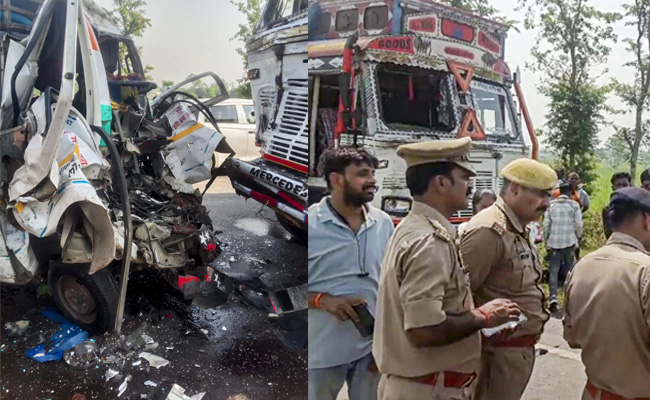
Lakhimpur Kheri (UP) (PTI): Ten people were killed when a van collided head-on with a truck on the Sisaiya-Lakhimpur national highway on Monday, police said.
The van was going to Sisaiya from Lakhimpur when the accident took place between Unchgaon and Bharehta villages.
Circle Officer of Dhaurahra, Shamsher Bahadur Singh, said all nine passengers travelling in the van and the driver were killed.
District Magistrate of Lakhimpur Kheri Anjani Kumar Singh told reporters that the van collided with a truck coming from the opposite direction, leading to nine casualties on the spot, while one succumbed to injuries at the district hospital.
Circle Officer, Dhaurahra, Shamsher Bahadur Singh told PTI, "Efforts are on to establish the identity of other deceased persons."
The seven of the deceased have been identified as Jaideep Singh (25), Pawan (23), Sohan (21), Ram Goyal (42), Sahajram (35), Pappu (18), all residents of Bahraich district and Adnan Khan (15), a resident of Lakhimpur Kheri district, police said.
Condoling the loss of lives in the accident, Uttar Pradesh Chief Minister Yogi Adityanath in a post on X, said, "The loss of life in the unfortunate road accident in Lakhimpur Kheri district is deeply distressing and heart-wrenching. My condolences are with the bereaved families."
"I have directed the local administration to provide prompt and adequate assistance to the injured and the victims. I pray to Lord Shri Ram to grant the departed souls a place at His divine feet and to bestow a speedy recovery upon the injured," Adityanath said on X.
Deputy Chief Minister Keshav Prasad Maurya and Brajesh Pathak too condoled the loss of lives in the accident.
"The loss of lives resulting from the road accident in Lakhimpur Kheri district is deeply tragic and heart-wrenching. My deepest condolences go out to the bereaved families," Maurya said.