Mental illness of death row convicts ground to spare them from gallows: Supreme Court
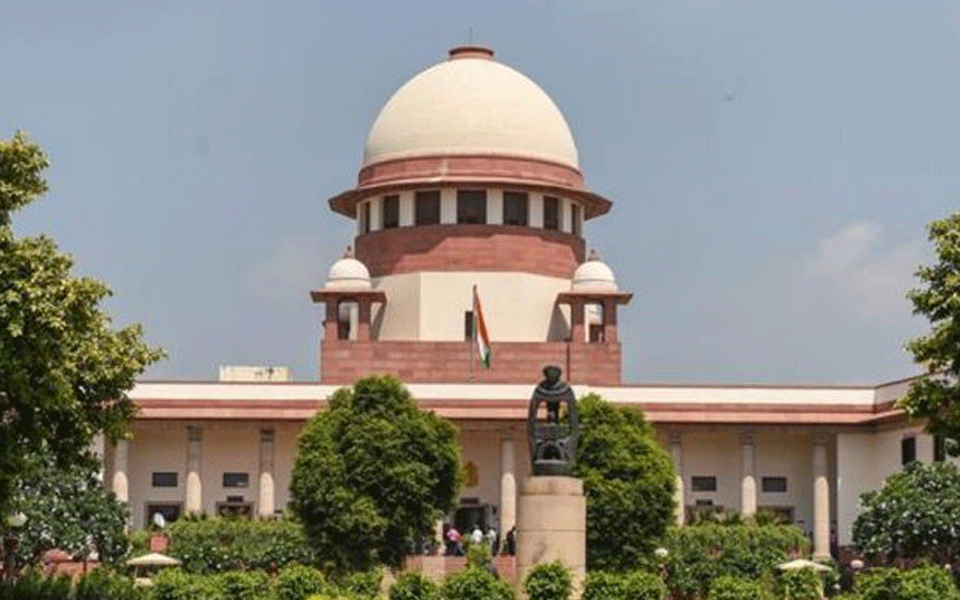
New Delhi: In a historic verdict, the Supreme Court has given a ray of hope to people on death row who develop "severe mental illness" post-conviction, saying their health condition would now be a "mitigating" factor for appellate courts for sparing them from the gallows.
An accused could till now take the plea of "legal insanity" under the Indian Penal Code (IPC) to avoid criminal prosecution and the defence was "made relatable to the moment when the crime is committed".
A three-judge bench headed by Justice N V Ramana spared a condemned prisoner, who has not been identified in the verdict owing to his mental condition.
He was given death penalty in a barbaric rape and murder of two minor cousins in Maharashtra in 1999.
It, however, took note of "barbaric and brutal manner of commission of the crime" and awarded the jail term to the convict for "remainder of his life" with the direction to the government to ensure proper mental health care to him.
The bench, also comprising Justices M M Shantanagoudar and Indira Banerjee, was faced with "complex questions" concerning the relationship between mental illness and crime and as to how "culpability" of a convict can be assessed if he develops mental condition after the court finds him guilty.
Delineating directions to be followed by appellate courts on sentencing mentally-ill accused, the bench said: "The post- conviction severe mental illness will be a mitigating factor that the appellate Court, in appropriate cases, needs to consider while sentencing an accused to death penalty.
"The assessment of such disability should be conducted by a multi- disciplinary team of qualified professionals (experienced medical practitioners, criminologists etc), including professional with expertise in accused person's particular mental illness."
To prevent misuse of the directions, the top court said the burden would be on the accused to prove "by a preponderance of clear evidence" that he is suffering with severe mental illness.
"The accused has to demonstrate active, residual or prodromal symptoms, that the severe mental disability was manifesting," it said.
The court said that the state government would be at liberty to "offer evidence to rebut such claim" of insanity or mental illness.
The court in appropriate cases could set up a panel to submit an expert report on the claim of mental illness of convicts, it said.
" Test of severity' envisaged...predicates that the offender needs to have a severe mental illness or disability, which simply means that objectively the illness needs to be most serious that the accused cannot understand or comprehend the nature and purpose behind the imposition of such punishment," it said.
To understand the phenomenon of post-conviction mental illness, the bench took note of the reports of the World Health Organisation and the International Red Cross. "It is well acknowledged fact throughout the world that, prisons are difficult places to be in."
There are multiple circumstances such as overcrowding, various forms of violence, enforced solitude, lack of privacy, inadequate health care facilities, concerns about family can take a toll on the mental health of the prisoners, it said.
It assessed the inclusion of post -conviction mental illness as a determining factor to hold that a case does not fall under the category of the "rarest of the rare" warranting the award of death penalty.
The mental disorders, for sparing the death row convicts from the gallows, would "generally include schizophrenia, other serious psychotic disorders, and dissociative disorders with schizophrenia.".
The convict, in the present case, was awarded death penalty by the trial court in the twin rape and murder case and both the high court and the apex court upheld the sentence.
The review plea against the apex court verdict was also rejected.
The apex court entertained the second review plea and passed the slew of directions on sentencing of convicts who develop mental conditions post convictions
Let the Truth be known. If you read VB and like VB, please be a VB Supporter and Help us deliver the Truth to one and all.
BCI urges CJI to take action against Andhra HC judge for sending young lawyer to 24-hour custody

New Delhi (PTI): The Bar Council of India on Wednesday sought the urgent intervention of Chief Justice of India Surya Kant following a "deeply disturbing" incident where a judge of the Andhra Pradesh High Court reportedly sent a young advocate to
24-hour judicial custody over a procedural lapse.
The Bar Council of India (BCI) Chairperson and senior advocate Manan Kumar Mishra, in a formal representation, termed the conduct of Justice Tarlada Rajasekhar Rao "grossly inappropriate" and "damaging to the confidence of the Bar".
“I most respectfully request your Lordship to kindly take immediate institutional cognizance of the matter and call for the video recording of the proceedings, the order passed, and the surrounding circumstances.
“I further request that appropriate administrative action may kindly be considered, including withdrawal of judicial work from the learned Judge pending review, his immediate transfer to some far off High Court, and his nomination for appropriate judicial training/orientation on court management, judicial temperament, Bar-Bench relations, and proportional exercise of contempt/judicial authority,” Mishra wrote.
This representation is made to preserve the “dignity, moral authority and public confidence of the judiciary”, he said, adding, “Judges command the highest respect not by fear, but by fairness, patience, restraint and constitutional humility”.
The communication urged the CJI to intervene at the earliest to ensure that the faith of Bar, particularly young advocates, in the protective and corrective role of the judiciary is restored.
The controversy stems from proceedings on May 5.
According to the BCI, a video circulating online shows Justice Rao rebuking a young advocate who was unable to produce a specific order copy during a hearing.
The letter said that despite the advocate "repeatedly seeking pardon and mercy" and claiming he was in physical pain, the judge remained "unmoved".
The judge allegedly told the lawyer, "now you will learn," and mocked his experience before directing the Registrar and police personnel to take him into custody for 24 hours.
The BCI chairperson said that the judge’s actions lacked proportionality and fairness.
"The dignity of the court is not enhanced when a lawyer is made to beg for grace in open court and is still sent to custody for a procedural lapse," the letter said.
"A young lawyer... is an officer of the Court, still learning, still growing, and entitled to correction without humiliation," it added.
The bar body said that such actions create a "chilling effect" on the legal fraternity, particularly among junior members, and undermine the mutual respect required between the Bench and the Bar.