Mere delay in intimating insurer of vehicle theft no ground for denying claim, says SC
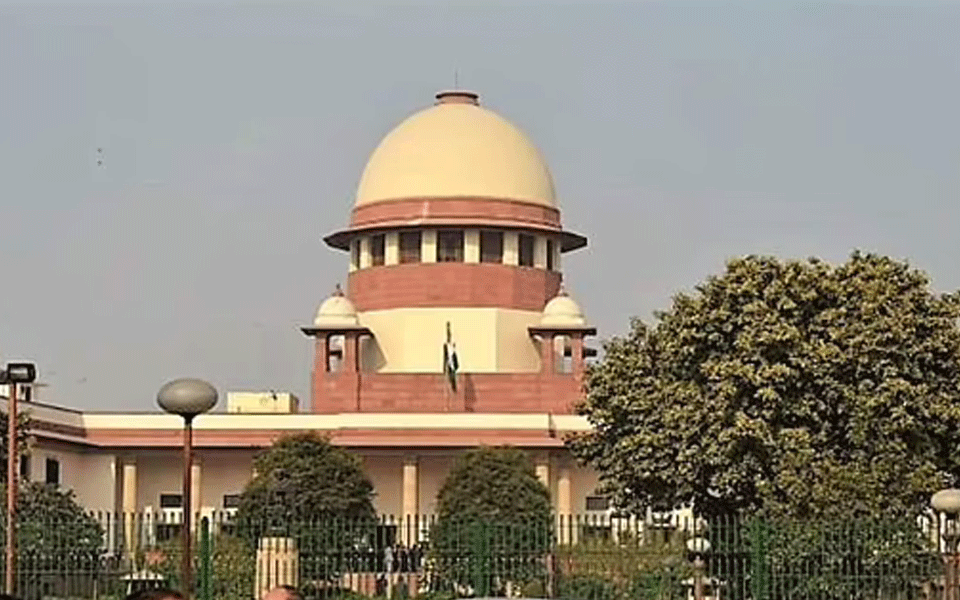
New Delhi(PTI): Mere delay in intimating an insurance company about theft of an insured vehicle cannot be a ground to deny the claim if an FIR about the incident has been lodged, the Supreme Court said on Friday.
The significant verdict came on an appeal of a company whose insured truck was robbed on November 4, 2007 and the police, acting on the FIR which was lodged next day, arrested the accused but could not recover the insured vehicle.
Oriental Insurance Company Ltd repudiated the claim on the ground that it was informed about the loss of vehicle belatedly and won the case at the National Consumer Disputes Redressal Commission (NCDRC).
The NCDRC, in 2016, had set aside the findings of the District Consumer Forum and the Haryana State Consumer Disputes Commission holding that the insurance firm rightly repudiated the claim on the ground of delayed intimation.
A bench comprising Justices Sanjiv Khanna and Bela M Trivedi set aside the NCDRC judgement and held that the mere delay in intimating the insurer was not fatal to the claim when an FIR had been registered promptly.
The precise question that falls for consideration before this Court is - whether the insurance company can repudiate the claim in toto, made by the owner of the vehicle which was duly insured with the insurance company, in case of loss of the vehicle due to theft, merely on the ground that there was a delay in informing the company regarding the theft of vehicle, the bench said.
Justice Trivedi, writing the judgement, referred to an apex court verdict in which it was held that when an insured has lodged the FIR immediately after the theft of a vehicle occurred and when the police after investigation have lodged a final report after the vehicle was not traced and when the surveyors/investigators appointed by the insurance company have found the claim of the theft to be genuine, then mere delay in intimating the insurance company about the occurrence of the theft cannot be a ground to deny the claim of the insured.
Dealing with the facts of the case, the judgement said in the instant matter, the FIR was lodged immediately on the next day of the occurrence of theft by Aina Construction Company and the accused were also arrested and chargesheeted.
However, the vehicle could not be traced out. Of course, it is true that there was a delay of about five months on the part of the complainant in informing and lodging its claim before the Insurance Company, nonetheless, it is pertinent to note that the Insurance Company has not repudiated the claim on the ground that it was not genuine, it said.
The verdict said the claim has been repudiated only on the ground of delay and when the complainant had lodged the FIR immediately and law was set in motion, the insurance firm could not have repudiated the claim merely on the ground that there was a delay in intimating about the theft.
Let the Truth be known. If you read VB and like VB, please be a VB Supporter and Help us deliver the Truth to one and all.
Congress using hijab issue to pacify minority anger, alleges Karnataka LoP R Ashoka

Bengaluru: Leader of Opposition in the Assembly R. Ashoka has accused the Congress government of using the hijab issue to placate what he described as discontent among minority voters after the Davanagere by-election.
In a post on X on Wednesday, Ashoka alleged that the state government, instead of addressing issues such as price rise, corruption, farmers’ distress and law and order, was attempting to retain its minority vote base by reviving the hijab issue.
Referring to the 2022 dress code introduced by the BJP government, which prohibited hijab in schools and colleges, Ashoka said the Karnataka High Court had upheld the policy and emphasised the importance of discipline in educational institutions.
He questioned the Congress government’s move to revisit the issue and asked whether setting aside the court-backed policy to benefit one community could be described as secularism.
Ashoka further alleged that while the government was willing to permit hijab, it continued to prohibit saffron shawls.
He accused the government of dividing students on religious lines rather than treating schools and colleges as spaces of equality.
Drawing a comparison with Mamata Banerjee’s government in West Bengal, Ashoka claimed that excessive appeasement politics had harmed the state and warned that the Congress in Karnataka could face a similar political response.
He said voters in Karnataka would teach the Congress a lesson for what he termed “vote-bank politics” and for compromising constitutional and judicial principles.