Metro services begin in Bhopal; excited residents flock to take rides, selfies
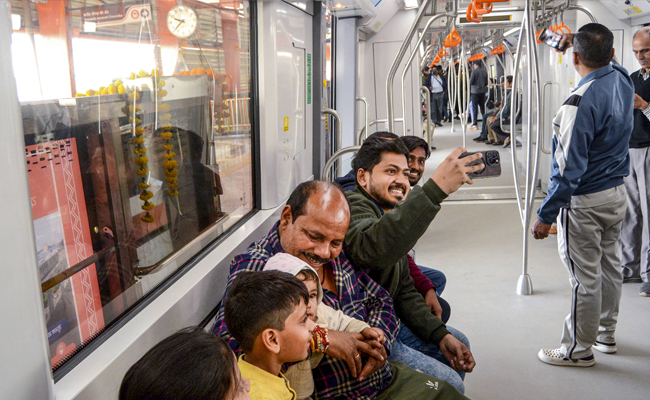
Bhopal (PTI): On the first day of the commercial run of the Metro services in Bhopal on Sunday, hundreds of residents enthusiastically took rides, expressing confidence that it will save time and provide relief from traffic jams.
An official said that the Metro’s first service began at 9 am from the AIIMS station, and by 6 pm, 5,731 people had travelled on the new mass-transit corridor.
He said that people, along with their family members, had been lining up for tickets since early morning. Several users were seen taking selfies and photos inside the Metro rakes and at stations.
ALSO READ: Snowfall blocks two key roads providing alternative connectivity to Kashmir
Earlier on Saturday, Union minister Manohar Lal Khattar and Madhya Pradesh Chief Minister Mohan Yadav inaugurated the Metro service by flagging off a train from Subhash Nagar station on a 7.5-kilometre stretch, called the “Priority Corridor”.
With this, Bhopal became the 26th city in the country and the second city in Madhya Pradesh, after Indore, to have the Metro service.
Rao Singh, who took a Metro ride, told PTI Videos that besides saving time and money, the new mode of transport will provide relief from traffic jams and pollution.
Another passenger, who identified himself as Chetan, said he was happy that Bhopal is now on the “Metro list”.
Office-goers will benefit a lot due to the Metro service, said a young man named Akshay.
While the estimated cost of the 30.8-km-long Bhopal Metro project is Rs 10,033 crore, a sum of Rs 2,225 crore was spent on the ‘Priority Corridor’, according to officials.
Let the Truth be known. If you read VB and like VB, please be a VB Supporter and Help us deliver the Truth to one and all.
Maharashtra sets up state vaccination task force to strengthen immunisation programme

Mumbai (PTI): The Maharashtra government has set up a State Vaccination Task Force to strengthen the regular immunisation programme and review the progress of related campaigns, a health department official said on Monday.
The State Vaccination Task Force will comprise at least 29 members and will be headed by the administrative head of the health department, he informed.
The government has also constituted separate district-level and municipal vaccination task forces to improve implementation and address challenges at the grassroots level, he said.
Municipal task forces, chaired by respective civic commissioners, have been constituted in view of the vast urban population in Maharashtra and the role of civic bodies in implementing different health programmes.
The district-level task forces will function under the chairmanship of collectors.
"Complete immunisation of children at the appropriate age is an extremely simple, cost-effective and highly effective measure to reduce child mortality and the prevalence of diseases among kids. Immunisation is a powerful tool for reducing illness in children," maintained the official.
To ensure full vaccination of all children, the state government implements various campaigns from time to time as per the central government guidelines, he pointed out.
"Active participation and cooperation of other relevant government departments are essential (in making these campaigns successful)," according to the official.
The state-level body will review the regular immunisation programme, associated campaigns and vaccine-preventable diseases in detail. It will also conduct focused assessments of high-risk districts and municipal corporations, including vacancies at district, municipal and sub-district levels, availability of cold chain equipment, resource gaps and training requirements, he noted.
The state task force will review allocation and utilisation of funds for immunisation and ensure timely action by officers concerned based on reports from district and municipal task forces and state-level monitoring mechanisms, the official said.
It will also ensure active coordination and participation of other government departments in immunisation drives, while district and municipal task forces will carry out similar functions at their respective levels, the official added.