MHA tweaks travel norms: Indians over 65, under 15 can use Aadhaar to visit Nepal, Bhutan
New Delhi, Jan 20 : Aadhaar cards are now valid travel documents for Indians under 15 and over 65 travelling to Nepal and Bhutan, according to a Home Ministry communique.
Indians other than those in the two age brackets will not be able to use Aadhaar to travel to the two neighbouring countries, for which no visas are needed, clarified the communique issued recently.
Indian citizens going to Nepal and Bhutan don't need a visa if they have a valid passport, a photo identity card issued by the government of India or an election ID card issued by the Election Commission, it added.
Earlier, persons over 65 and under 15 could show their PAN card, driving licence, Central Government Health Service (CGHS) card or ration card, but not the Aadhaar, to prove their identity and visit the two countries.
The Aadhaar card has now been added to the list, explained a senior Home Ministry official.
"Now, persons in the age group of over 65 years and below 15 years have been allowed to use Aadhaar as a valid travel document," the official told PTI.
Aadhaar is a 12-digit unique identification number issued by the Unique Identification Authority of India (UIDAI). It is being made mandatory for using a host of government services.
Giving details, the official said a certificate of registration issued by the Embassy of India, Kathmandu, to Indian nationals is not an acceptable travel document for travelling between India and Nepal.
"However, the emergency certificate and identity certificate issued by the Indian Embassy in Nepal will be valid for single journey for travelling back to India," he said, citing the communique.
Teens between 15 to 18 years will be allowed to travel between India and Nepal on the basis of an identity certificate issued by the principal of their school in a prescribed form, the officer said.
In case of a family (like husband, wife, minor children and parents) travelling together, all persons will not be required to carry relevant documents (such as a passport or an election ID) if one of the adult members has valid travel papers, he said.
However, the other family members must have some proof of their identity with a photograph and their relationship as a family, such as a CGHS card, ration card, a driving licence or an ID card issued by school/college, the official explained.
Indian nationals travelling to Bhutan need to have either an Indian passport with minimum validity of six months or a voter identity card issued by the Election Commission of India.
Bhutan, which shares borders with the Indian states of Sikkim, Assam, Arunachal Pradesh and West Bengal, has about 60,000 Indian nationals, employed mostly in the hydroelectric power and construction industry.
In addition, between 8,000 and 10,000 daily workers enter and exit Bhutan everyday in border towns.
About six lakh Indians live in Nepal, according to data by the Ministry of External Affairs.
These include businesspersons and traders who have been living in Nepal for a long time, professionals (doctors, engineers, IT personnel) and labourers (including seasonal/migratory) in the construction sector, it said.
Nepal shares a border of over 1,850 km with five Indian states Sikkim, West Bengal, Bihar, Uttar Pradesh and Uttarakhand.
Let the Truth be known. If you read VB and like VB, please be a VB Supporter and Help us deliver the Truth to one and all.
Bhojshala complex registered as 'mosque' in old revenue records: Muslim side to MP HC
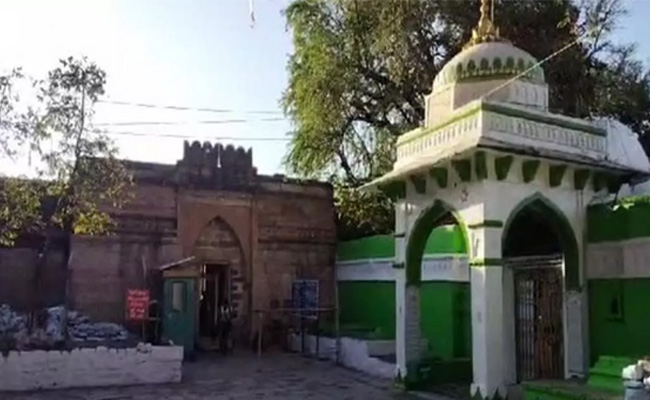
Indore (PTI): The disputed Bhojshala Temple-Kamal Maula Mosque complex has historically been registered as a 'mosque' in revenue records and available sources don't clearly mention any Saraswati temple established by then-king Raja Bhoj, the Muslim side has told the Madhya Pradesh High Court.
The Hindu community considers Bhojshala a temple dedicated to Goddess Saraswati, while the Muslim side calls the 11th-century monument Kamal Maula Mosque. The disputed complex located in Dhar district is protected by the Archaeological Survey of India (ASI).
During the hearing before the HC's Indore bench of Justices Vijay Kumar Shukla and Justice Alok Awasthi on Wednesday, Qazi Moinuddin questioned two PILs filed as intervenors in the Bhojshala case by an organisation named Hindu Front for Justice, one Kuldeep Tiwari and another individual.
Moinuddin claims to be a descendant of Sufi saint Maulana Kamaluddin Chishti and the 'Sajjadanashin' (spiritual head, guru, or successor of a Sufi shrine, khanqah, or religious site).
The PILs state that Bhojshala is actually a Saraswati temple and only Hindus should be granted the right to worship at the disputed complex.
Moinuddin's lawyer, Noor Ahmed Sheikh, claimed in the court that his client's ancestors, who are descendants of Maulana Kamaluddin Chishti, have historically held titles to the complex, and the site was also recorded as a "mosque" in government revenue records.
He contended that those associated with the management of the Kamal Maula Mosque, located within the complex, have been in "continuous and peaceful occupation" of the site for a long time.
Citing Muslim law, Sheikh argued that in the case of religious property, particularly a mosque or its related properties, officials such as the Sajjadanashin and Mutawalli (person entrusted with management, maintenance, and administration of a Waqf), and their descendants, not only have the right to intervene, but also have the right to manage and use such a structure.
Citing provisions of the Ancient Monuments Preservation Act 1904, the Muslim side's lawyer said the term "in-charge of the property" is used in this law, which makes it clear that the person or party who has been in charge of a property for a long time has rights over it.
During the hearing, Touseef Warsi, the lawyer representing the Maulana Kamaluddin Welfare Society of Dhar, claimed that Hindu parties in both PILs had made "misleading representations" regarding historical facts before the high court.
He further claimed that available historical sources do not clearly mention the existence of a Saraswati temple established by Raja Bhoj, the legendary king of the Parmar dynasty who ruled Dhar from 1010 to 1055.
The ASI, a central government agency, has adopted three different positions in the lawsuits filed regarding the Bhojshala dispute, changing its answers from time to time, and this situation raises serious questions about judicial scrutiny of the complex, Warsi submitted.
He raised objections regarding the ASI's process of scientific survey of the Bhojshala complex, carried out on the HC order in 2024, and the method of videography and requested the court to examine these objections.
The hearing in the Bhojshala case will continue on Thursday.
The HC has been regularly hearing four petitions and one writ appeal since April 6, contesting the religious nature of the monument.