Mid-day meal scheme: Supreme Court slaps fine on 5 states, Delhi
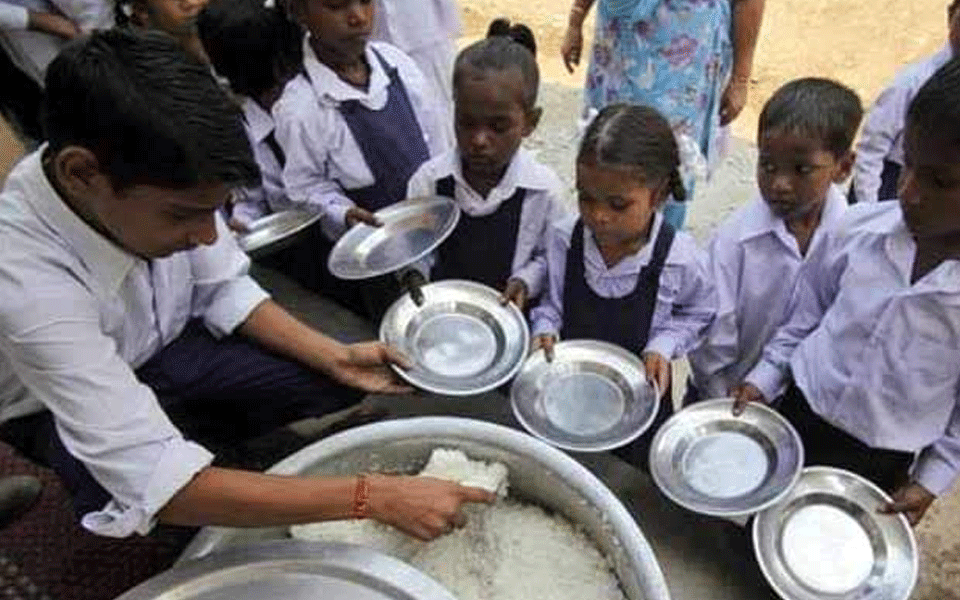
New Delhi, Dec 4 : The Supreme Court on Tuesday slapped a fine on five states and Delhi, saying they were "not taking seriously" the matter related to implementation of the mid-day meal scheme in schools.
The apex court directed states of Andhra Pradesh, Odisha, Arunachal Pradesh, Meghalaya and Jammu and Kashmir to pay Rs one lakh each as costs for their failure to create an online link along with a chart meant for monitoring the implementation and hygiene of mid-day meal scheme in government-run schools.
Besides this, a bench headed by Justice Madan B Lokur also slapped Rs two lakh as costs on Delhi for not providing the requisite information related to implementation of the scheme.
The bench, also comprising Justices Deepak Gupta and Hemant Gupta, directed that the costs be deposited with the Supreme Court Legal Services Committee within four weeks.
"The mid-day meal scheme, which is of considerable benefit to the children in the country, is not being taken seriously by several states. Data has not been supplied and there are allegations made by the petitioner about foodgrains disappearing and not reaching the schools and thereby denying the benefit of mid-day meal scheme to children," the bench said.
"We have been trying to get the states to render assistance and to upload all the data so that necessary corrective steps can be taken from time to time. In spite of several of our orders, there has been little or no co-operation from some of the states," it said.
The bench said that on October 26, the states of Andhra Pradesh, Arunachal Pradesh, Meghalaya and Odisha had said they would comply with the requirements of the scheme and provide necessary online links but "more than a month has gone by and there has been absolutely no progress made by these states".
"Since the states have not supplied the necessary links or the details which are required for effective implementation of the scheme, we have been left with no option but to impose costs for this totally unnecessary adjournment and for effectively denying benefits to the children of their states to which they are entitled," the bench said.
The counsel appearing for Jammu and Kashmir said they have already created the online link but it was not working. "We do not see the value of a link that does not work," the court said and imposed Rs one lakh costs on Jammu and Kashmir.
The bench has posted the matter for further hearing after four weeks.
The apex court had earlier noted that two committees at national and state levels were suggested to be set up to monitor various aspects like maintaining hygiene in the mid-day meal schemes in schools.
The court was hearing a plea filed by NGO 'Antarrashtriya Manav Adhikaar Nigraani Parishad' in 2013 on the issue of mid-day meals.
The top court had on March 23 last year asked the state governments and Union Territories to upload the information including the total number of students getting benefit of the mid-day meal scheme within three months on their websites.
The PIL has claimed that in over 12 lakh government-run and aided schools across the country, children receive free, cooked lunch every day but "they are constantly exposed to the risk of food poisoning and related health hazards due to a lack of mid-day meal infrastructure and proper monitoring of the scheme".
Let the Truth be known. If you read VB and like VB, please be a VB Supporter and Help us deliver the Truth to one and all.
Tribals, Scheduled Castes preserved India's identity and soul despite foreign invasions: Bhagwat
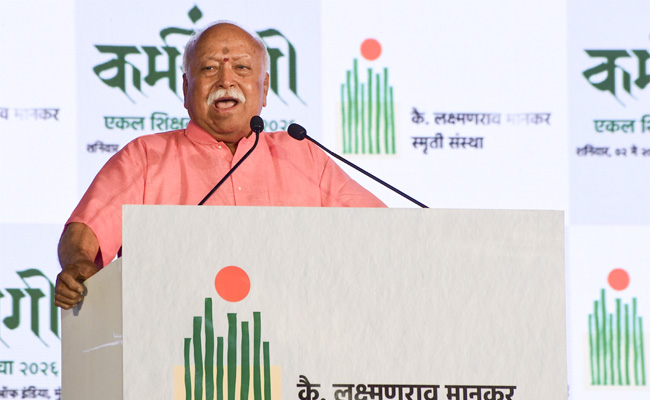
Mumbai (PTI): RSS chief Mohan Bhagwat has said that despite foreign invasions and hardships, tribal communities and Scheduled Castes preserved the country's identity and soul, stressing the need to integrate them into the mainstream development process.
He was speaking on Saturday at the Karmayogi awards ceremony in Mumbai, where Union Road Transport and Highways Minister Nitin Gadkari was also present.
"Human life is defined by giving back to the world, as we are all part of one great family. A person works and spends for the betterment of society, not as a favour, but out of duty. In serving others, we foster our own development. By helping others to thrive, we elevate ourselves and grow as human beings. This principle is the core value of this Indian land, commonly known as a Hindu society," Bhagwat said.
"This is the society's enduring ethos, which has survived for thousands of years. For various reasons, partly because of our indifference and partly because of foreign invasion, those who preserved this ethos paid a heavy price," he said.
The foreign invaders found that this ethos, this value system of the society is its soul and the key to keeping it alive. So they ensured that those who tried to preserve this soul would be uprooted and face extreme hardships, the Rashtriya Swayamsevak Sangh (RSS) chief noted.
But despite foreign invasions and hardships, tribal communities and Scheduled Castes preserved the country's identity and its soul, he said.
"Despite such adversities, the country's core identity remained intact among tribal communities and those belonging to SC and ST groups," he said, emphasising the need to integrate them into the mainstream development process while ensuring they receive equal access to services and facilities.
Referring to global developments, Bhagwat said the present world is "stumbling forward" and struggling to maintain balance, and asserted that India could emerge as a stabilising force.
The country must not only safeguard its own interests but also extend support to the world, he said.
"The world should get to see that the country is not only solving its own misery and sorrow but also helping the world to address similar issues," he said.
The RSS chief stressed that service to society is not a favour but a duty that contributes to one's own development.
Helping others grow also elevates individuals and strengthens the collective fabric of society, he said.
The so-called educated and developed sections have, over time, distanced themselves from these communities, Bhagwat pointed out, and called for the need to bridge this gap.
The identities preserved by these communities represent the true identity of Indian society, he said and underlined that without identity, existence itself is at risk.