Milma calls cross-border milk sale by state federations unethical; resents Nandini entry into Kerala
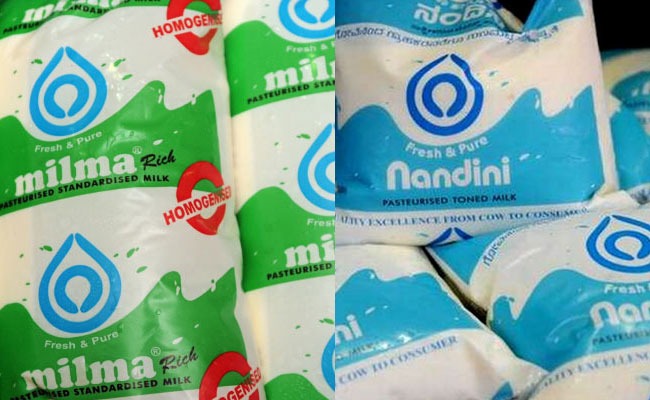
Thiruvananthapuram (PTI): Kerala Co-operative Milk Marketing Federation (KCMMF), known by the brand Milma, has termed as "unethical" the tendency of some state milk marketing federations to aggressively enter markets outside their respective states.
Criticising the Karnataka Milk Marketing Federation (KMF) for opening its outlets in parts of Kerala to sell its Nandini brand of milk and other products, Milma said that this involved a total breach of cooperative spirit based on which the country's dairy sector has been organized for the benefit of millions of dairy farmers.
"Of late, there has been a growing tendency on the part of some of the state milk marketing federations to market their staple products outside their respective domain. This grossly violates the federal principles and co-operative spirit based on which the country's dairy co-operative movement has been built and nurtured by pioneers like Tribhuvandas Patel and Dr Verghese Kurien", Milma Chairman K S Mani said in a statement here.
He noted that the move of Amul to promote its staple products in Karnataka has been met with strong resistance from the stakeholders in that state.
"But Karnataka Milk Marketing Federation recently opened its outlets in parts of Kerala to sell its Nandini brand of milk and other products. How could this be justified? Whoever does this, it is a highly unethical practice which defeats the very purpose of India's dairy movement and harms the interests of the farmers," Mani said.
This trend will only lead to unhealthy competition among states, which needs to be reined in with the Union and state governments coming together to evolve a consensus, Mani said.
As per the prevailing agreement and courteous business relations existing among milk co-operatives, cross-border marketing of liquid milk shall be avoided as it amounts to blatant encroachment of the sale area of the respective state, he said.
Such practices from any side will jeopardize the spirit of co-operative principles that have been nurtured for long by mutual consent and goodwill, Mani said.
The tendency to enter the markets outside one's domain by opening sales outlets or roping in franchisees should be avoided. Initially, they sell only value-added products, then start selling liquid milk also and subsequently begin shop-to-shop distribution of milk.
Eventually, they will seek to capture markets outside their respective area, taking advantage of the state-to-state variations in price and production cost, the Milma chairman said.
Though the input cost in the dairy sector in Kerala is much higher compared to other states, Milma passes on 83 per cent of its turnover to dairy farmers through the cooperative societies in its network.
Also, the bulk of Milma's surplus is given to the farmers as an additional incentive on milk price and subsidy on cattle feed as the well-being of the dairy farmers is its prime concern.
Considering these stark realities, it is in the best interest of dairy co-operative federations of various states that they refrain from plans to open sales outlets or make franchisee arrangements to sell liquid milk and other staple products outside the respective state, Mani added.
Let the Truth be known. If you read VB and like VB, please be a VB Supporter and Help us deliver the Truth to one and all.
India, New Zealand ink free trade agreement
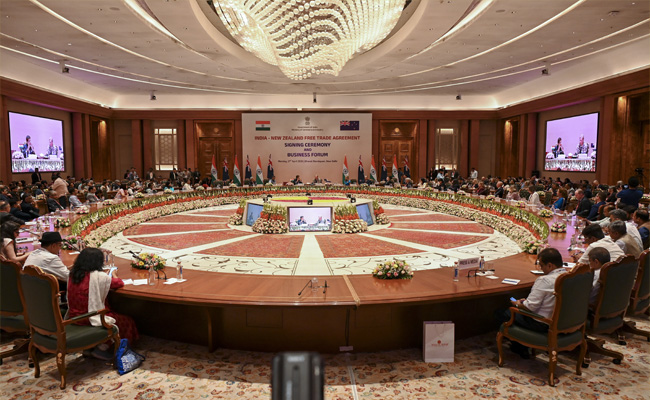
New Delhi (PTI): India and New Zealand on Monday inked a free trade agreement, aimed at boosting two-way commerce and investments.
The pact was signed by Commerce and Industry Minister Piyush Goyal and visiting New Zealand's Trade and Investment Minister Todd McClay.
The FTA provides duty-free access for 100 per cent of India's exports to New Zealand, covering all tariff lines or produce categories, and is expected to significantly boost MSMEs and employment by enhancing competitiveness in labour-intensive sectors such as textiles, apparel, leather, footwear, gems and jewellery, engineering goods, and processed foods.
Earlier, New Zealand maintained peak tariffs of up to 10 per cent on key Indian exports, including ceramics, carpets, automobiles, and auto components.
With zero-duty market access from entry into force as New Zealand's other trade partners, Indian products will be fully competitive in that country, enjoying a level playing field.
ALSO READ: Cal HC urges EC to dispose of TMC complaint over police observer's meeting with BJP nominee
Significantly, India also secured duty-free inputs for its manufacturing sector, including wooden logs, coking coal, and waste and scraps of metals, lowering production costs and enhancing the global competitiveness of the Indian industry.
On the other hand, India has offered tariff liberalisation on 70.03 per cent of tariff lines covering 95 per cent of bilateral trade value, while keeping 29.97 per cent of tariff lines excluded to protect India's sensitive sectors.
The products that are kept in exclusion are mainly -- dairy (milk, cream, whey, yoghurt, cheese etc.), animal products (other than sheep meat), agricultural products (onions, chana, peas, corn, almonds), sugar, artificial honey, animal, vegetable or microbial fats and oils, arms and ammunition, gems and jewellery, copper and articles thereof (cathodes, cartridges, rods, bars, coils), aluminium and articles thereof (ingots, billets, wire bars) among others.
On 30 per cent of tariff lines of New Zealand, India will provide duty elimination on goods such as wood, wool, sheep meat, and leather-raw hides.
Similarly, 35.60 per cent of tariff lines are subject to phased elimination over 3, 5, 7, and 10 years, including petroleum oil, malt extract, vegetable oils, selected electrical and mechanical machinery, and peptones.
New Zealand products which enjoy tariff reductions include wine, pharmaceutical drugs, polymers, aluminum, iron and steel articles, and goods that only 0.06 per cent fall under tariff rate quotas, including Manuka honey, apples, kiwi fruit, and albumins, including milk albumin.
The FTA also includes a commitment to facilitate USD 20 billion in investment into India.
A rebalancing clause is incorporated into the Agreement to provide a framework for addressing any shortfall in investment delivery, thereby ensuring robust and tangible economic outcomes.
Total bilateral trade in goods and services reached USD 2.4 billion in 2024.