Minorities must not be in awe of majority in terms of number: Amartya Sen
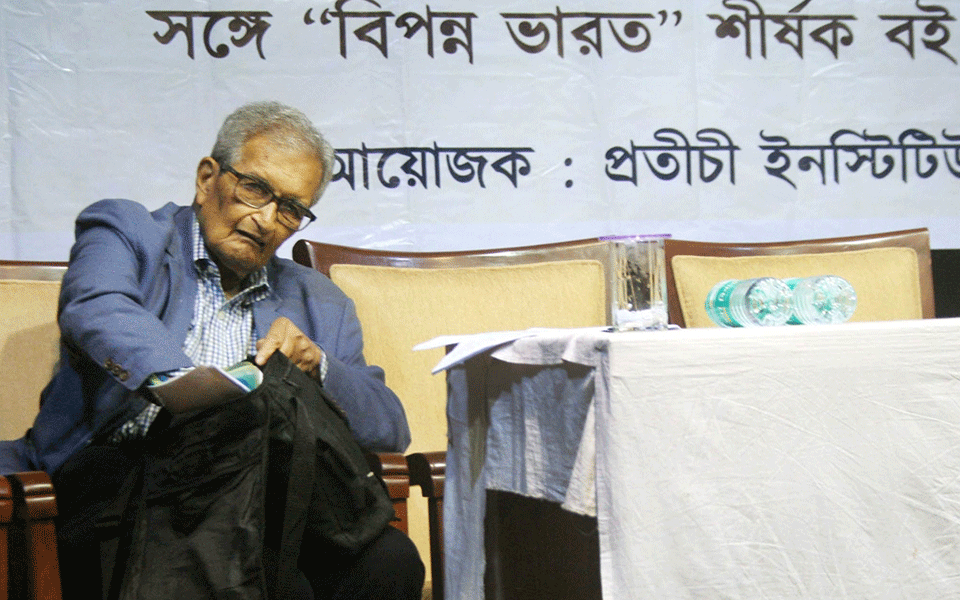
Kolkata, Aug 25: Nobel laureate economist Amartya Sen on Saturday said the minorities and the liberal forces in India, who oppose the divisive politics of the present day, need to be more vocal and assertive.
Discussing the present scenario in India, Sen said those ruling the country do not constitute a majority, but they are in power by virtue of their ability to skilfully use the tools of the political system.
"I think in modern days, the majority and minority cannot be decided based on who is a Hindu or who is a Muslim, as it is not really clear who is a Hindu.
"Definitely, the number of Dalits and other minorities is very less. But the fact is that those who are ruling the nation they are not the majority in terms of number, but the reason of their power is that they are aptly using the tools of our political system," Sen said at a discussion on where the Indian democracy is heading.
According to Sen, if the census is considered then the number of Hindu population is quite high.
"The result of 2014 only reflects that the victorious party was successful in that particular system," said Sen.
Answering a question regarding the fear factor among Muslims residing in India, he said: "This very state of mind that if we are minority we will be deprived and will have to suffer, is very weakening in itself."
"The result will not depend on numbers, but on the reach of electoral procedure and the political system. The important fact for victory would be the ability to strongly raise the issues that need immediate attention and deserve thorough discussion," Sen said.
A social activist, Urba Choudhury raised the question of the relevance of leftist ideologies in the current scenario.
Talking about the presence of the Leftist forces in India, Sen said: "I consider myself a Leftist but one must remember all political questions don't centre around Left and Right-wing ideologies. We have issues like Minority treatment and Secularism, fulfilling the needs of all different religions, but it is not just an issue addressed by leftists."
"We have many reasons to join hands with other people who are not really leftists. This is a striking question even before the 2019 election. But one thing must be made clear that joining hands doesn't mean that two parties forming an alliance must give consent to all views of each other. One needs to fight against the divisive politics and the minority treatment," he added.
He insisted that all people who have liberal thinking must raise their voice together so that it can be loud enough to stand against the ruling majority.
Sen also expressed his concern about the prevalent gender discrimination after a panellist pointed out that as per the report of the Thomson Reuters Foundation, India is the world's most dangerous country for women.
"It is very sad and shameful that little girls are kidnapped and treated as trade materials for which India holds a very bad record internationally. On one hand, we have to do away with the discrimination between girls and boys, on the other the rich-poor divide," said the octogenarian.
Let the Truth be known. If you read VB and like VB, please be a VB Supporter and Help us deliver the Truth to one and all.
Maharashtra sets up state vaccination task force to strengthen immunisation programme

Mumbai (PTI): The Maharashtra government has set up a State Vaccination Task Force to strengthen the regular immunisation programme and review the progress of related campaigns, a health department official said on Monday.
The State Vaccination Task Force will comprise at least 29 members and will be headed by the administrative head of the health department, he informed.
The government has also constituted separate district-level and municipal vaccination task forces to improve implementation and address challenges at the grassroots level, he said.
Municipal task forces, chaired by respective civic commissioners, have been constituted in view of the vast urban population in Maharashtra and the role of civic bodies in implementing different health programmes.
The district-level task forces will function under the chairmanship of collectors.
"Complete immunisation of children at the appropriate age is an extremely simple, cost-effective and highly effective measure to reduce child mortality and the prevalence of diseases among kids. Immunisation is a powerful tool for reducing illness in children," maintained the official.
To ensure full vaccination of all children, the state government implements various campaigns from time to time as per the central government guidelines, he pointed out.
"Active participation and cooperation of other relevant government departments are essential (in making these campaigns successful)," according to the official.
The state-level body will review the regular immunisation programme, associated campaigns and vaccine-preventable diseases in detail. It will also conduct focused assessments of high-risk districts and municipal corporations, including vacancies at district, municipal and sub-district levels, availability of cold chain equipment, resource gaps and training requirements, he noted.
The state task force will review allocation and utilisation of funds for immunisation and ensure timely action by officers concerned based on reports from district and municipal task forces and state-level monitoring mechanisms, the official said.
It will also ensure active coordination and participation of other government departments in immunisation drives, while district and municipal task forces will carry out similar functions at their respective levels, the official added.