Missing HDFC Vice-President Found Dead in Mumbai’s Kalyan; Suspect Led Cops to Body
Mumbai, Sept 10: The body of an HDFC vice-president who had been missing for five days was found in Mumbai’s Kalyan on Monday morning, a day after a suspect in the case allegedly confessed to killing the banker.
Siddharth Sanghavi, a resident of upscale Malabar Hill area in South Mumbai, was last seen on September 5 when he left for work around 8.30am. He, however, did not return home, following which his wife approached the NM Joshi Marg Police Station in Central Mumbai.
Sanghavi's car, a blue-coloured Maruti Ignis, was found by the police near Sector 11 in Airoli, Navi Mumbai, on Thursday. A police officer said blood stains and a knife were found on the rear seat of the car.
Investigators have also examined the CCTV footage of Kamala Mills compound, where he used to work, and have found that the executive left the bank around 7.30pm. However, his car could not be located leaving the premises. The last mobile tower location of Sanghavi's phone was traced in Kamala Mills around 7pm, after which his phone was switched off.
On Sunday, one person was detained from Kopar Khairane by Navi Mumbai police and later handed over to Mumbai Police after the suspect allegedly confessed to killing a person. Based on the information revealed by the suspect, three more people were detained.
According to sources, the suspect, a 20-year-old man, worked as a driver with a cab aggregator. He told the police that he killed a man and that someone had hired him to do so.
According to sources, the suspect allegedly attacked Siddharth in the parking lot of Kamala Mills, where his car was parked. Blood stains were found at the spot where Siddharth's car was parked and were also found on the rear seat.
The suspect allegedly told the police that he dumped the body in Haji Malang area of Kalyan before leaving the car at Airoli.
Courtesy: www.news18.com
Let the Truth be known. If you read VB and like VB, please be a VB Supporter and Help us deliver the Truth to one and all.
CM Siddaramaiah alleges ‘criminal conspiracy’ in Sringeri recount, vows legal action
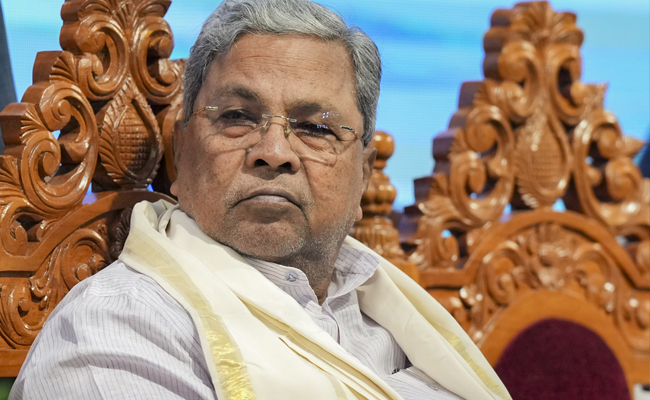
Bengaluru (PTI): Alleging a “criminal conspiracy” by BJP candidate D N Jeevaraj in the Sringeri Assembly poll recounting, Karnataka CM Siddaramaiah on Tuesday said the outcome was manipulated after valid postal ballot votes in favour of Congress leader T D Raje Gowda were tampered with during the recounting process.
Following a Karnataka High Court order on an election petition filed by Jeevaraj, challenging Raje Gowda’s election, the reverification and recounting were conducted on Saturday.
After the reverification and recount of postal ballots for the Sringeri Assembly constituency, votes polled in favour of Raje Gowda were reduced by 255, the returning officer said.
A report on the matter has been submitted to the Election Commission of India for further action, the officer added.
Congress leader Raje Gowda had won the 2023 Assembly polls from Sringeri by 201 votes, defeating his nearest rival Jeevaraj.
Addressing a press conference in Bengaluru, Siddaramaiah said the High Court had directed the recounting of postal ballots and that irregularities were noticed during the exercise conducted on May 2.
“This is a clear case of criminal conspiracy,” Siddaramaiah said, alleging that valid votes cast in favour of Raje Gowda were altered after being accepted by counting agents of all parties, including Congress, BJP, and JD(S).
He claimed that during the recounting of postal ballots, 255 votes were initially accepted as valid by all agents but were later tampered with by subordinate officials.
“There is a second mark on the votes polled in favour of Raje Gowda. They had accepted these as valid votes. Subsequently, another mark was made by officials. This is a clear case of criminal conspiracy,” he said.
When asked who was behind the alleged conspiracy, the CM replied, “It was hatched by Jeevaraj and others. It is planned.”
Siddaramaiah further alleged that the returning officer acted improperly by declaring the result despite the presence of an Election Commission observer during the recounting.
“Immediately after the counting, the returning officer announced the result. He should not have done so; this is against the law,” he said.
He pointed out that Raje Gowda had originally won by 201 votes, but after the recounting, the BJP candidate was declared the winner by 52 votes.
“The BJP has committed a criminal act of conspiracy. This is not vote chori but vote dacoity,” he alleged.
The CM said a police complaint had already been filed by Raje Gowda’s election agent, Sudhir Kumar, and emphasised the need for electoral integrity.
“We want transparency and free and fair elections. That is what our Constitution mandates,” he added.
Stating that the government would pursue legal remedies, Siddaramaiah said, “We are preparing an appeal challenging the returning officer’s announcement in a court of law.”
Responding to a separate query on elections in other states, the CM said there appeared to be an anti-incumbency factor in West Bengal, while results in Tamil Nadu were “surprising,” adding that Vijay’s party was emerging as the largest there.
Following the victory of party candidates in Bagalkote and Davanagere South, Siddaramaiah expressed confidence about future electoral prospects in Karnataka.
“Even in 2028, we will win the Assembly elections. We will come back,” the CM said.
Siddaramaiah added that he would order a forensic examination into the alleged tampering of postal ballots.