Mixed response to farmers' agitation in MP amid heavy police presence
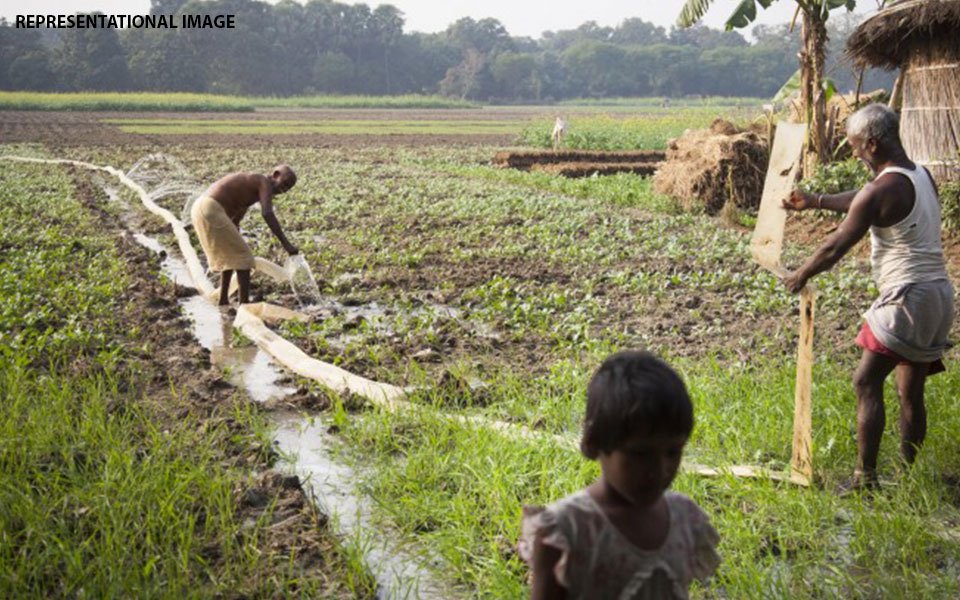
Bhopal, June 1: A mixed response was witnessed to the Madhya Pradesh farmers' call for the 10-day shutdown in the state beginning Friday amid heavy police presence, coninciding with the first anniversary of the death of seven persons in police firing on farmers.
In state capital Bhopal, Mandsaur and other places, milk and vegetables supply was affected, due to which prices of vegetables recorded an uptick.
Security personnel, including those from the paramilitary forces, were deployed in strength.
Though the shutdown had limited affect in big cities and towns, it was widespread in small towns and suburbs.
Aam Kisan Union Kedar Sirohi told IANS: "Farmers are united and continuing with their protest. The state government is trying to make their protest a failure but they are not ready to bow before the government at any cost."
Rashtriya Kisan Mazdoor Mahasangh leader Shivkumar Sharma accused the government of spreading lies and rumours on the agitation by farmers.
"The question is not who is supporting the agitation. The question is if the demands of the farmers are valid," he said.
Let the Truth be known. If you read VB and like VB, please be a VB Supporter and Help us deliver the Truth to one and all.
Efforts of party cadres will be rewarded on May 4: DMK chief Stalin
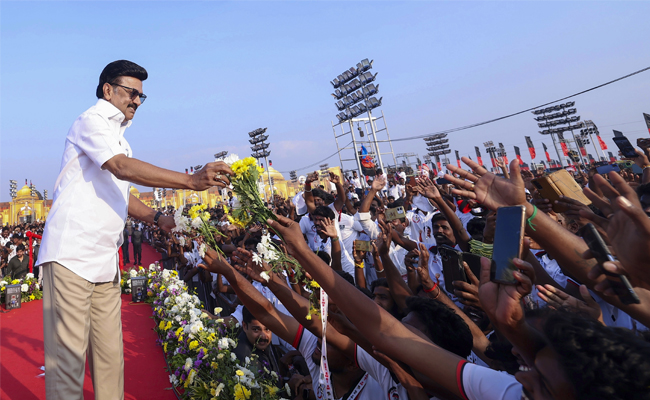
Chennai (PTI): Tamil Nadu Chief Minister M K Stalin on Friday said that the efforts made by his party cadres during the Assembly elections would be rewarded on May 4.
The counting of votes for the Assembly elections held on April 23 will be taken up on May 4.
"We are set to reap the rewards of the hard work put in by our party cadres on the coming fourth (May 4 counting day). There is absolutely no change in this and not even the slightest deviation," Stalin said at a May Day event here.
"There is no need for anyone to assume that I am speaking merely on the basis of exit polls," he added.
Stalin, who is also DMK chief, said that "good news" would come for those eagerly waiting for the election results.
Stating that the DMK governance is based on philosophy and principles, Stalin said, "This will continue."
He recalled the pivotal role of the then Chief Minister C N Annadurai, who first declared May Day as a government holiday, and subsequently, late CM M Karunanidhi, who was instrumental in extending it as a paid holiday across the nation.
"Responding to the request of Kalaingnar (Karunanidhi), the then Prime Minister V P Singh accepted the plea and declared it (May 1) a paid government holiday not merely for Tamil Nadu, but for the entire nation," Stalin said.