Modi government approves ordinance on triple talaq
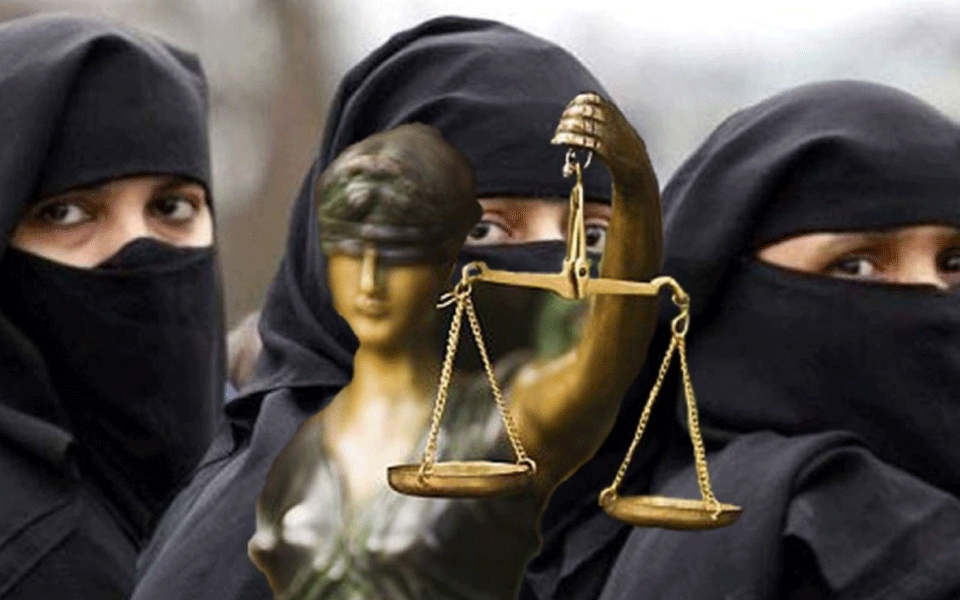
New Delhi, Sep 19: Ahead of Assembly elections in five states, the Union Cabinet on Wednesday approved an ordinance making triple talaq a criminal offence, with the government stating that there was a "compelling necessity" and "overpowering urgency" to do so.
The ordinance, which will be sent to the President for approval, comes against the backdrop of the government's inability to get a bill on the issue passed in the last monsoon session of Parliament.
The government then brought some changes in the original bill providing for only the women or their blood relations to file complaints against the erring husbands in a bid to get support from the Congress and other parties in the Rajya Sabha but did not succeeded in passing it.
Briefing reporters after a meeting of the union cabinet on why it was resorting to an ordinance, Law Minister Ravi Shankar Prasad said that instances of instant triple talaq have "continued unabated" in spite of the Supreme Court declaring it unconstitutional and Lok Sabha passing a bill that is now pending in the Rajya Sabha.
He attacked the Congress and said it had not supported the bill in the Rajya Sabha due to "vote bank politics".
Prasad said the issue pertained to respect for women and not to religion or path of worship.
"The issue of triple talaq has nothing to do with faith, mode of worship. It is pure issue of gender justice and gender equality."
He said triple talaq was still being given on flimsy grounds such as chapati getting burnt and wife waking up late. There were instances of the instant divorce having being given on social media platform WhatsApp, he said.
"Women are being oppressed, they are suffering. Most instances are taking place in Uttar Pradesh," he said.
Giving out figures of triple talaq cases between January 2017 and September 2018 from several states that totalled 430 including 229 before the Supreme Court judgement and 201 later, he said there could be many other unreported cases.
"The bottomline is that cases of triple talaq continue unabated. Whatever we have collected is shocking," he said.
Prasad said several Islamic countries have banned instant triple talaq but it still prevailed in a secular country like India.
He said the offence will become cognizable (with provision of three years imprisonment) if the FIR is filed by the woman or by her blood relations. A compromise can be reached at the initiative of woman and with appropriate conditions imposed by the magistrate concerned.
Prasad also said that bail can be given by the magistrate after hearing the woman who has filed the case. The custody of minor children will go to the mother and she will be entitled to maintenance for herself and her minor children.
He said the purpose was not to break families and a compromise will have the court's seal.
Prasad appealed to UPA chairperson Sonia Gandhi to support the efforts for giving justice to women by rising above the considerations of "vote bank politics."
He made a similar appeal to BSP chief Mayawati and West Bengal Chief Minister Mamata Banerjee. "Support it by rising above politics," he said.
Prasad said the Congress supported the bill in the Lok Sabha but not in the Rajya Sabha.
"Let them publicly say when the session commences we will support it. We would appreciate their support in the House, not before TV channels," he said.
He said the government tried to take the Congress along. Parliamentary Affairs Minister Ananth Kumar had, on the directions of Prime Minister Narendra Modi, met Congress leaders to seek their support for the passage of the bill in the Rajya Sabha.
Asked if steps will be taken for empowerment of Muslim women, including BJP giving ticket during elections, Prasad said the issue should not be reduced to political empowerment: "We are consciously keeping this bill away from political divide. It is for gender justice."
Let the Truth be known. If you read VB and like VB, please be a VB Supporter and Help us deliver the Truth to one and all.
Bhojshala case: Disputed structure built from remains of pre-existing temples, claims ASI
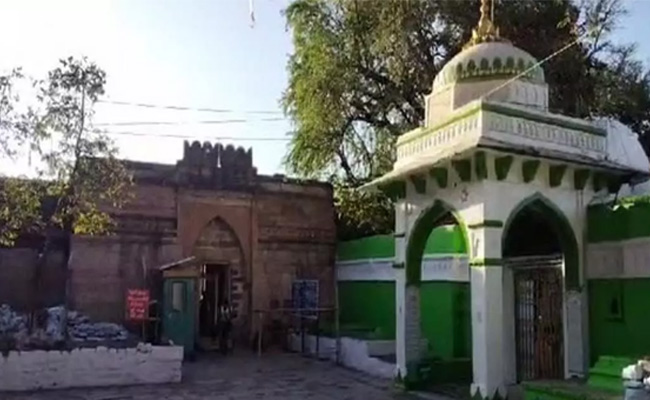
Indore (PTI): The ASI has told the Madhya Pradesh High Court that a massive structure dating back to the Paramara kings' rule existed at the disputed Bhojshala temple-Kamal Maula mosque complex, and the current structure was built from the remains of temples.
The Archaeological Survey of India (ASI) made the claim on Tuesday based on its 98-day scientific survey and over 2,000-page report.
The Hindu community considers Bhojshala a temple dedicated to Vagdevi (Goddess Saraswati), while the Muslim side claims the monument as the Kamal Maula Mosque. The disputed complex is protected by the ASI.
During the hearing before Justices Vijay Kumar Shukla and Alok Awasthi of the HC's Indore bench, Additional Solicitor General Sunil Kumar Jain, representing the ASI, presented a detailed account of the scientific survey conducted two years ago at the complex.
Referring to the ASI's survey report, he said, "Retrieved architectural remains, sculptural fragments, large slabs of inscriptions with literary texts, Nagakarnika inscriptions on pillars, etc, suggest that a large structure associated with literary and educational activities existed at the site. Based on scientific investigations and archaeological remains recovered during the investigations, this pre-existing structure can be dated to the Paramara period."
It can be said that the existing structure was made from the parts of earlier temples, based on scientific investigations, survey and archaeological excavations conducted, study and analysis of retrieved finds, study of architectural remains, sculptures, and inscriptions, art and sculptures, Jain said quoting the report.
Summarising the report, he also drew the court's attention to the fact that the archaeological study identifies that many architectural components, such as pillars and beams, were originally part of temple structures before being repurposed for a mosque.
"The evidence of this transition includes Sanskrit and Prakrit inscriptions that were damaged or hidden, alongside sculptures of deities and animals that were often mutilated or defaced," Jain contended.
The report also states that "all Sanskrit and Prakrit inscriptions are older than the Arabic and Persian inscriptions, indicating that users or engravers of the Sanskrit and Prakrit inscriptions occupied the place earlier".
In light of the Muslim side's earlier objections, the bench wanted to know why there were some discrepancies in the ASI's responses regarding the status of the disputed complex in the cases filed over the years.
The Additional Solicitor General argued that earlier studies of the complex involved only officials, while the current survey involved scientists and the use of advanced technologies such as Ground Penetrating Radar (GPR).
The hearing in the Bhojshala case will continue on Wednesday.
The high court has been regularly hearing four petitions and one writ appeal regarding the religious nature of the Bhojshala temple-Kamal Maula mosque complex since April 6.