Modi government seeks to reduce states' share of central taxes from 2026: Reports
New Delhi: The Union government is considering reducing the share of tax revenue allocated to states, sources familiar with the matter have said.
The proposal will be submitted to the constitutionally-appointed Finance Commission of India, which makes recommendations on tax sharing and other aspects of Union-state fiscal relations. The commission, headed by economist Arvind Panagariya, is expected to submit its recommendations by October 31, with implementation set for the 2026-27 fiscal year. The recommendations are binding.
According to one source, the Union government intends to lower the states' share of tax revenue from the current 41% to at least 40%. A cabinet decision on the proposal is expected by the end of March before being forwarded to the Finance Commission. A 1% reduction in states' share would give the Union government approximately ₹35,000 crore ($4.03 billion), based on current tax projections.
The Ministry of Finance and the Finance Commission have not yet responded to queries regarding the proposal.
The share of central taxes allocated to states has increased from 20% in 1980 to 41% at present. However, the Union government’s spending requirements, particularly during economic slowdowns, have led to calls for a reduced allocation to states. India's fiscal deficit is projected at 4.8% of GDP for 2024-25, while state deficits stand at 3.2% of GDP.
States account for over 60% of total government expenditure, primarily focusing on social infrastructure such as health and education. Meanwhile, the Union government allocates more resources to physical infrastructure. The introduction of the Goods and Services Tax (GST) in 2017 has limited states' ability to generate independent revenue. Additionally, since the COVID-19 pandemic, the Union government has increased the share of cesses and surcharges, taxes not shared with states, to over 15% of gross tax revenue, up from 9-12% earlier.
The Union government is also expected to propose measures to discourage states from offering cash handouts, debt waivers, and other welfare schemes often labeled as "freebies" for political gains. One possibility under consideration is linking Union grants to states' adherence to specific fiscal conditions.
Over the past five years, revenue-deficit grants to states have declined from ₹1.18 lakh crore ($13.61 billion) in 2021-22 to an estimated ₹13,700 crore ($1.58 billion) for 2025-26. It remains unclear whether grants will be denied to states that continue to offer such welfare schemes.
Let the Truth be known. If you read VB and like VB, please be a VB Supporter and Help us deliver the Truth to one and all.
Rupee falls 28 paise to 94.77 against US dollar in early trade
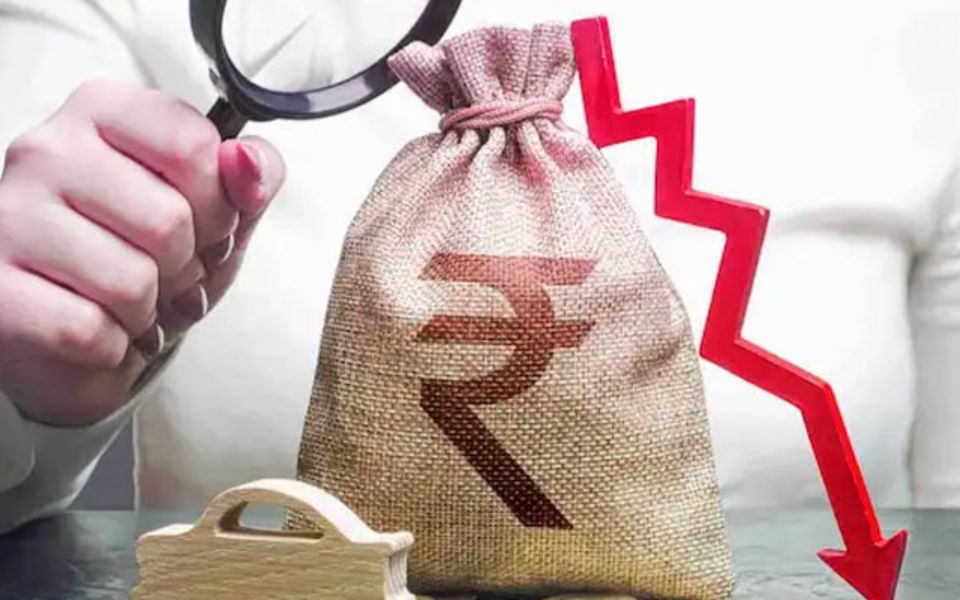
Mumbai (PTI): The rupee depreciated 28 paise to 94.77 against the US dollar in early trade on Thursday as market sentiment took a dramatic turn after reports emerged that the US and Iran are discussing a 14-point Memorandum of Understanding (MOU) aimed at reducing tensions and reopening negotiations.
Forex traders said Brent oil prices, which had fallen to USD 98 on the US-Iran peace deal, edged slightly higher to USD 101 per barrel after investors weighed the prospects for a Middle East peace deal.
Moreover, factors such as unabated foreign capital outflows amid rising geopolitical uncertainties further dented investor sentiment.
At the interbank foreign exchange market, the rupee opened at 94.77 against the US dollar, registering a fall of 28 paise over its previous close.
On Wednesday, the rupee appreciated 69 paise to close at 94.49 against the US dollar.
"Markets are currently focused on the critical 48-hour window during which the US expects Tehran’s formal response through Pakistani mediators," said CR Forex Advisors MD Amit Pabari.
US President Donald Trump on Wednesday threatened Iran with more bombing if it doesn't reopen the Strait of Hormuz, amid a report that the warring sides were nearing an agreement to end the war.
US media outlet Axios reported, quoting US officials and two other sources, that the US and Iran were getting close to a one-page memorandum of understanding to end the war and set a framework for more detailed nuclear negotiations.
The US expects Iranian responses on several key points over the next 48 hours, Axios reported, adding that nothing has been agreed yet. This was the closest the parties had been to an agreement since the war began.
Meanwhile, the dollar index, which gauges the greenback's strength against a basket of six currencies, was trading at 98.01, down 0.01 per cent.
Brent crude, the global oil benchmark, was trading higher by 0.65 per cent at USD 101.83 per barrel in futures trade.
On the domestic equity market front, the 30-share benchmark index Sensex declined 160.24 points to 77,798.28 in early trade, while the Nifty was down 30.25 points to 24,300.70.
Foreign Institutional Investors offloaded equities worth Rs 5,834.90 crore on Wednesday, according to exchange data.
On the domestic macroeconomic front, the country's goods and services exports rose 4.6 per cent to an all-time high of USD 863.11 billion during 2025-26, up from USD 825.26 billion in 2024-25, despite global economic uncertainties, according to revised commerce ministry data.
Merchandise exports grew 0.93 per cent to USD 441.78 billion in the last fiscal year from USD 437.70 billion in 2024-25, the data showed.