Modi govt bulldozed MGNREGA, says Sonia Gandhi, vows fight against new 'black law'
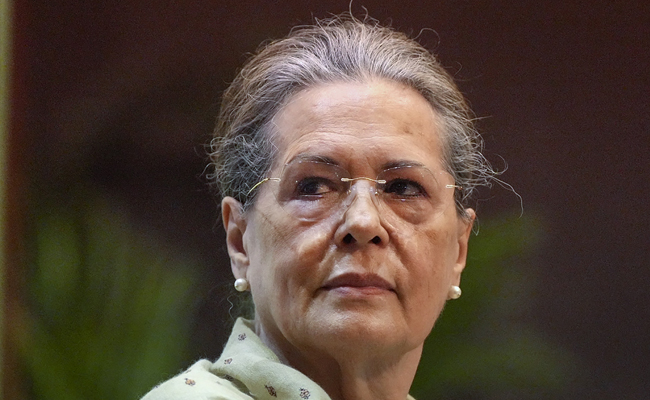
New Delhi (PTI): Congress Parliamentary Party chairperson Sonia Gandhi on Saturday accused the Modi government of bulldozing the MGNREGA, and asserted that the "black law" that seeks to repeal it will be defied by the lakhs of party workers across the country.
In a video message, she said that by weakening MGNREGA, the Modi government had attacked the interests of crores of farmers, labourers, and landless across the country.
She alleged that over the past 11 years, the Centre had ignored the interests of the rural poor.
Addressing the rural population, Gandhi said she vividly remembers the day 20 years ago, when Manmohan Singh was prime minister, and the MGNREGA Act was passed in Parliament by consensus.
ALSO READ: In PM’s absence, Bengal Guv launches national highway projects worth Rs 3,200 cr
The former party president said it was "such a revolutionary step," and became a means of livelihood for the deprived, the exploited, and the poorest of the poor.
She said, due to MGNREGA, migration in search of work came to a halt, a legal right to employment was provided, and gram panchayats were empowered.
"Through MGNREGA, a concrete step was taken towards realising the dream of an India based on Mahatma Gandhi's vision of Gram Swaraj," she said.
"But it is a matter of great regret that just recently, the government ran a bulldozer over MGNREGA. Not only was Mahatma Gandhi's name removed, but the form and structure of MGNREGA was changed arbitrarily without any deliberation, without consulting anyone, without taking the opposition into confidence," the Congress leader alleged.
She said under the new law, who gets how much employment, where and in what manner, will be decided by the government in Delhi, which is far removed from the ground realities.
Claiming that the Congress had a major role in bringing and implementing MGNREGA, she said it was never a party-specific matter.
"It was a scheme connected to the national interest and the people's interest. By weakening this law, the Modi government has attacked the interests of crores of farmers, labourers, and landless poor in the rural sector across the country.
"We are all ready to counter this attack. Twenty years ago, I too fought to secure the right to employment for our poor brothers and sisters; today, I remain committed to fighting against this black law. All Congress leaders like me and lakhs of workers stand with you," Gandhi said in her video statement.
The Congress earlier claimed that it would take its fight against the repeal law to the grassroots.
Parliament on Thursday passed the VB-G RAM G Bill that seeks to replace the 20-year-old Mahatma Gandhi National Rural Employment Guarantee Act, or MGNREGA.
The proposed bill that guarantees 125 days of rural wage employment every year was met with vociferous protests by the Opposition.
Defending the bill, Union minister Shivraj Singh Chouhan asserted that it was needed to fix shortcomings in the old scheme.
The Viksit Bharat Guarantee for Rozgar and Ajeevika Mission (Gramin) (VB-G RAM G) Bill was passed by the Rajya Sabha with a voice vote, hours after the Lok Sabha cleared it on Thursday.
The Opposition strongly protested the removal of Mahatma Gandhi's name from the MGNREGA, and said that the government was putting the financial burden on states.
Let the Truth be known. If you read VB and like VB, please be a VB Supporter and Help us deliver the Truth to one and all.
Maharashtra sets up state vaccination task force to strengthen immunisation programme

Mumbai (PTI): The Maharashtra government has set up a State Vaccination Task Force to strengthen the regular immunisation programme and review the progress of related campaigns, a health department official said on Monday.
The State Vaccination Task Force will comprise at least 29 members and will be headed by the administrative head of the health department, he informed.
The government has also constituted separate district-level and municipal vaccination task forces to improve implementation and address challenges at the grassroots level, he said.
Municipal task forces, chaired by respective civic commissioners, have been constituted in view of the vast urban population in Maharashtra and the role of civic bodies in implementing different health programmes.
The district-level task forces will function under the chairmanship of collectors.
"Complete immunisation of children at the appropriate age is an extremely simple, cost-effective and highly effective measure to reduce child mortality and the prevalence of diseases among kids. Immunisation is a powerful tool for reducing illness in children," maintained the official.
To ensure full vaccination of all children, the state government implements various campaigns from time to time as per the central government guidelines, he pointed out.
"Active participation and cooperation of other relevant government departments are essential (in making these campaigns successful)," according to the official.
The state-level body will review the regular immunisation programme, associated campaigns and vaccine-preventable diseases in detail. It will also conduct focused assessments of high-risk districts and municipal corporations, including vacancies at district, municipal and sub-district levels, availability of cold chain equipment, resource gaps and training requirements, he noted.
The state task force will review allocation and utilisation of funds for immunisation and ensure timely action by officers concerned based on reports from district and municipal task forces and state-level monitoring mechanisms, the official said.
It will also ensure active coordination and participation of other government departments in immunisation drives, while district and municipal task forces will carry out similar functions at their respective levels, the official added.