Modi govt promoting concentration of wealth; it's direct attack on soul of democracy: Congress
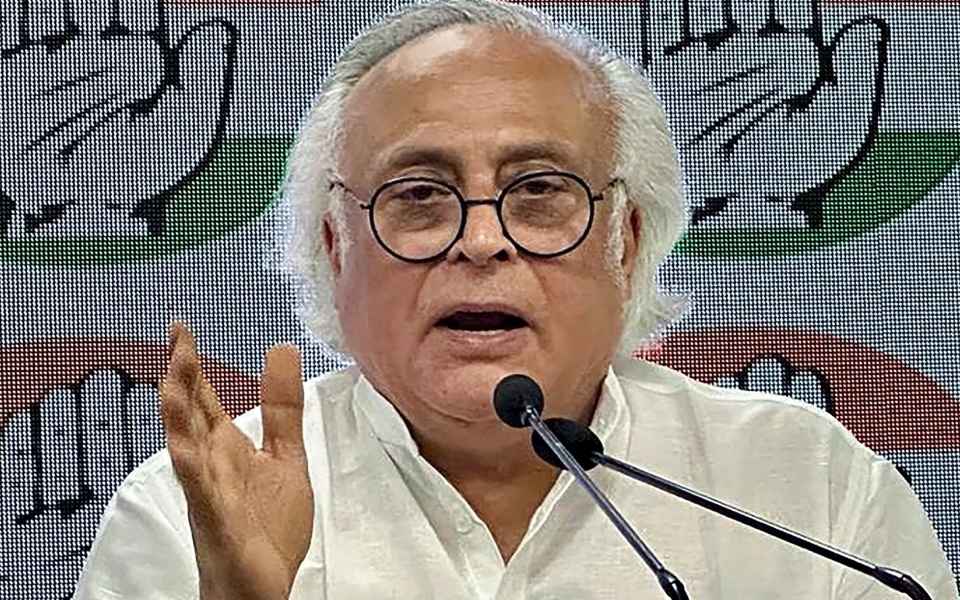
New Delhi, (PTI): Flagging the issue of concentration of wealth, the Congress on Sunday alleged that it is driven by the Modi government's economic policies and asserted that it is not just a problem for the economy, but a "direct attack on the very soul of democracy".
Congress general secretary in-charge communications Jairam Ramesh shared a media report on X which claimed that India is now becoming the new hub of billionaires and the number of rich people in the country is increasing rapidly year after year.
"One report after another is warning about the widespread concentration of wealth in India. While millions of Indians struggle to meet daily needs, just 1,687 people possess half the country's wealth," Ramesh said in a post in Hindi on X.
एक के बाद एक रिपोर्ट भारत में धन के व्यापक केंद्रीकरण के बारे में आगाह कर रही है।
— Jairam Ramesh (@Jairam_Ramesh) October 5, 2025
एक तरफ करोड़ों भारतीय रोज़मर्रा की ज़रूरतें पूरी करने के लिए संघर्ष कर रहे हैं, वहीं दूसरी तरफ सिर्फ़ 1687 लोगों के पास देश की आधी दौलत है।
मोदी सरकार-प्रेरित आर्थिक नीतियों के कारण धन का इतना… pic.twitter.com/9cRluF1tDo
"This huge concentration of wealth, driven by the Modi government's economic policies, is creating massive economic inequality in our country. This inequality is giving rise to widespread social insecurity and discontent," he said.
Recent events in other countries have shown that this same extreme economic inequality and crippled democratic institutions have become catalysts for political anarchy, he said.
This government is pushing India down the same path, Ramesh said.
"A few industrialists are becoming richer and richer due to the power nexus. The Prime Minister's policies are focused solely on the benefits of his few industrialist friends," he alleged.
The MSME sector, the backbone of India's economy, is under unprecedented pressure and this pressure is the result not only of domestic policies but also of foreign policy failures, he claimed.
"Earning opportunities for ordinary people are shrinking. Inflation has risen so high that even employed people are increasingly burdened with debt instead of savings. Investment in education and health is steadily declining, and social security schemes are being weakened," Ramesh said.
Successful schemes like MGNREGA, which provided a social and economic security net for millions of people, are now grappling with wage crises, he said, adding that workers are not even getting paid on time.
"Such extreme concentration of wealth is not just a problem for the economy, but a direct attack on the very soul of democracy. When economic power is concentrated in a handful of hands, political decisions also begin to favour them," Ramesh said.
This is leading to a growing social and economic inequality, he said.
As a result, millions of citizens are gradually being excluded from the process of democracy and development, Ramesh said.
The cumulative wealth of those in the M3M Hurun India Rich List 2025 is pegged at Rs 167 lakh crore, equivalent to nearly half of India's GDP.
The list has 1,687 individuals with wealth of Rs 1,000 crore, which was up by 284 while there are 148 new entrants.
Hurun said India has created a billionaire every week for the past two years now, with those in the list adding Rs 1,991 crore in wealth every day.
Let the Truth be known. If you read VB and like VB, please be a VB Supporter and Help us deliver the Truth to one and all.
NIA registers case to probe recovery of 79 crude bombs in poll-bound West Bengal
New Delhi (PTI): The National Investigation Agency (NIA) on Sunday registered a case to probe recovery of 79 crude bombs in poll-bound West Bengal, officials said.
The move came following a directive by the Union Home Ministry in this regard, they said.
In pursuance to the home ministry's order, the anti-terror agency on Sunday registered a case, which was originally filed at Uttar Kashi police station, Bhangar division, Kolkata on Saturday, and took up the investigation, an NIA spokesperson said in a late night statement.
"The case pertains to recovery of 79 crude bombs and other incriminating materials by Kolkata police, which were being stored at a spot, thereby endangering human life and property," the spokesperson said.
Earlier in the day, the Election Commission had directed the West Bengal Police to launch a special drive to arrest those involved in illegal manufacturing of crude bombs in the poll-bound state, an official said.
It asserted that all cases related to the making of any such explosive would be probed by the National Investigation Agency, the official said.
The directive came after the police recovered a large number of crude bombs from the house of a person, allegedly a TMC worker, at Bhangar in South 24 Parganas district, days ahead of the second and final phase of the assembly polls in the state.
The explosives were recovered during a search at the residence of Rafikul Islam following specific inputs, the official said.
The poll panel also issued a warning to senior police officers across the state over any lapse in maintaining law and order before the April 29 polling.
The first phase of the assembly elections in West Bengal was held on April 23, while the second phase will take place on April 29. Votes will be counted on May 4.
A record 93.19 per cent turnout has been recorded in the first round of polling. Bhangar will vote in the second phase.