Modi govt sent CBI to Sisodia home after NYT carried positive story on Delhi model of education: AAP
New Delhi (PTI): The BJP-led Centre sent the CBI to conduct searches at Deputy Chief Minister Manish Sisodia's residence here just after the New York Times published a positive story in its front page about the Delhi model of education, AAP leaders said.
Aam Aadmi Party (AAP) national spokesperson and Rajya Sabha MP Sanjay Singh termed the CBI action against Sisodia "petty thinking of Prime Minister Narendra Modi, while Delhi Chief Minister Arvind Kejriwal assured of extending all cooperation to the probe agency and asserted it will not find anything incriminating against his deputy.
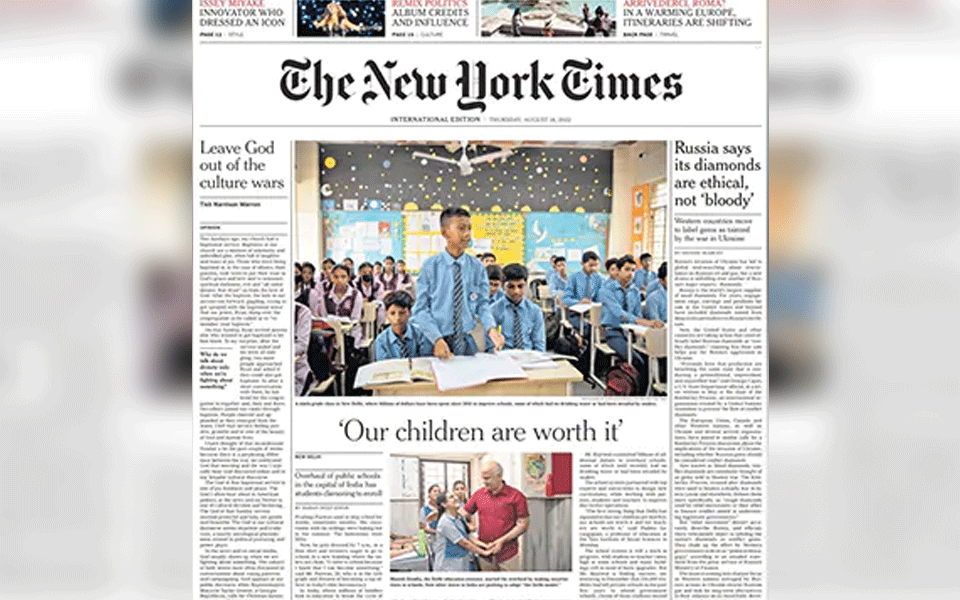
On August 18, The New York Times published a story in the front page of its international edition titled, 'Our children are worth it', highlighting the broader transformation of Delhi's education system during the Aam Aadmi Party regime and noting that the overhaul of the public schools in the capital of India has students clamouring to enroll".
Along with the story, the NYT also published a picture of Sisodia with three girl students of Delhi government schools, with the caption, "Manish Sisodia, the Delhi education minister, started the overhaul by making surprise visits to schools. Now other states in India are pushing to adopt the Delhi model."
"The day Delhi education model's praise and Manish Sisodia's photograph was published in the front page of America's largest (selling) newspaper NYT, Centre sent the CBI to Manish's residence, Kejriwal said in a tweet in Hindi.
The CBI is welcome. Will fully cooperate. There have been many tests/raids in the past as well. Nothing came out. Still nothing will come out, he said.
In another tweet in Hindi, the chief minister alleged the Union government under Prime Minister Narendra Modi is using the central investigation agencies to raid and arrest his ministers because the education and health model of his government in Delhi is being discussed all over the world.
"The whole world is discussing the education and health model of Delhi. They want to stop it. That is why the raids and arrests on Delhi's health and education ministers, he said in his tweet.
Whoever tried to do good work in 75 years was stopped. That's why India was left behind. Will not let Delhi's good works stop, Kejriwal added.
Addressing a press conference, AAP leader Sanjay Singh hit out at the prime minister over the CBI action against Sisodia, saying the investigation agency was sent to conduct searches at the Delhi education minister's residence and other locations after the NYT published a story on the Delhi model of education on its front page.
Entire country is happy with it. Sisodia is being discussed all over the world. But our prime minister's thinking is so petty that he sent the CBI to Sisodia's residence..., he said, calling the CBI action against the deputy chief minister a shame .
Senior AAP leader and Punjab Chief Minister Bhagwant Mann hailed Sisodia as the best education minister of Independent India and hit out at the prime minister over the CBI action against him, wondering how will the country progress if such things happen.
Manish Sisodia is the best education minister of independent India. Today the largest US newspaper NYT printed his photo on the front page. And, today itself, Modi ji sent the CBI to his house, Mann said in a tweet in Hindi, asking, How will India progress like this?
AAP Rajya Sabha member from Punjab Raghav Chadha also slammed the BJP.
The BJP's CBI has raided the residence of Manish Sisodia, hero of the education revolution. They have got many raids conducted but nothing incriminating could be found. Keep getting such raids done. We will fully cooperate in the investigation, he said in a tweet.
Let the Truth be known. If you read VB and like VB, please be a VB Supporter and Help us deliver the Truth to one and all.
Massive turnout in assembly polls across states, women voters outnumber men: EC data
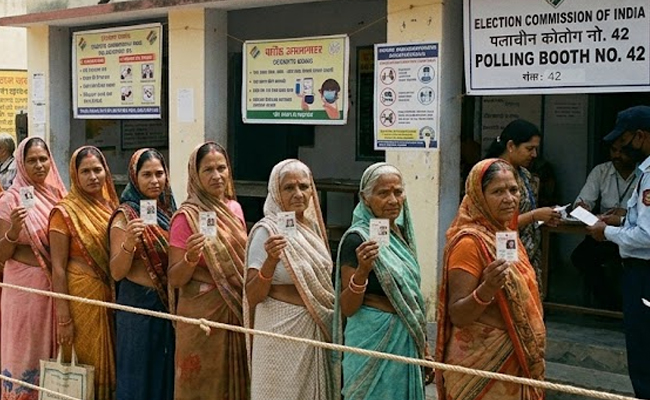
New Delhi (PTI): The recently-concluded assembly elections witnessed exceptionally high voter participation across states, with women voters outnumbering men in turnout percentages, according to Election Commission data.
West Bengal recorded the highest voter turnout among states, with 93.71 per cent polling in 293 constituencies where counting has been completed. The state saw over 6.38 crore votes cast, including postal ballots, against a total of more than 6.81 crore electors.
Women voters recorded a turnout of 93.8 per cent in the West Bengal Assembly polls, slightly higher than the 92.06 per cent participation among men.
The data for West Bengal does not include the figures for the Falta assembly constituency, which is scheduled for repolling.
Tamil Nadu registered an 85.01 per cent turnout, with nearly 4.8 crore votes polled from an electorate of 5.74 crore. Women voters recorded a turnout of 86.2 per cent, higher than the 83.77 per cent among men.
Assam also witnessed robust participation, with the final turnout touching 85.74 per cent. More than 2.15 crore votes were cast in the state, while female turnout at 86.53 per cent marginally exceeded the 84.95 per cent recorded among male voters.
Kerala registered a turnout of 78.11 per cent, with over 2.12 crore votes polled. Female voter participation stood at 81.17 per cent against 74.9 per cent among men.
Puducherry recorded a turnout of 89.82 per cent, with women voters again leading participation at 91.39 per cent. More than 8.5 lakh votes were polled in the Union territory.
Yet, women's representation among elected candidates remained modest.
Tamil Nadu elected 23 women MLAs (9.83 per cent) out of 234 members, West Bengal elected 37 women legislators (12.62 per cent) out of 293, while Kerala returned only 11 women MLAs (7.85 per cent) in the 140-member House.
Only two third-gender candidates contested the elections - one each from Tamil Nadu and Kerala, and both lost, forfeiting their deposits.
The elections also reflected extensive electoral mobilisation infrastructure. West Bengal had the highest number of polling stations at 85,092, followed by Tamil Nadu with 75,064 and Assam with 31,490.
In terms of candidates, Tamil Nadu saw the largest contest with 4,023 candidates in the fray across 234 constituencies, averaging 17 candidates per seat and peaking at 79 contestants in one constituency.
West Bengal pitted 2,920 candidates for 293 constituencies, while Kerala had the fewest contestants among the major states, with 883 candidates for 140 seats.
The data also showed relatively low NOTA votes across states. Tamil Nadu recorded the lowest NOTA share at 0.4 per cent of total votes polled, while Assam recorded the highest at 1.23 per cent. In West Bengal, 0.78 per cent of the total votes polled were NOTA, while it 0.77 per cent and 0.57 per cent of the electorate opted for None of the Above (NOTA) in Puducherry and Kerala, respectively.