Modi govt should reveal National Monetisation Pipeline objectives: Chidambaram
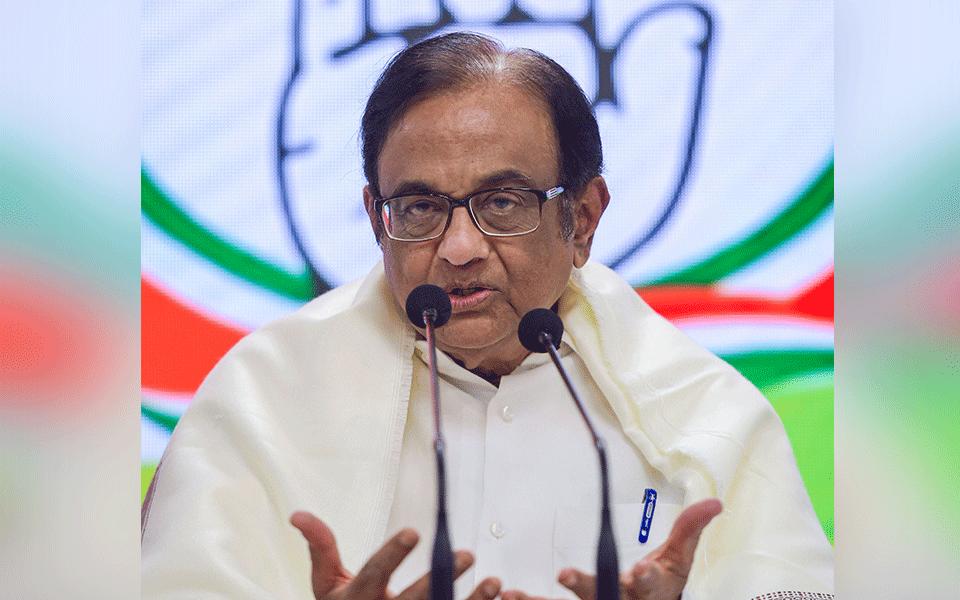
Mumbai, (PTI): Former Union finance minister P Chidambaram on Friday demanded that the Centre reveal the objectives of the National Monetisation Pipeline (NMP) and if its sole objective was raising revenue over a four-year period.
Addressing a press conference, Chidambaram posed 20 questions to the Modi government and said his Congress party has objections and reservations about NMP and the government's proposal to monetise identified assets and earn revenue of Rs six lakh crore over four years.
He said the identified assets must be currently yielding a certain revenue every year.
Has the government calculated the difference between the current undisclosed revenue and the expected revenue of Rs six lakh crore over four years? If so, what is the difference between the two amounts every year during the four years, he asked.
The NMP is intended to co-terminus with the National Infrastructure Pipeline (NIP) that is expected to require Rs 100 lakh crore. How will Rs six lakh crore over four years be sufficient to finance the Rs 100 lakh crore NIP, he asked.
The senior Congress leader also wanted the government to specify that the Rs six lakh crore, when realised, will not be used to partly finance the fiscal deficit of Rs 5.5 lakh crore in 2021-22 or for retiring old debts.
He also sought to know from the government the total capital investment in the identified assets that are expected to yield the expected revenue of Rs six lakh crore.
Chidambaram also asked if the lessee in the monetised assets will maintain the current level of employment and the policy of reservations.
He also wanted to know if the government has examined the impact of NMP on the prices of goods and services in the sector/industry concerned.
Slamming the NMP, he said the Congress party monetised non-core, loss-making assets when in power, in stark contrast to what the Narendra Modi-led government proposes to do.
The Congress government never sold off strategic assets, he said. We always ensured that there is no monopoly in monetisation as we chose assets based on criteria," he added.
Chidambaram asked the government if provisions will be included in the invitation to bid (ITB) to ensure the monetisation process doesn't create monopolies or duopolies in the sector.
What provisions will be included to prevent monopolies emerging in ports, airports, telecom and power sectors," he asked.
What the Modi government plans is a day-light robbery of assets which took years to build," he said.
Chidambaram demanded that the Centre reveal the current revenue from the assets it plans to sell.
Konkan Railway and Delhi Mumbai freight corridor will also be sold," he said, adding the announcement was made without discussions and consultations and to avoid parliamentary debate.
Chidambaram asked the government to reveal the value of assets that will come back to the government after a period.
What are the objectives of the National Monetisation Pipeline? Is the sole objective raising revenue over a four-year period, he asked.
The finance minister must be surely owning a house somewhere in India. She should give it to me on lease for 99 years and she can hang on with the paper that calls her as the owner of the house. What will I give back to her after 99 years? Will I maintain, repair and upgrade it if I am not the owner, he said, referring to the government's stand that it will continue to be the owner of the assets.
"What will be the interest of the party in maintaining the assets if it is not the owner," he asked.
Chidambaram said in listing the assets to be monetised, the government has acknowledged the work done in the last 70 years. A big lie has been exposed by its list, he added.
He said people should raise their voices against the danger of selling assets.
Asked if Congress plans to challenge the government legally, he said so far only a policy announcement has been made.
After the invitation to bid (ITB) process starts, someone will surely challenge it. Congress prefers the people's court and we will raise awareness about the dangers, he said.
Chidambaram asked if the government will stipulate in the contract that the amount of depreciation should be put in a depreciation reserve account used only to maintain, upgrade or add to the assets so that at the end of the lease period, a valuable asset is returned to the government. He also asked if there will be asset stripping by the lessee.
Let the Truth be known. If you read VB and like VB, please be a VB Supporter and Help us deliver the Truth to one and all.
Steel mirrors deployed in Mysuru to discourage public urination
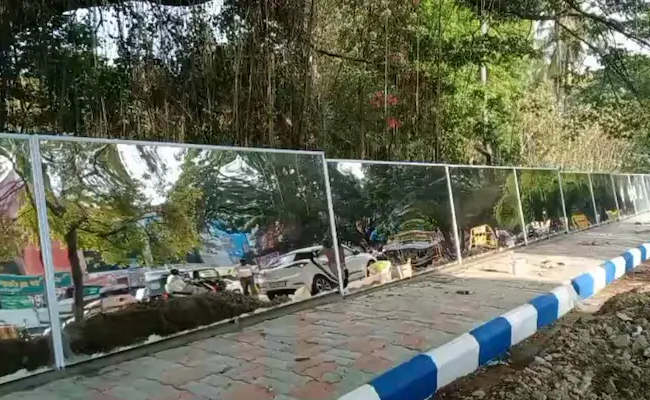
Mysuru (PTI): Fed up with people relieving themselves along roadsides, the Mysuru City Corporation has adopted a unique strategy to curb the practice and promote civic sense by installing reflective steel mirrors along pavements, officials said on Friday.
In what officials described as a first-of-its-kind initiative, the Corporation installed stainless steel sheets with a mirror finish along an 80-metre stretch opposite the Mysuru Suburban Bus Stand.
Officials said the reflective sheets are intended to confront anyone attempting to urinate in public with their own reflection, thereby discouraging the act psychologically.
“The idea is to maintain cleanliness and hygiene, prevent public nuisance, and promote civic sense. It is a simple yet psychological approach that encourages self-awareness through reflection,” officials added.
Soon after the mirrors were installed, videos of the initiative went viral on social media, with many people appreciating the administration’s innovative attempt to address public urination. At the same time, some users pointed out the lack of basic civic sense among people.
Several social media users also suggested that more public toilets, maintained in a hygienic condition, were needed to further discourage open urination.
Explaining how the idea originated, Nitesh Patil, Administrator and Regional Commissioner of the Mysuru City Corporation, told PTI that despite a public toilet being located next to the bus stand, many people continued to urinate in the open.
Even fines and warnings failed to deter them from relieving themselves against vacant compound walls, leaving behind a foul smell.
“One of our engineers came up with this idea, and we decided to implement it. The initiative has received a very positive response from the public, social media, and the press. We are now planning to identify more such locations in the city and install similar reflectors,” he said.
According to him, to ensure that the installation is both effective and visually appealing, LED lighting that switches on along with the streetlights has also been added, causing the stretch to glow at night and enhancing the city’s appearance.
Patil said the initiative had helped create civic awareness while also beautifying the city.
“We want our city to be clean and hygienic. We aspire to become the cleanest city in the country,” he added, recalling that Mysuru secured third place nationally in the Swachh Survekshan Awards 2024–25 last year.