Modi govt's response on Palestine issue abdication of humanity, morality: Sonia Gandhi

New Delhi (PTI): Asserting that India needs to demonstrate leadership on the issue of Palestine, Congress Parliamentary Party chairperson Sonia Gandhi on Thursday slammed the Modi government's stance, saying its response has been characterised by a "profound silence" and an abdication of both humanity and morality.
She said the government's actions appear to be driven primarily by the personal friendship between Prime Minister Narendra Modi and his Israeli counterpart Benjamin Netanyahu and rather than India's constitutional values or its strategic interests.
"This style of personalised diplomacy is never tenable and cannot be the guiding compass of India's foreign policy. Attempts to do the same in other parts of the world, most notably in the United States, have come undone in the most painful and humiliating ways in recent months," Gandhi said in her article published in The Hindu.
This is the third article by Gandhi on the Israel-Palestine conflict, published in a national daily in the recent past, in which she has vehemently criticised the Modi government's stance on the issue.
India's standing on the world stage cannot be wrapped up into the personal glory-seeking ways of one individual, nor can it rest on its historical laurels. It demands persistent courage and a sense of historical continuity, she said in her article titled 'India's muted voice, its detachment with Palestine'.
Gandhi pointed out that France has joined the United Kingdom, Canada, Portugal and Australia in recognising Palestinian statehood -- "the first step in the fulfilment of the legitimate aspirations of the long-suffering Palestinian people".
More than 150 of the 193 countries that are members of the United Nations have now done so, she said.
Gandhi underlined that India had been a leader in this regard having formally recognised Palestinian statehood way back on November 18, 1988, after years of support to the Palestine Liberation Organisation (PLO).
She cited the examples of how India raised the issue of Apartheid South Africa even before Independence and during the Algerian struggle for independence (1954-62), India was one of the strongest voices for an independent Algeria.
In 1971, India intervened firmly to prevent genocide in what was then East Pakistan, midwifing the birth of modern-day Bangladesh, she pointed out.
On the critical and sensitive issue of Israel-Palestine as well, India has long maintained a delicate but principled position, emphasising its commitment to peace and the protection of human rights, the former Congress chief said.
India needs to demonstrate leadership on the issue of Palestine, which is now a battle for justice, identity, dignity and human rights, Gandhi asserted.
In the last two years, since the outbreak of hostilities between Israel and Palestine in October 2023, India has all but relinquished its role, she opined.
"The brutal and inhumane Hamas attacks on Israeli civilians on October 7, 2023, were followed by an Israeli response that has been nothing less than genocidal. As I have previously raised, more than 55,000 Palestinian civilians have been killed, including 17,000 children," she said.
The residential, schooling and health infrastructure of the Gaza Strip has been obliterated, as have agriculture and industry, Gandhi said.
"Gazans have been forced into a famine-like situation, with the Israeli military cruelly obstructing the delivery of much-needed food, medicine, and other aid -- a 'drip-feeding' of aid amidst an ocean of desperation," she said.
In one of the most revolting acts of inhumanity, hundreds of civilians have been shot down while trying to access food, she pointed out.
Gandhi opined that the world has been slow to respond, implicitly legitimising the Israeli actions.
The recent moves by several countries to recognise Palestine as a sovereign state are a welcome and long-due departure from the policy of inaction, she said.
"This is a historical moment and an assertion of the principles of justice, self-determination and human rights. These steps are not merely diplomatic gestures; they are affirmations of the moral responsibility that nations bear in the face of prolonged injustice.
It is a reminder that in the modern world, silence is not neutrality, it is complicity," she said.
And here, India's voice, once so unwavering in the cause of freedom and human dignity, has remained "conspicuously muted", Gandhi said, hitting out at the Modi government.
Meanwhile, it is appalling that just two weeks ago, India not only signed a bilateral investment agreement with Israel, in New Delhi, but also hosted its highly controversial far-right finance minister who has invited global condemnation for his repeated incitements of violence against Palestinian communities in the occupied West Bank, she said.
Gandhi argued that India must not approach the issue of Palestine as merely a matter of foreign policy but as a test of India's ethical and civilisational heritage.
The people of Palestine have endured decades of displacement, prolonged occupation, settlement expansion, restrictions on movement and repeated assaults on their civil, political and human rights, she said.
Their plight echoes the struggles that India faced during the colonial era -- a people deprived of their sovereignty, denied a nationhood, exploited for their resources, and stripped of all rights and security.
"We owe Palestine a sense of historical empathy in its quest for dignity, and we also owe Palestine the courage to translate that empathy into principled action," she said.
Let the Truth be known. If you read VB and like VB, please be a VB Supporter and Help us deliver the Truth to one and all.
Putin meets Iran's FM Araghchi, says Russia ready to do its best to help bring peace to West Asia
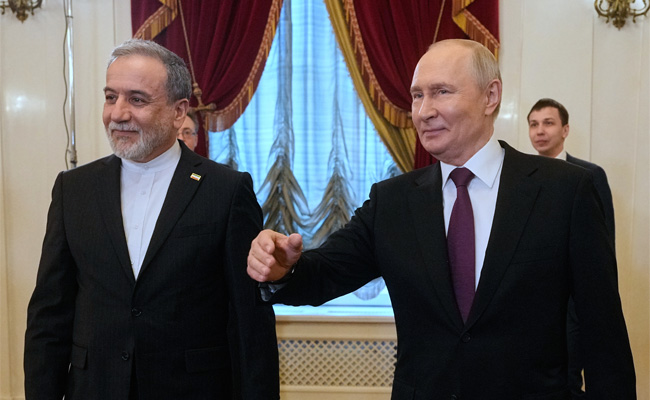
Moscow (PTI): Iran's Foreign Minister Abbas Araghchi on Monday met Russian President Vladimir Putin, who hailed the Iranian people for fighting bravely and heroically for their sovereignty and said Moscow is ready to do its best to help bring peace to West Asia as soon as possible.
Araghchi, who held talks with Omani and Pakistani leadership before arriving in Russia, met Putin in St. Petersburg and thanked him for supporting Iran, state-owned TASS news agency reported.
"Russia is ready to do everything in its power to ensure that peace in the Middle East is achieved as soon as possible," Putin said during his meeting with Araghchi, which was also attended by Russian Foreign Minister Sergey Lavrov.
Revealing that he received a message from Iranian Supreme Leader Mojtaba Khamenei last week, Putin asked Araghchi to convey his "gratitude for this message and best wishes for his health and well-being."
He praised the Iranian people for fighting "bravely and heroically" for their sovereignty, Iran's state-run PRESS TV reported.
"We really hope that, based on the courage and desire for independence, the Iranian people, under the guidance of the new leader, will weather this difficult period of trials and peace will come,” Putin said.
He also stressed that Russia “intends to maintain” its strategic relations with Iran.
Araghchi said that the world witnessed Iran’s strength in countering the US during the recent war, and that the Islamic Republic is a "stable and powerful establishment."
"With their courage, the Iranian people succeeded in resisting the US aggression and will be able to endure it,” he said.
He said that it became clear that Iran has “great friends and allies” like Russia, and conveyed “warmest greetings” from Supreme Leader Mojtaba Khamenei and President Masoud Pezeshkian to the Russian leader.
Araghchi said relations between Moscow and Tehran represent a “strategic partnership at the highest level” and will continue to develop "regardless of circumstances."
"We are grateful to you for the solid and strong positions in support of the Islamic Republic of Iran," he said.
Foreign Minister Lavrov said that the talks between President Putin and the Iranian Foreign Minister were "useful and constructive."
Kremlin Spokesman Dmitry Peskov later said that Russia is "ready to provide any good offices, any mediation services that are acceptable to the parties."
"We will be ready to do everything so that ultimately peace ensues, guaranteed peace, and that there is no return to hostilities," Peskov was quoted as saying by TASS.
He was asked how Moscow can assist in future negotiations on the Iranian settlement.
Araghchi arrived in Russia after his whirlwind trip to Islamabad, which, according to him, was “very productive” and involved “good consultations" with Pakistan's Army Chief Field Marshal Asim Munir, amid uncertainty over the second round of peace talks to resolve the war in West Asia.
"We held good consultations with our friends in Pakistan. The trip was successful. We assessed the outcome of our recent (meetings) and discussed in what direction and under what conditions talks can move on,” Araghchi said in a video posted on his Telegram channel upon his arrival in St Petersburg.
Referring to the second round of talks between the US and Iran to resolve the conflict in West Asia, Araghchi said: "Developments have taken place in the negotiations."
"Despite some progress in earlier rounds, the talks failed to reach their objectives due to the Americans' approach, the excessive demands they made, and the wrong approaches they adopted. Therefore, it was necessary to consult with our friends in Pakistan to review the latest situation,” Iran's official news agency IRNA quoted him as saying.
He said that the trip to Pakistan was a good opportunity to review developments related to the US-Israeli war against Iran, expressing confidence that “these consultations and coordination between the two countries will be highly significant.”
Araghchi arrived at St. Petersburg's Pulkovo Airport early Monday, where he was welcomed by Russian officials and Iran’s ambassador to Russia, Kazem Jalali, the report said.
The first round of peace talks between Iran and the US, held on April 11 and 12, failed to bring the desired result for the parties to the conflict.
The Iranian minister arrived in Islamabad for the second time on Sunday after a short visit to Oman, where he held talks with Sultan Haitham bin Tariq al-Said on security in the Strait of Hormuz and diplomatic efforts to end the Iran-US conflict.
After Araghchi left Pakistan for Oman on Saturday, President Donald Trump announced that US negotiators Steve Witkoff and Jared Kushner would no longer be going to Islamabad for talks with Iran, contending that Washington held all the cards on the matter.
Trump on Sunday reiterated that the US and Iranian officials can talk by phone for a peace solution to the conflict.
On Tuesday, Trump extended the two-week ceasefire with Iran indefinitely to give Tehran more time to prepare a unified proposal to end the war, just hours before the truce was set to expire.
The war began when the US and Israel jointly attacked Iran on February 28, killing Iranian Supreme Leader Ayatollah Ali Khamenei and several top commanders. The retaliation by the Islamic Republic extended the war to the entire Gulf region.