Modi in J&K: Internet suspended, schools closed
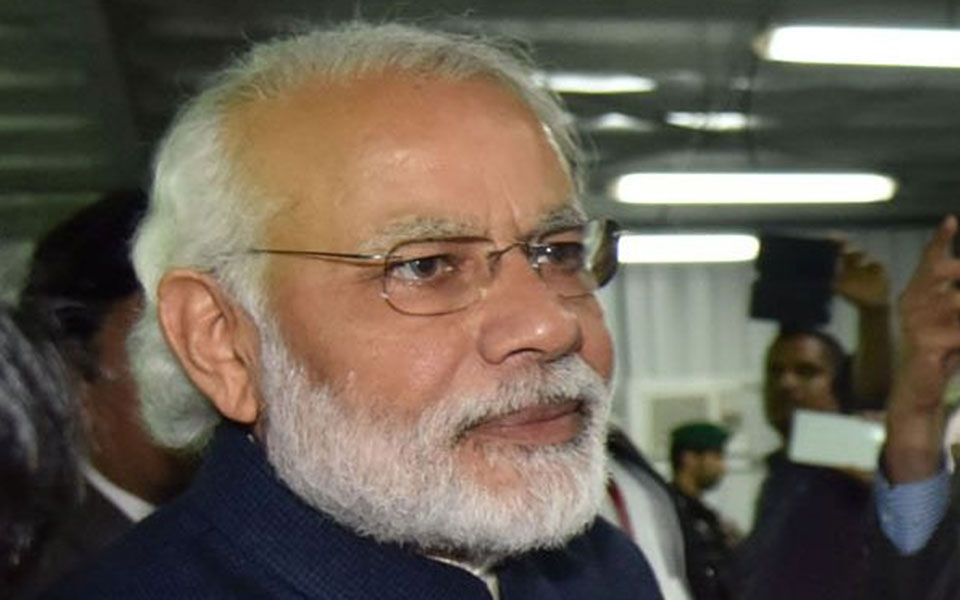
Srinagar, May 19: Prime Minister Narendra Modi arrived in Leh town of the Ladakh region on Saturday beginning his day-long visit to Jammu and Kashmir amid hightended security as authorities suspended internet services and shut down schools and colleges for the day.
Modi was received at the Leh Airport by Governor N.N. Vohra and Chief Minister Mehbooba Mufti.
As separatists called for protest march to Srinagar's city centre Lal Chowk against Modi's visit, the authorities suspended mobile internet services across the Kashmir Valley as a precautionary measure, police said.
Restrictions were also imposed in several areas in Srinagar. All schools and colleges were shut for the day.
Separatists leaders, including Syed Ali Geelani and Mirwaiz Umer Farooq have been placed under house arrest while Yasin Malik has been taken into preventive custody.
The Prime Minister has a hectic schedule that includes the unveiling of a plaque to mark the commencement of work on the Zojila Tunnel, India's longest road tunnel and Asia's longest bi-directional tunnel.
The state-of-the-art Zojila Tunnel would provide all weather connectivity between the Ladakh region, that remains cut off from the rest of the country during the winter months.
It will cut down the time taken to cross the Zojila pass from three-and-a-half hours to just 15 minutes, besides providing all-round economic and socio-cultural integration of the region. It also has immense strategic importance, an announcement said.
Modi would also attend the closing ceremony of the birth centenary celebration of Buddhist spiritual leader Kushok Bakula Rinpoche in Leh.
He will also dedicate the 330 MW Kishanganga hydropower project to the nation, at the Sher-i-Kashmir International Conference Centre (SKICC) in Srinagar during the day. Besides, laying the foundation stone of the four lane 41.2-km long Srinagar Ring Road.
In Jammu city, Modi will lay the foundation stone of the Pakul Dul Power Project and the four lane 58.2-kilometre-long Jammu Ring Road.
Ring Roads in Srinagar and Jammu are aimed at reducing traffic congestion and making road travel safer, faster, more convenient and more environment friendly.
Modi will also inaugurate the Tarakote Marg and Material Ropeway of the Shri Mata Vaishno Devi Shrine Board that will facilitate pilgrims visiting the shrine.
The Prime Minister will also attend the Convocation of the Sher-e-Kashmir University of Agricultural Sciences and Technology in Jammu.
After a busy day, Modi will fly back to New Delhi in the evening.
Let the Truth be known. If you read VB and like VB, please be a VB Supporter and Help us deliver the Truth to one and all.
Karnataka launches state-led Centre of Excellence for Space Technology in Bengaluru
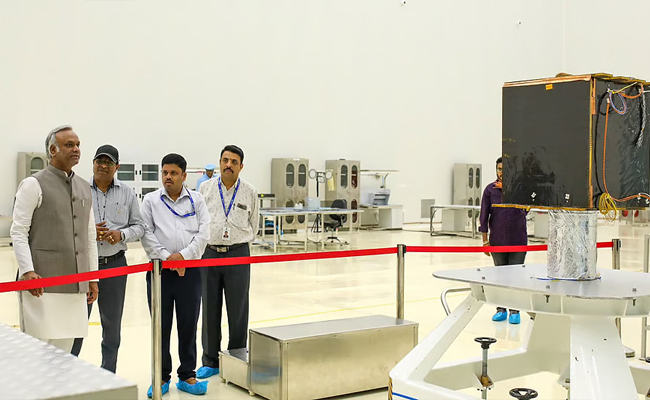
Bengaluru (PTI): In a significant boost to India’s rapidly expanding space economy, the Karnataka government on Friday launched the country’s first state-led Centre of Excellence for Space Technology here, officials said.
The initiative is aimed at strengthening India’s capabilities to translate space innovation into scalable commercial outcomes, they said.
The Centre, established by the Government of Karnataka through the Karnataka Innovation and Technology Society in collaboration with SIA (Satcom Industry Association India) -India, was inaugurated by Minister for Electronics, IT/BT, and Rural Development and Panchayat Raj, Priyank Kharge, in the presence of senior officials and industry leaders, officials said.
Speaking at the launch, Minister Kharge said that Karnataka has consistently been at the forefront of India's technology and innovation journey. With the launch of this Centre of Excellence for Space Technology, we are extending that leadership into one of the most strategic sectors of the future.
"Our focus is not just on advancing research, but on creating an ecosystem where innovation can translate into real-world applications, economic growth, and high-quality jobs. This Centre will play a critical role in positioning Karnataka as a key driver of India's space economy," he said.
According to an official statement, the CoE SpaceTech Foundation has been established under a Memorandum of Agreement between KITS and SIA-India to drive research and innovation in space technologies, industry-aligned training, startup incubation and cross-sector applications, it said.
The Centre has also formalised strategic MoUs with multiple industry and academic partners to support research in space biotech and microgravity, enable collaboration, build talent pipelines, and provide startups with training and market access, it added.