Modi invites Biden to be chief guest at upcoming Republic Day celebrations
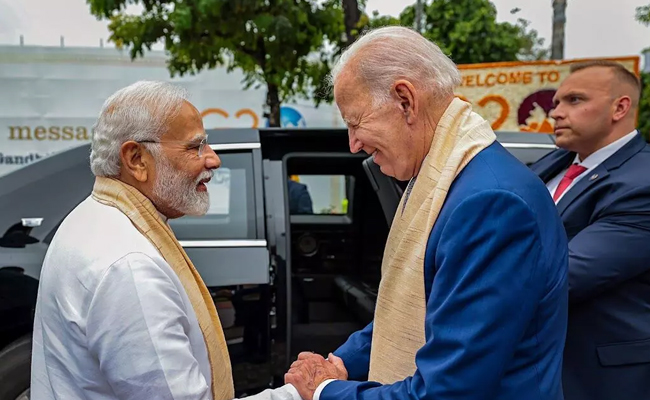
New Delhi (PTI): Prime Minister Narendra Modi invited US President Joe Biden to be the Chief Guest for the Republic Day celebrations on January 26 during their bilateral meeting on the sidelines of the G20 summit, US Ambassador to India Eric Garcetti said on Wednesday.
Asked whether the Quad summit is being planned in India around the same time, Garcetti indicated that he was not aware of it. The Quad comprises India, the US, Japan and Australia. It is India's turn to host the annual Quad summit next year.
The US ambassador was asked at an event about the reports that India is considering inviting leaders of the Quad nations to grace the Republic Day celebrations.
US President Biden was invited to the Republic Day celebrations by Prime Minister Modi during the bilateral meeting on the sidelines of the G20 summit, Garcetti said.
Egyptian President Abdel Fattah El-Sisi was the chief guest at this year's Republic Day celebrations.
Every year, India invites world leaders to attend its Republic Day celebrations. There was no Republic Day Chief guest in 2021 and 2022 in view of the COVID-19 pandemic.
In 2020, the then Brazilian President Jair Bolsonaro was the chief guest.
In 2019, South African President Cyril Ramaphosa was the chief guest at the parade, while in 2018, leaders of all 10 ASEAN countries attended the celebrations.
In 2017, Crown Prince of Abu Dhabi Sheikh Mohamed bin Zayed Al Nahyan was the chief guest at celebrations, while the then French President Francois Hollande graced the occasion in 2016.
In 2015, the then US President Barack Obama watched the parade.
In 2014, the then Japanese Prime Minister Shinzo Abe was the chief guest at the celebrations, while Bhutan king Jigme Khesar Namgyel Wangchuck attended the parade in 2013.
Other heads of state and government who have attended the Republic Day celebrations include Nicolas Sarkozy, Vladimir Putin, Nelson Mandela, John Major, Mohammed Khatami and Jacques Chirac.
The then British Prime Minister John Major had attended the celebrations in 1993, Nelson Mandela participated as then South African President in 1995 while South Korean President President Lee Myung Bak witnessed the parade in 2010.
Let the Truth be known. If you read VB and like VB, please be a VB Supporter and Help us deliver the Truth to one and all.
Karnataka launches India’s first digital grievance system for gig workers
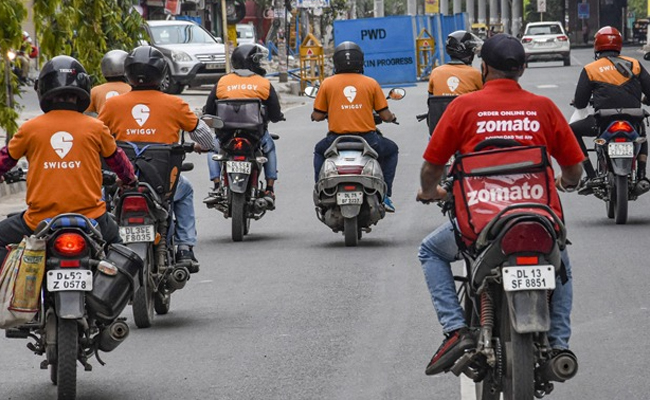
Bengaluru: In a first-of-its-kind initiative in India, the Karnataka government has launched a digital grievance redressal system for gig workers to provide structured support and protection to platform-based workers.
According to The Hindu, the system, developed by the Karnataka Platform-based Gig Workers’ Board in collaboration with the Department of e-Governance, allows workers to file complaints through the Integrated Public Grievance Redressal System (IPGRS).
Gig workers can raise issues related to pay, working conditions, and platform-specific disputes. Complaints will be routed to the Internal Dispute Resolution Committees (IDRCs) of respective platforms and are expected to be resolved within a defined timeframe. This is expected to bring transparency and legal recourse for a workforce that has so far operated without a formal dispute resolution framework.
Under The Karnataka Platform-Based Gig Workers (Social Security and Welfare) Act and Rules, every aggregator platform must constitute an Internal Dispute Resolution Committee (IDRC). Platforms such as Namma Yatri and Yulu have already integrated their IDRC contact details with the government portal.
Around 12 lakh gig workers have been identified in the state, and a unique identification system is being developed to remove duplicate entries. Officials said welfare schemes are also being designed based on type of work, working hours, and contribution.
Labour Minister Santosh Lad said that Karnataka, technology capital of the country, is leveraging this potential for worker welfare as well. “By launching this system, we are ensuring that the gig economy is no longer an informal space, but a structured one where every worker’s voice is heard,” he said.
“The schemes will vary based on the type of platforms. For example, cab rides are mostly undertaken by men whereas urban domestic activity is undertaken mostly by women. It may also be based on the contribution made, and the quantum of gig work done by a gig worker. Some gig workers work for more than eight hours while some may work on a few gigs. So, work load, nature of work, and time period of work could vary,” TH quoted G. Manjunath, Additional Labour Commissioner and CEO of the Board as saying.
“It has to be scientifically structured based on their effort and labour. We are working with experts, including academicians from Briston University, King’s College, and IISc, and other stake holders, including board members,” he said.
Officials added that aggregator platforms will be required to contribute 1 per cent towards worker welfare, with implementation beginning July 5.