Modi launches medley version of Bapu's favourite bhajan
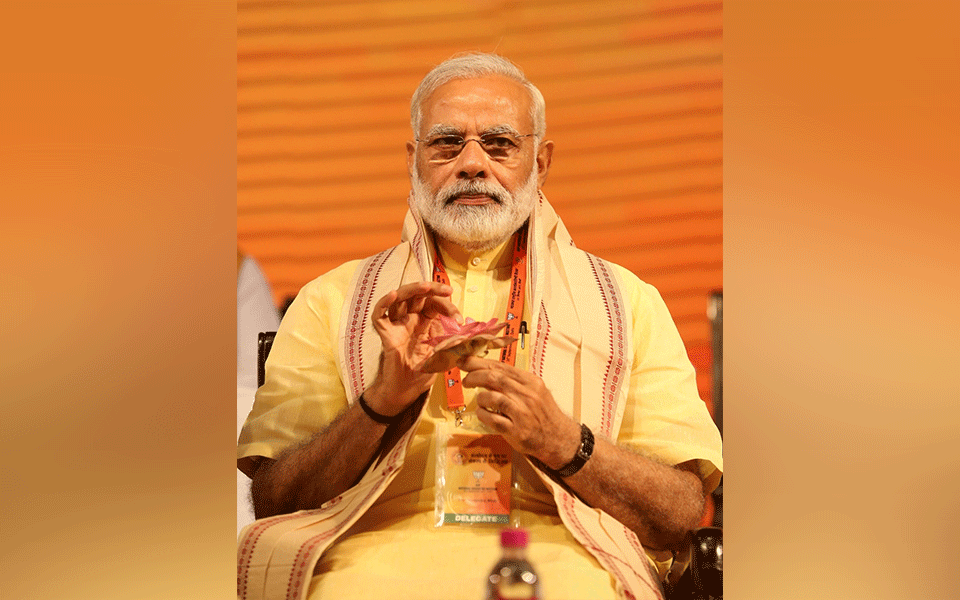
New Delhi, Oct 2 : Prime Minister Narendra Modi on Tuesday launched a medley version of Bapu's favourite bhajan 'Vaishnav jan to tene kahiye' sung by artists from over 40 countries, during the closing ceremony of the Mahatma Gandhi International Sanitation Conference here.
As part of the year-long celebrations leading to Gandhi's 150th birth anniversary, artists from over 124 countries have contributed musically and paid homage to the Mahatma through his favourite bhajan.
"All Indian missions abroad identified a local artist/group to record the bhajan in the run-up to Gandhi Jayanti, which is observed on October 2. The result is an eclectic, colourful and rich rendition of the hymn infused with the local flavours of the region," the MEA said in a release.
From Armenia to Angola, Sri Lanka to Serbia, Iraq to Iceland, prominent singers/groups have showcased their talent for the 15th century hymn that was close to Gandhi's heart.
Written by the poet Narsinh Mehta the bhajan was included in Mahatma Gandhi's daily prayers.
The different videos from world over were put together in a fusion of about five minutes to give global flavour to the bhajan. It is expected to have contribution from all the countries recognised by the UN, it said.
Amongst the star performers is President Baron Divavesi Waqa of Nauru.
"President Waqa's gesture was not just a special tribute to Mahatma Gandhi on his 150th birth anniversary but was also a personal gift from him to Modi," the Ministry of External Affairs said.
Modi launched the bhajan in the presence of the UN Secretary General Antonio Gutierrez, External Affairs Minister Sushma Swaraj and Minister of Drinking Water and Sanitation Uma Bharti.
The famous Gujarati hymn used to be sung routinely before Gandhi's meetings.
The medley version, as well as the individual country contributions are available on the MEA's YouTube page.
Let the Truth be known. If you read VB and like VB, please be a VB Supporter and Help us deliver the Truth to one and all.
Gold, silver soar as US-Iran deal hopes lift bullion demand

New Delhi (PTI): Gold prices rebounded by Rs 2,900 to Rs 1.55 lakh per 10 grams in the national capital on Wednesday, while silver climbed to Rs 2.54 lakh per kilogram as easing geopolitical tensions triggered a pullback in oil rates, boosting demand for precious metals.
According to the All India Sarafa Association, the yellow metal of 99.9 per cent purity jumped by Rs 2,900, or nearly 2 per cent, to Rs 1,55,400 per 10 grams (inclusive of all taxes) from Tuesday's closing level of Rs 1,52,500 per 10 grams.
Traders attributed the surge in bullion prices to reports that Washington and Tehran are close to finalising a framework agreement to end months of conflict, raising the prospects of smoother flows through the Strait of Hormuz and easing inflation concerns tied to energy markets.
"Gold rallied strongly on Wednesday as easing geopolitical tensions triggered a sharp reversal in key macro drivers that had recently pressured precious metals," Saumil Gandhi, Senior Analyst - Commodities at HDFC Securities, said.
Silver prices also advanced for the third straight session by rising Rs 3,500, or 1.4 per cent, to Rs 2,54,500 per kg (inclusive of all taxes). The metal had settled at Rs 2,51,000 per kg in the previous session, as per the Association.
"The prospect of a diplomatic breakthrough triggered a steep decline in oil prices and the US dollar, easing concerns about inflation while boosting demand for precious metals," Gandhi said.
Globally, spot gold increased by USD 106.15, or 2.33 per cent, to USD 4,663.70 per ounce while silver gained USD 3.40, or 4.68 per cent, to USD 76.24 per ounce.
"Gold witnessed a sharp rally as markets reacted positively to reports that the US and Iran are moving closer to a one-page agreement framework aimed at ending the conflict," Jateen Trivedi, VP Research Analyst - Commodity and Currency, LKP Securities, said.
Despite strong international gains, rupee strength limited the upside in domestic gold prices. The market is now highly focused on final confirmation and execution of the proposed deal, he added.
Any negative surprise or breakdown in negotiations could trigger a sharp sell-off in gold, while a successful agreement and sustained ceasefire could push the bullion prices higher in the near-term, Trivedi said.