Modi says greed for power has united opposition
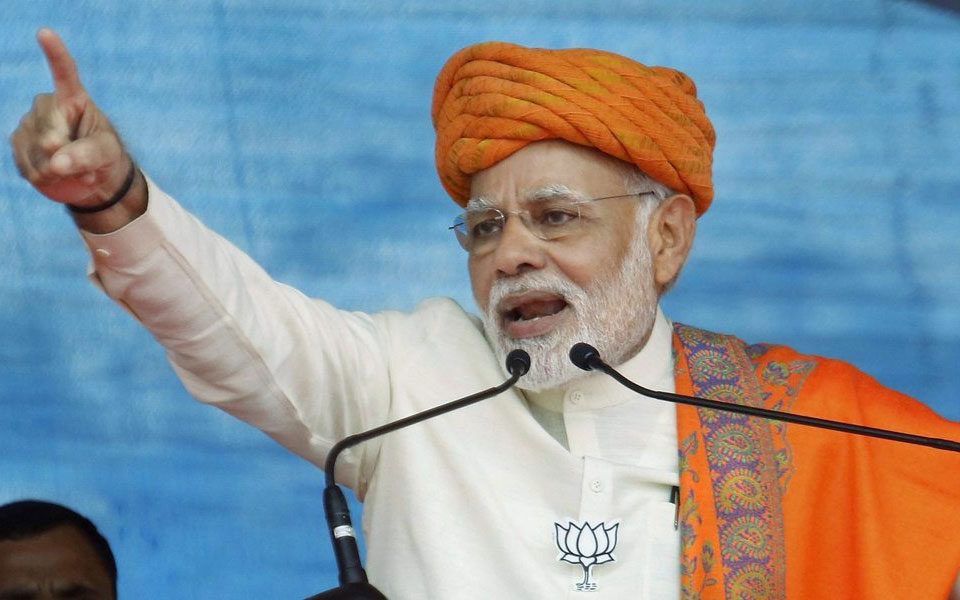
Maghar (Uttar Pradesh), June 28 : Prime Minister Narendra Modi on Thursday launched a blistering attack on the opposition parties and accused them of being blinded in their pursuit of power.
Addressing a public rally here in Sant Kabir Nagar district, where the 15th century mystic poet and saint Kabir Das breathed his last, Modi said that while the saint wanted rulers to work for people's welfare ignoring caste and status, political parties were now joining hands just for power.
"The very people who opposed each other and measures like Emergency are now coming together for power," he said, rebuking the opposition parties.
He added that these "(opposition) politicians, leaders and political parties had nothing to do with the people or their welfare as their self promotion and the welfare of their own families was on top of their minds".
The Prime Minister said the opposition was out to create disruptions and chaos. Such people, he said, were cut off from the ground realities and were merely pursuing politics of self interest.
Only a few days back, the 47th anniversary of Emergency was marked by unusual bonhomie between opposition parties who were at one point bitter critics of Emergency but were now standing together.
The Prime Minister also referred to the triple talaq issue and said the move by his government was to provide equality to Muslim women but some political parties put a spanner in the issue.
"Such political parties are not concerned about the welfare of the women of the Muslim community."
Recalling the ethos of Kabir, Modi said the saint always propagated equality and welfare of all sections and said his government was pursuing the same path.
"My government is working relentlessly for the poor, Dalits, marginalized and deprived. Bank accounts have been opened for 5 crore persons, 1.25 crore toilets have been built and one crore persons have been brought under the ambit of insurance."
Modi earlier offered floral tributes at the 'samadhi' and 'mazaar' of Kabir Das here. He became the first Prime Minister to visit the place.
The Prime Minister was flanked by Uttar Pradesh Chief Minister Yogi Aditytanath and the priests of the shrine as he took a round of the place. He was later gifted a 'angawastra' and literature on the saint.
Officials told IANS that Modi took keen interest in knowing details about Maghar even as he surprised many with his knowledge of the saint who is revered equally by Hindus and Muslims. The entire place was decked up with flowers for the momentous occasion.
Later, addressing a public gathering, which drew thousands of locals and followers of the saint, Modi pointed out how Kabir became great not by his birth but by his 'karma's (deeds).
Modi began his address in Bhojpuri dialect, pleasing the gathering. He said he had for long wished to visit the shrine and now that he was here, he was elated and overwhelmed.
"I have also seen the caves where Sant Kabir, Guru Nanak and Guru Gorakhnath held spiritual parleys," he said.
Earlier, due to the flooding of the Gorakhpur airport runway, the Prime Minister's aircraft landed in Lucknow where he was welcomed by Uttar Pradesh Governor Ram Naik, Adityanath and others.
Let the Truth be known. If you read VB and like VB, please be a VB Supporter and Help us deliver the Truth to one and all.
Trump administration says its war in Iran has been 'terminated' before 60-day deadline
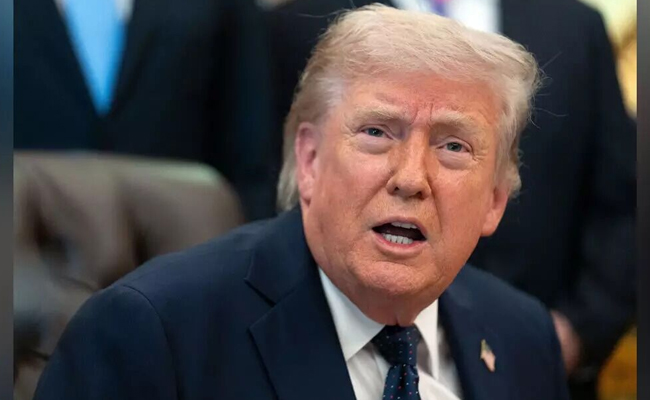
Washington (AP): The Trump administration is arguing that the war in Iran has already ended because of the ceasefire that began in early April, an interpretation that would allow the White House to avoid the need to seek congressional approval.
The statement furthers an argument laid out by Defense Secretary Pete Hegseth during testimony in the Senate earlier Thursday, when he said the ceasefire effectively paused the war. Under that rationale, the administration has not yet met the requirement mandated by a 1973 law to seek formal approval from Congress for military action that extends beyond 60 days.
A senior administration official, who spoke on condition of anonymity to discuss the administration's position, said for purposes of that law, “the hostilities that began on Saturday, Feb 28 have terminated.” The official said the US military and Iran have not exchanged fire since the two-week ceasefire that began April 7.
While the ceasefire has since been extended, Iran maintains its chokehold on the Strait of Hormuz, and the US Navy is maintaining a blockade to prevent Iran's oil tankers from getting out to sea.
Under the War Powers Resolution, the law that sought to constrain a president's military powers, President Donald Trump had until Friday to seek congressional authorisation or cease fighting. The law also allows an administration to extend that deadline by 30 days.
Democrats have pushed the administration for formal approval of the Iran war, and the 60-day mark would likely have been a turning point for a swath of Republican lawmakers who backed temporary action against Tehran but insisted on congressional input for something longer.
“That deadline is not a suggestion; it is a requirement,” said Sen Susan Collins, R-Maine, who voted Thursday in favour of a measure that would end military action in Iran since Congress hadn't given its approval. She added that “further military action against Iran must have a clear mission, achievable goals, and a defined strategy for bringing the conflict to a close."
Richard Goldberg, who served as director for countering Iranian weapons of mass destruction for the National Security Council during Trump's first term, said he has recommended to administration officials to simply transition to a new operation, which he suggested could be called “Epic Passage,” a sequel to Operation Epic Fury.
That new mission, he said, “would inherently be a mission of self-defence focused on reopening the strait while reserving the right to offensive action in support of restoring freedom of navigation.”
“That to me solves it all,” added Goldberg, who is now a senior adviser at the Foundation for Defense of Democracies, a hawkish Washington think tank.
During testimony before the Senate Armed Services Committee on Thursday, Hegseth said it was the administration's “understanding” that the 60-day clock was on pause while the two countries were in a ceasefire.
Katherine Yon Ebright, counsel at the Brennan Center's Liberty and National Security Program and an expert on war powers, said that interpretation would be a “sizeable extension of previous legal gamesmanship” related to the 1973 law.
“To be very, very clear and unambiguous, nothing in the text or design of the War Powers Resolution suggests that the 60-day clock can be paused or terminated,” she said.
Other presidents have argued that the military action they've taken was not intense enough or was too intermittent to qualify under the War Powers Resolution. But Trump's war in Iran would certainly not be such a case, Ebright said, adding that lawmakers need to push back against the administration on that kind of argument.