Modi wants to do away with MGNREGA: Rahul in Raebareli
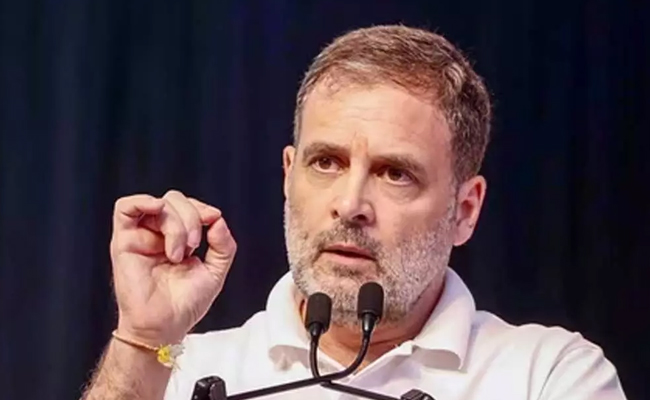
Raebareli (UP) (PTI): Congress leader Rahul Gandhi accused Prime Minister Narendra Modi on Tuesday of seeking to centralise power and weakening welfare safeguards for the poor, alleging that the MGNREGA has been undermined and that Modi wants to do away with it.
Addressing party workers during a visit to Raebareli, his parliamentary constituency, the leader of opposition in the Lok Sabha said the BJP-led Centre has "insulted" Mahatma Gandhi by replacing the Mahatma Gandhi National Rural Employment Guarantee Act (MGNREGA) with another law and, more importantly, withdrawing the security it provided to the marginalised.
He termed the move an attack on the roots of democracy.
Parliament on December 18, 2025, passed the Viksit Bharat - Guarantee for Rozgar and Ajeevika Mission (Gramin) (VB-G RAM G) Bill, replacing the 20-year-old UPA-era MGNREGA and guaranteeing 125 days of rural wage employment every year.
The opposition had protested the removal of Mahatma Gandhi's name from the new law and accused the Centre of putting the financial burden on states.
"The Congress is running a nationwide movement to protect the MGNREGA. We stand with labourers and are committed to protecting their rights," Gandhi said.
He alleged that Modi wants the country's wealth to be concentrated in the hands of industrialists like Gautam Adani and Mukesh Ambani.
"On one hand, we are protecting the people, while on the other, Narendra Modi is diverting the country's wealth to a select few," he said.
The former Congress chief said the MGNREGA was introduced by the UPA government with the objective that no worker in the country should be forced to work for wages lower than the rates fixed under the programme.
He stressed that the scheme should not be run from offices in Delhi, Lucknow or by officials, but should be implemented at the panchayat level, with clear accountability of the village head.
"Financial decisions related to the MGNREGA should rest with the pradhans," Gandhi said.
He said Modi claimed in Parliament a few years ago that the MGNREGA did not benefit anyone and attempted to dismantle the scheme.
The Congress leader alleged that the prime minister wants to do away with the scheme now, so that the funds meant for workers are diverted to industrialists, such as "Adani and Ambani".
"The money that goes to labourers should not end up with big corporate houses," he said.
Gandhi pointed out that under the VB-G RAM G Act, the states will have to contribute 40 per cent of the funding.
He alleged that BJP-ruled states would not provide their share.
Gandhi reiterated that the MGNREGA is a panchayat-based programme and claimed that the ruling Bharatiya Janata Party (BJP) is trying to dismantle a scheme that has protected poor workers.
He also accused the BJP of insulting Mahatma Gandhi and said the biggest issue is that the rights of poor labourers are being taken away.
The Congress leader said his party is organising programmes across the country in protest against this move of the BJP-led Centre.
Calling it a fight to protect the Constitution, he alleged that Modi and the Rashtriya Swayamsevak Sangh (RSS) want India to return to the pre-Independence situation, where people's land could be taken away and handed over to large corporate houses.
The Congress launched the "MGNREGA Bachao Sangram", a nationwide campaign demanding the restoration of the earlier law, on January 10. The campaign will be run till February 25.
Earlier in the day, Gandhi inaugurated a cricket tournament in Raebareli. The Congress leader, who was on a two-day visit to his Lok Sabha constituency, also met office-bearers and workers of the party.
Let the Truth be known. If you read VB and like VB, please be a VB Supporter and Help us deliver the Truth to one and all.
RR beat RCB by six wickets in IPL
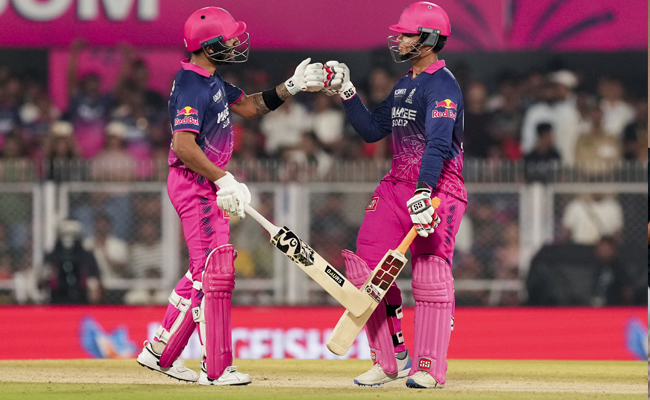
Guwahati (PTI): Blistering fifties by Vaibhav Sooryavanshi and Dhruv Jurel powered Rajasthan Royals to a six-wicket win over Royal Challengers Bengaluru in their IPL match here on Friday.
Sent in to bat, RCB rode on a fighting half-century by skipper Rajat Patidar (63) to post 201 for 8.
Virat Kohli (32), Romario Shepherd (22) and Venkatesh Iyer (29) also chipped in with useful contributions.
In reply, Sooryavanshi (78 off 26 balls) and Dhruv Jurel (81 not out off 43 balls) shared a 37-ball 108-run partnership for the second wicket to set the platform. Krunal Pandya (2/30) tried to bring them back with back-to-back wickets.
But Jurel, in the company of Ravindra Jadeja (24), completed the task with another 68-run stand, with two overs to spare.
For RR, Jofra Archer (2/33), Ravi Bishnoi (2/32) and Brijesh Sharma (2/37) took two wickets.
Brief scores:
Royal Challengers Bengaluru: 201 for 8 in 20 overs (Rajat Patidar 63; Jofra Archer 2/33, Ravi Bishnoi 2/32, Brijesh Sharma 2/37).
Rajasthan Royals: 202 for 4 in 18 overs (Vaibhav Sooryavanshi 78, Dhruv Jurel 80 not out; Krunal Pandya 2/30, Josh Hazlewood 2/44).