Modifications in National Pension Scheme financially untenable: Finance Ministry
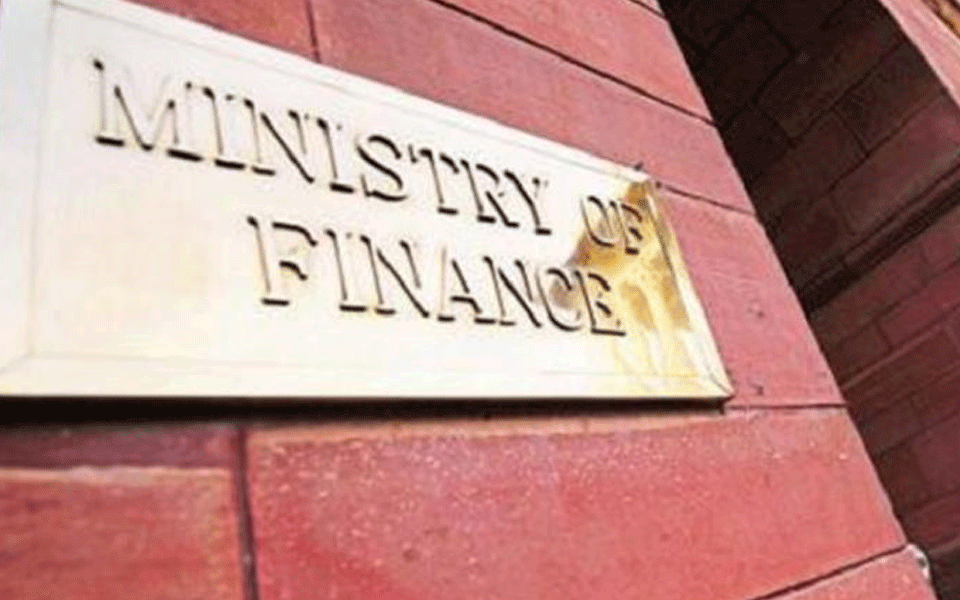
New Delhi: The Finance Ministry has ruled out proposals by a federation of central and state governments employees seeking modification in the National Pension Scheme, saying its corpus is invested in a prudential manner to ensure optimal returns and suggested that changes will be financially untenable.
The response comes following a petition to the Prime Minister's Office (PMO) by Manjeet Singh Patel, president of Delhi unit of the National Movement for Old Pension Scheme (NMOPS), seeking revival of the old pension scheme on account of uncertain returns, besides raising other matters.
Patel demanded modification in the National Pension Scheme (NPS) so that a large part of the contributory fund, which is currently invested in the market, can be made available to governments to supplement their fight against COVID-19.
"Regarding uncertainty of returns in NPS, it is stated that, though NPS is market-linked, the investments of the accumulated corpus are made in a prudential manner so as ensuring optimal returns," the Finance Ministry said in an order, a copy of which was shared with Patel.
Further, the investments under NPS are very well diversified, the ministry said, which was responding to the reference made to it by the Ministry of Personnel, Public Grievances and Pensions seeking its comments.
"In fact, the Asset Under Management (AUM) of the central government (Rs 1.45 lakh crore) and state government (Rs 2.20 lakh crore) schemes have been invested through pension funds across the government securities (around 50 per cent), corporate bonds (around 36 per cent) and only around 10 per cent is in equities and rest in money market instruments," it said, adding that the scheme has provided returns of around 9. 5per cent since inception.
Also, NPS investments are continuously monitored by NPS trust at the first-level and regulated by the Pension Fund Regulatory and Development Authority (PFRDA) under the PFRDA Act 2013, the ministry said, adding that the investment guidelines are also reviewed from time-to-time, as per the prevailing market conditions.
Stating that currently the equity market is volatile, it said, "Volatility in the equity market gets evened out in the long run, for a very long term product like pensions, with vesting period of around 30-40 years."
It said NPS is a considered policy decision of the central government for its employees and balances providing old age income security to employees with managing fiscal burden of the government on account of pensions and other developmental needs.
Responding to a suggestion made by Patel that NPS corpus equivalent to employees' contribution may be transferred to the government's treasury and declared as General Provident Fund (GPF), the finance ministry said, adding that it was "not legally tenable in terms of PFRDA Act, 2013 and PFRDA (Exit and Withdrawal) Regulations, 2015, specified by PFRDA, as they stand today".
"Further, the request is also not financially tenable as lump-sum withdrawal/disinvestment of such a huge amount of Rs 1.80 lakh crores suddenly would amount to off-loading about Rs 90,000 crores of government securities and state development Loans, about Rs 65,000 crores of corporate bonds and Rs 18,000 crores of equities, which will have catastrophic impact on financial and securities markets and will have very serious adverse fiscal implications," the order said.
Therefore, it said, the suggestions made in the representation are financially untenable and may be counterproductive for the economy, NPS subscriber and the government's goal of reducing unproductive expenditure and unfunded liability.
Since January 2004, the Centre and state governments have implemented a share-market based pension system for their employees, including the ones in autonomous organisations, said Patel, who represents NMOPS, a non-profit organisation with over 13 lakh central and state government employees as its members.
NMOPS has demanded that the central and state governments should come out with relevant legislations to modify this NPS, where both employees and employer contribute a certain sum of money, close on the lines of the old pension scheme, Patel said.
The old scheme allows contribution of a definite amount of basic salary of the employees into the government's treasury by declaring it as general provident fund (GPF).
The GPF, which would be in many crores of rupees, can then be used by the central and state governments to supplement their fight against COVID 19, as the amount will be with their respective treasuries, which are under their control and free from the risk of the stock market, said Patel, who works with the Delhi government.
In his petition, Patel said PFRDA has Rs 3.41 lakh crore assets under management in the form of contributions from the central and state government, and their employees as on January 31.
There are around 67.76 lakh subscribers of NPS, 20.82 lakh in the central government and 46.93 lakh in state governments, Patel said quoting PFRDA data.
For many years, NPS is being criticised by some associations of central and state government employees and many protests have been held by them demanding restoration of a guaranteed older pension system for old age social economical security, he said.
NMOPS, formed to oppose NPS system, is working actively in over 16 states and Union Territories, including Delhi, Uttar Pradesh, Bihar, Rajasthan, Haryana, Punjab, Himachal Pradesh, Madhya Pradesh, Maharashtra, Kerala and Andhra Pradesh, among others.
Let the Truth be known. If you read VB and like VB, please be a VB Supporter and Help us deliver the Truth to one and all.
Justice must be seen to be done: Kejriwal on refusal to appear in excise case before HC judge
New Delhi (PTI): Aam Aadmi Party chief Arvind Kejriwal has written to Delhi High Court Justice Swarana Kanta Sharma, saying he will not appear in the excise case personally or through a lawyer before her, the party said on Monday.
Pointing to a "grave miscarriage of justice", Kejriwal, in a four-page letter, said he has "serious and unreconciled" concerns regarding the matter.
"I have decided that I shall not participate in the further proceedings in this matter, either in person or through counsel. I do not take this step lightly," Kejriwal added.
In his letter, Kejriwal further said that "justice must not only be done, but must also be seen to be done".
"The principle that justice must not only be done, but must also be seen to be done, is among the most sacred assurances that a court gives to a citizen in a democracy," he said.
The assurance cannot be dishonoured by asking the citizen to ignore what "anyone can plainly see" in a case like this, he added in the letter.
The letter also invoked the principles of Satyagraha and the teachings of Mahatma Gandhi, with Kejriwal saying that his intent is "strengthening of judiciary and prevent its weakening".
He added that he has given the authority an opportunity to consider and correct what he perceived to be a grave miscarriage of justice.
His earlier plea seeking the recusal of Justice Sharma, which was rejected on April 20, was interpreted as a personal attack, the AAP chief claimed.
"After the said judgment, I am left with the painful and inescapable impression that what I had urged as a lawful plea of apprehension was received and answered as a personal attack upon Your Ladyship and as an assault on the institution itself.
"Those are not, with respect, answers to the case I had brought. They show me that my plea of apprehension has been judicially understood as a personal and institutional affront," he said in the letter.
The letter further noted the leader's belief that it was now "impossible to receive an impartial hearing" in Justice Sharma's court.
Kejriwal also reiterated two grounds cited earlier in his recusal plea.
"First, the issue of Your Ladyship's repeated public association with the RSS's legal front, the Akhil Bharatiya Adhivakta Parishad (ABAP) -- an organisation belonging to the ideological ecosystem of the ruling dispensation," he wrote, further pointing out that Justice Sharma's children "are professionally engaged on multiple advocates' panels of the Union government which happens to be the opposite party in this case".
Reflecting on his personal experience during the proceedings, the former Delhi chief minister expressed concern over the broader implications of his case on public trust in the judiciary, while he said he maintains respect for the institution.
ALSO READ: ED raids in case against former Punjab Police DIG Bhullar, linked entities
"When I appeared before Your Ladyship to argue my case, the question in my heart was simple: Will I get justice? Today, with the deepest respect, I must say that the same question has become graver and deeper in my conscience," he said.
This case has now become a matter of widespread public discussion. It is being discussed not merely in legal and political circles, but in homes across the country, the letter read.
Addressing potential criticism, Kejriwal clarified that his remarks should not be interpreted as opposition to the judiciary.
"As I write this, I am also cognisant of the fact that some might portray me as someone 'against' the judiciary. But how can that ever be the case when I have personally received relief from the judiciary, including orders of bail and the present discharge?
"Today, I walk free because of the judiciary. Let there exist no figment of imagination that my present stand is against the institution," he asserted.
Kejriwal further said his respect for the judiciary "remains intact" and he has "unwavering faith" in the Constitution of India.
"My objection is not to the institution of the High Court or the larger judicial system, but only to the continuance of this matter before Your Ladyship (Sharma) under a cloud of grave and unresolved questions and circumstances that have generated grave public doubt in your ability to dispense impartial justice," Kejriwal further wrote in the letter.
He also clarified that his "personal inability" is confined to just this matter.
"I shall continue to appear in matters where these serious and unreconciled concerns do not arise, including matters in which the solicitor general does not appear and matters unconnected with the Union government, the BJP or the RSS," the letter added.
He further said he has made the decision by listening to the voice of his conscience and that he is prepared to bear the consequences.
"I may prejudice my own legal interests. I understand that I may lose the opportunity to advance submissions before this Hon'ble Court and that adverse consequences in law may follow. I am prepared to bear those consequences," the AAP chief said.
He added that he will reserve the right to approach the Supreme Court to appeal against Justice Sharma's decision.