Money in Swiss banks: India at 77th place, accounts for just 0.06% of all foreign funds
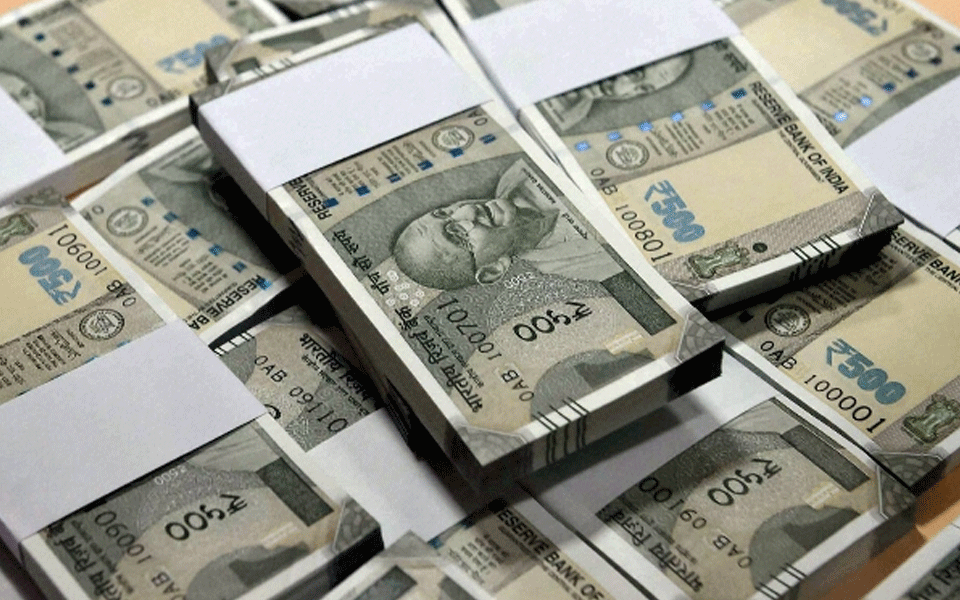
New Delhi/Zurich: India has moved down three places to 77th rank in terms of money parked by its citizens and enterprises with Swiss banks at the end of 2019, while the UK has retained its top position, as per the latest data from Switzerland's central bank.
India was ranked 74th in the previous year.
An analysis of the latest annual banking statistics released by the Swiss National Bank (SNB) showed that India remains ranked very low when it comes to money parked by Indian individuals and enterprises in Swiss banks, including through their India-based branches, accounting for just about 0.06 per cent of the aggregate funds parked by all foreign clients of Switzerland-based banks.
In comparison, the top-ranked UK accounted for close to 27 per cent of the total foreign funds parked with Swiss banks at the end of 2019.
According to the latest SNB data, funds parked by Indian individuals and enterprises in Swiss banks, including through India-based branches, fell by 5.8 per cent in 2019 to 899 million Swiss francs (Rs 6,625 crore).
The data is for 'total liabilities' of Swiss banks towards Indian clients takes into account all types of funds of Indian customers at Swiss banks, including deposits from individuals, banks and enterprises. This also includes data for branches of Swiss banks in India, as well as non-deposit liabilities.
These are official figures reported by banks to the SNB and do not indicate the quantum of the much-debated alleged black money held by Indians in Switzerland. These figures also do not include the money that Indians, NRIs or others might have in Swiss banks in names of third-country entities.
Among the top-ranked jurisdictions, the UK is followed by the US, West Indies, France and Hong Kong in the top five.
The top-five countries alone account for more than 50 per cent of the aggregate foreign funds parked with the Swiss banks, while the top-10 account for nearly two-thirds.
The top-15 countries account for nearly 75 per cent of all foreign money in Swiss banks, while the contribution of the top-30 is almost 90 per cent.
The top-10 countries also include Germany, Luxembourg, Bahamas, Singapore and Cayman Islands.
Only 22 jurisdictions have 1 per cent of more of the total foreign funds parked with Swiss banks and these include China, Jersey, Russia, Saudi Arabia, Australia, Panama, Italy, Cyprus, UAE, Netherlands, Japan and Guernsey.
Among the five-nation BRICS block of emerging economies, India is ranked the lowest while Russia is ranked the highest at the 20th place (same as last year), followed by China at 22nd (same as 2018-end), South Africa at 56th (up two places) and Brazil at 62nd (up from 65th last year) in terms of money parked by their citizens and enterprises at the end of 2019.
The countries ranked higher than India also include Kenya (74th), Mauritius (68th), New Zealand (67th), Venezuela (61st), Ukraine (58th), Philippines (51st), Malaysia (49th), Seychelles (45th), Indonesia (44th), South Korea (41st), Thailand (37th), Canada (36th), Israel (28th), Turkey (26th), Mexico (26th), Taiwan (24th), Saudi Arabia (19th), Australia (18th), Italy (16th), UAE (14th), Netherlands (13th), Japan (12th) and Guernsey (11th).
However, several of India's neighbouring nations are ranked lower, with Pakistan ranked 99th, Bangladesh 85th, Nepal 118th, Sri Lanka 148th, Myanmar 186th and Bhutan 196th. All these countries recorded decline in their figures for 2019.
A number of countries have seen their funds falling in Swiss banks in recent years amid a global clampdown against the erstwhile banking secrecy walls in the Alpine nation.
In terms of percentage change in the aggregate amount during 2019, Central African Republic saw the biggest increase of over 3,600 per cent, while Iraq and North Korea also figured among the top-ten countries in terms of rise in their figures of nearly 500 per cent and 110 per cent, respectively. The decline was highest for Maldives at over 97 per cent.
It has been often alleged that Indians and other nationals seeking to stash their illicit wealth abroad use multiple layers of various jurisdictions, including tax havens, to shift the money to Swiss banks.
Also, with Switzerland putting in place an automatic information exchange framework with India and various other countries, the famed secrecy walls of Swiss banks are said to have crumbled. India started getting this automatic data last year, while it has already been getting information on accounts where proof of illicit funds can be furnished.
At the end of 2018, funds officially held by Indians with banks in Switzerland accounted for about 0.07 per cent of the total funds kept by all foreign clients in the Swiss banking system, almost the same as the level seen a year before that after a modest increase from 0.04 per cent in 2016.
India was placed at 75th position in 2015 and 61st in the year before, though it used to be among the top-50 countries in terms of holdings in Swiss banks till 2007. The country was ranked highest at 37th place in the year 2004.
The total money held in Swiss banks by foreign clients from across the world rose marginally to CHF 1.44 trillion in 2019.
In terms of individual countries, the UK continues to account for the largest chunk at about CHF 385 billion (up from CHF 372 billion a year ago), which accounts for nearly 27 per cent of the total foreign money with Swiss banks.
The US remains on the second position with an increase in its funds to USD 160 billion, accounting for over 11 per cent of all foreign funds.
India was ranked in the top-50 continuously between 1996 and 2007, but its rank started declining after that -- 55th in 2008, 59th in 2009 and 2010 each, 55th again in 2011, 71st in 2012 and then to 58th in 2013.
Let the Truth be known. If you read VB and like VB, please be a VB Supporter and Help us deliver the Truth to one and all.
Putin meets Iran's FM Araghchi, says Russia ready to do its best to help bring peace to West Asia
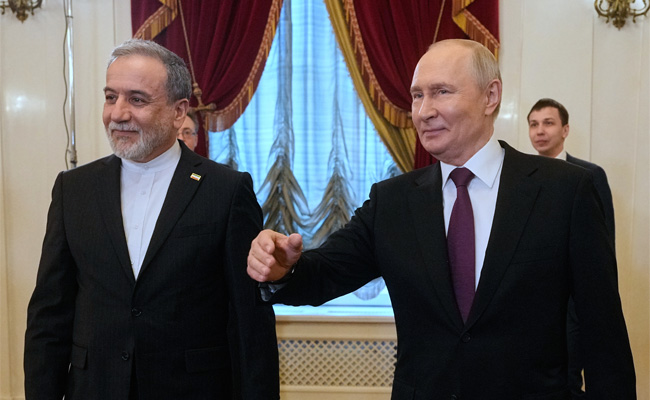
Moscow (PTI): Iran's Foreign Minister Abbas Araghchi on Monday met Russian President Vladimir Putin, who hailed the Iranian people for fighting bravely and heroically for their sovereignty and said Moscow is ready to do its best to help bring peace to West Asia as soon as possible.
Araghchi, who held talks with Omani and Pakistani leadership before arriving in Russia, met Putin in St. Petersburg and thanked him for supporting Iran, state-owned TASS news agency reported.
"Russia is ready to do everything in its power to ensure that peace in the Middle East is achieved as soon as possible," Putin said during his meeting with Araghchi, which was also attended by Russian Foreign Minister Sergey Lavrov.
Revealing that he received a message from Iranian Supreme Leader Mojtaba Khamenei last week, Putin asked Araghchi to convey his "gratitude for this message and best wishes for his health and well-being."
He praised the Iranian people for fighting "bravely and heroically" for their sovereignty, Iran's state-run PRESS TV reported.
"We really hope that, based on the courage and desire for independence, the Iranian people, under the guidance of the new leader, will weather this difficult period of trials and peace will come,” Putin said.
He also stressed that Russia “intends to maintain” its strategic relations with Iran.
Araghchi said that the world witnessed Iran’s strength in countering the US during the recent war, and that the Islamic Republic is a "stable and powerful establishment."
"With their courage, the Iranian people succeeded in resisting the US aggression and will be able to endure it,” he said.
He said that it became clear that Iran has “great friends and allies” like Russia, and conveyed “warmest greetings” from Supreme Leader Mojtaba Khamenei and President Masoud Pezeshkian to the Russian leader.
Araghchi said relations between Moscow and Tehran represent a “strategic partnership at the highest level” and will continue to develop "regardless of circumstances."
"We are grateful to you for the solid and strong positions in support of the Islamic Republic of Iran," he said.
Foreign Minister Lavrov said that the talks between President Putin and the Iranian Foreign Minister were "useful and constructive."
Kremlin Spokesman Dmitry Peskov later said that Russia is "ready to provide any good offices, any mediation services that are acceptable to the parties."
"We will be ready to do everything so that ultimately peace ensues, guaranteed peace, and that there is no return to hostilities," Peskov was quoted as saying by TASS.
He was asked how Moscow can assist in future negotiations on the Iranian settlement.
Araghchi arrived in Russia after his whirlwind trip to Islamabad, which, according to him, was “very productive” and involved “good consultations" with Pakistan's Army Chief Field Marshal Asim Munir, amid uncertainty over the second round of peace talks to resolve the war in West Asia.
"We held good consultations with our friends in Pakistan. The trip was successful. We assessed the outcome of our recent (meetings) and discussed in what direction and under what conditions talks can move on,” Araghchi said in a video posted on his Telegram channel upon his arrival in St Petersburg.
Referring to the second round of talks between the US and Iran to resolve the conflict in West Asia, Araghchi said: "Developments have taken place in the negotiations."
"Despite some progress in earlier rounds, the talks failed to reach their objectives due to the Americans' approach, the excessive demands they made, and the wrong approaches they adopted. Therefore, it was necessary to consult with our friends in Pakistan to review the latest situation,” Iran's official news agency IRNA quoted him as saying.
He said that the trip to Pakistan was a good opportunity to review developments related to the US-Israeli war against Iran, expressing confidence that “these consultations and coordination between the two countries will be highly significant.”
Araghchi arrived at St. Petersburg's Pulkovo Airport early Monday, where he was welcomed by Russian officials and Iran’s ambassador to Russia, Kazem Jalali, the report said.
The first round of peace talks between Iran and the US, held on April 11 and 12, failed to bring the desired result for the parties to the conflict.
The Iranian minister arrived in Islamabad for the second time on Sunday after a short visit to Oman, where he held talks with Sultan Haitham bin Tariq al-Said on security in the Strait of Hormuz and diplomatic efforts to end the Iran-US conflict.
After Araghchi left Pakistan for Oman on Saturday, President Donald Trump announced that US negotiators Steve Witkoff and Jared Kushner would no longer be going to Islamabad for talks with Iran, contending that Washington held all the cards on the matter.
Trump on Sunday reiterated that the US and Iranian officials can talk by phone for a peace solution to the conflict.
On Tuesday, Trump extended the two-week ceasefire with Iran indefinitely to give Tehran more time to prepare a unified proposal to end the war, just hours before the truce was set to expire.
The war began when the US and Israel jointly attacked Iran on February 28, killing Iranian Supreme Leader Ayatollah Ali Khamenei and several top commanders. The retaliation by the Islamic Republic extended the war to the entire Gulf region.