Monitoring by centralised authority main reason for success of Project Tiger, says SC
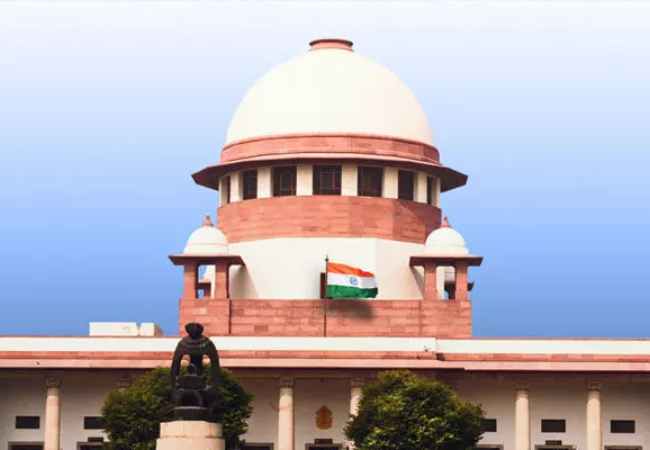
New Delhi (PTI): The Supreme Court on Wednesday said one of the main reasons for the success of the tiger conservation project in the country is the continuous monitoring by a centralised authority.
The observation came from a bench of Justices P S Narasimha and A S Chandurkar which reserved its verdict in a matter concerning the protection of the Great Indian Bustard (GIB).
These critically endangered birds are particularly found in Rajasthan and Gujarat, and the alarming decrease in their numbers can be attributed to frequent collisions with overhead power transmission lines, including those of solar plants, near their habitats.
GIBs have lateral vision as their eyes are positioned on the sides of their head and they find it difficult to change their course of flight when confronted with a live wire.
During the arguments, Additional Solicitor General Aishwarya Bhati, appearing for the Centre, said the government is duty-bound to promote conservation.
"We have been pioneers in many projects saving species which have gone on the brink of extinction and are now thriving in our environs and in our sub-continent," Bhati said.
The bench referred to the success of Project Tiger, which was initiated in 1973 to save the big cats.
"One of the main reasons for its success is the centralised monitoring authority which has been established," the bench observed.
It inquired about the person in charge of the conservation of GIB. Bhati said no authority, like the National Tiger Conservation Authority (NTCA), has been set up for it.
She referred to the 'Project GIB' which is aimed at conservation of the remaining population of the critically endangered birds.
Bhati said that according to the updated affidavit filed in the matter, there are 68 GIB chicks in captivity today.
She said the apex court-appointed committee has submitted its report in the matter and the panel has completed the mandate given by the court.
The law officer referred to the top court's March 2024 verdict which had set up the expert committee.
The committee has submitted two reports, one each for Rajasthan and Gujarat.
The bench reserved its verdict in the matter and said the parties may file their written submissions within a week.
Observing that GIBs were an endangered species that requires urgent protection, the apex court in March last year formed an expert committee to suggest areas for underground laying of power transmission lines in priority and potential GIB habitats in Rajasthan and Gujarat.
The 2024 verdict noted that the total priority area was 13,663 sq km in both states whereas the total potential area was 80,680 sq km.
The verdict had further noted that in Rajasthan, 13,163 sq km was a priority area, 78,580 sq km was a potential area and 5,977 sq km was an additionally important area.
Similarly, for Gujarat, the verdict had noted 500 sq km was a priority area, 2,100 sq km was a potential area and 677 sq km was an additionally important area.
The apex court was hearing a PIL filed by retired IAS officer M K Ranjitsinh and others which said the birds were on the verge of extinction and the top court's 2021 order had not been complied with.
The top court, in its 2021 judgment on the PIL, passed a slew of directions to protect the birds.
It had earlier directed the Gujarat and Rajasthan governments to replace overhead electric cables with underground cables, wherever feasible, and install bird diverters in priority areas where the birds live.
Let the Truth be known. If you read VB and like VB, please be a VB Supporter and Help us deliver the Truth to one and all.
US renews sanctions waiver for purchase of Russian oil

Washington (PTI): The United States has extended by a month a waiver from sanctions to allow countries to buy petroleum products from Russia, days after it ruled out renewal of the special measure.
The US Department of Treasury issued an order late Friday extending the waiver from sanctions on Russian oil that is already at sea on or before April 17 through May 16.
Earlier, the US had granted an exemption from sanctions to India for buying Russian oil for a month beginning March 5. A few days later, a similar waiver was extended to several other countries, which ended on April 11.
The general licence issued by the US on Friday does not authorise any transaction involving a person, entity or joint venture located in Iran, North Korea, Cuba, or parts of Ukraine.
On Wednesday, Treasury Secretary Scott Bessent said Washington would not be renewing the waiver for Russian oil and another for Iranian oil.
The previous waiver of sanctions had made available 140 million barrels of Russian oil already loaded on ships to global markets as prices soared against the backdrop of the US war with Iran.
"Effective April 17, 2026, General License No. 134A, which was dated March 19, 2026 and expired on April 11, 2026, is replaced and superseded in its entirety by this General License No. 134B," said the order issued by the Department of Treasury.